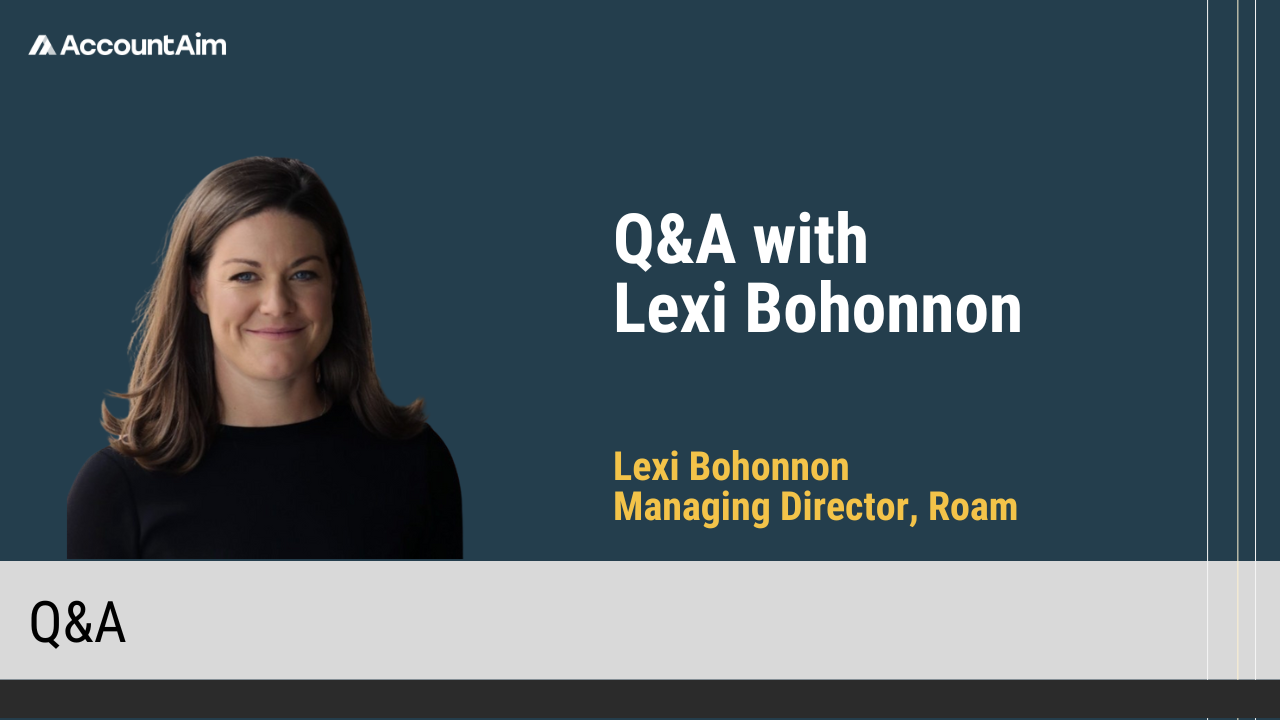

The Roam managing director and former Yext exec shares lessons on alignment, customer-centric design, and building systems that scale
Lexi Bohonnon has built systems at scale. Over ten years at Yext, she helped lead the company from $30 million to $400 million in revenue, serving in senior roles across sales, customer success, and go-to-market strategy. Now, as managing director at Roam, she’s in early-stage mode again, designing infrastructure from scratch, informed by real-world experience.
While Lexi has never carried a RevOps title, she’s led teams that depend on RevOps every day. Her vantage point offers a sharp perspective on what separates reactive operators from strategic ones. In this conversation, she shares how centralizing ops functions improved alignment, why process needs to flex with the customer journey, and what she’s focusing on at Roam.
How do you define RevOps, and how has that definition evolved?
I see RevOps as the systems, processes, and tools that support the most effective customer journey. That journey should drive how RevOps is structured. Too often, RevOps gets boxed into rigid workflows, which creates friction instead of value. The best teams stay flexible and focus on outcomes for the customer.
“When I think about revenue operations, it’s all the things we need to do to facilitate the best customer experience and the customer journey.”
What changed after you consolidated ops functions at Yext?
For years, sales ops, CS ops, marketing ops, and product ops operated independently. It led to inconsistent data, duplicated efforts, and a lot of internal friction. Eventually, we unified those teams into one group under a single leader. We called it go-to-market strategy and operations.
That structure helped shift the mindset. People moved from defending their silos to solving problems as one team. The work didn’t get easier, but the alignment made us more effective.
How did aligning data and meetings reduce finger-pointing?
It shortened the gap between problem and resolution. Instead of quarterly reviews where surprises came too late, we had weekly shared meetings. Marketing reported on lead generation, sales reported on follow-up, and we all looked at the same numbers.
No one could argue about the source or spin a narrative. If a process broke down, it became obvious quickly. That level of visibility forced action and built trust.
What are some common pitfalls for RevOps leaders in fast-growing companies?
One is holding onto legacy processes. It’s understandable, those processes helped get results. But growth demands change. Sometimes the right move is to start over.
“Sometimes starting from scratch is okay… Too often leaders are trying to retrofit or evolve a model when they could be better just doing something entirely new.”
RevOps leaders need to be willing to throw out what no longer works and rebuild with a clean approach. That takes courage, but it’s often necessary.
What makes a RevOps leader effective, from your perspective?
The best ones balance internal and external focus. Their stakeholders are sales, marketing, and CS leaders, but they never lose sight of the buyer. They’re not just taking requests, they’re asking what actually helps the customer.
They’re also present. They show up to leadership meetings, speak up when something isn’t working, and bring ideas to the table. That combination of proximity and perspective is powerful.
What advice would you give to someone starting in RevOps or joining a startup?
Build a network of peers. Think of it as your own board of directors. Talk to people in similar roles at other companies. Learn what they’re seeing and bring those insights back to your team.
You don’t need to have done everything yourself to contribute. If you can synthesize what others are doing and share that perspective internally, you’ll earn credibility quickly.
Go Deeper
If you enjoyed this Q&A, check out the full conversation at YouTube or Spotify.
About AccountAim
AccountAim is the planning and analytics platform built for Strategic RevOps teams. With AccountAim, RevOps teams connect all of their fragmented GTM data, automatically snapshot and see trended changes over time, and build full-funnel reporting — all without SQL or data team support. Learn how Strategic RevOps teams use AccountAim to streamline forecasting, territories, cross-sells and more here.
James Geyer: , [00:00:00] thanks everyone for joining us on our aim for excellence webinar series, where we’re breaking down strategic operational and career related best practices and rev ops with leaders in the space that we admire. Again, I’m James co founder of AccountAim or go to market data and automation platform that streamlines account based sales territory management for B2B sales teams.
I’m really excited to have Lexi Bohannan on today. She’s a managing director at Roam after a really impressive run leading numerous teams at Yext. Lexi, do you want to share a bit more about your background for folks?
Lexi Bohonnon: Yeah. Thanks so much for having me. I’m excited to be here. I started my career at IBM I had a tech bootcamp there for a couple years in consulting and had the opportunity to join Yext.
Back in 2014, we were about 30 million in revenue a little over a hundred, 150 people and scaling and growing quickly. So over a 10 year plus. Run at next saw the company scale from that place to over 400 million in revenue global offices around the world. And had a ton of fun doing so in a variety of different roles as the company grew.
And then had the opportunity to join [00:01:00] Howard and the founding team here at Roam. And joined this summer. So I’m back to square one in build mode. And super excited to be here.
James Geyer: Yeah, we were just talking about how you’re back in player coach mode after being pretty senior at Yext. So it’s probably fun to get back in the thick of it.
Happy to chat about your experiences, whether it’s at your, decade long career at Yext or at Roam. I know you’re just a few months into Roam. So I suspect that a lot of your experience will be about Yext. Just to set the stage, but I’m really excited to have you on because of all the different orgs that you’ve been in and run.
And so I think you have a really unique, probably perspective. And also you’re our first guest who is not a RevOps specific practitioner. So I think you’ll bring an interesting lens to the other side of the table as it relates to working with ops.
Lexi Bohonnon: Yeah.
James Geyer: So I’d love to hear from your experience.
RevOps is a broad term. It’s defined slightly differently by everyone. So how do you think about it and define RevOps?
Lexi Bohonnon: Yeah, and it was it’s an awesome question because it’s changed so much over the last decade as well, which we can certainly get into. I think about Rev Ops as the systems, the processes and tools really that [00:02:00] enable a team to facilitate the most effective customer journey.
Whatever that means at the certain stage of your growth, right? So I think that one of the biggest pitfalls that teams fall into is Being super rigid in that from a rev ops perspective and not letting kind of the customer journey rule. And so for me, when I think about revenue operations, it’s all the things we need to do to facilitate the best customer experience and the customer journey.
James Geyer: I think that’s really well put. Are there any kind of examples that come to mind as you think of even defining the customer journey? Because even that you could unpack a full session with, right?
Lexi Bohonnon: I think it’s the whole smattering, right? I think it’s like from the beginning of the buyer journey, whether that is inbound outbound, whether it’s nurturing, any.
Part of that buyer journey and all the pieces that go into it to then that handoff between pre to post sale, which is historically always a clunky thing. As well as then what kind of sustainment of the life cycle of the partnership looks like. So [00:03:00] Everything from the onboarding to the build out if that’s relevant to your product to then that first business review and showing, the return on investment to then talking about the renewal and implementing new product and the upsell.
I think it’s the whole entire journey. And I think that What I’ve seen over the course of micro so far be some of those common traps or pitfalls is thinking about rev ops is too rigid, or we can talk about to having broken out teams that are not aligned to the same leader for each step of that journey.
James Geyer: Totally. And we have a strong view at AccountAim that Rev Ops has the potential to be like one of the most strategic functions at a company because they should have this full view both on the ground but also operational. And so often that gets lost to your point. Maybe I’d love to hear how was this structured at Yex.
So you, I think you led enterprise sales, CX for a time, you’re involved with sales engineering. How did you plug in with Rev Ops and how, how are they most helpful for you across these various functions? Thanks.
Lexi Bohonnon: Oh, man. Yeah. So there, there were [00:04:00] so many different phases of RebOps over that 10 year span.
The beginning, it wasn’t a thing, right? It was, really just, we had a variety of different roles. We had an account coordinator role, which kind of was a blend of an early BDR, as well as a RebOps strategist and helping to think about the pieces of the journey and supporting the sales team, the CS team, all of that.
And then, of course, really morphed into a real function. But for so many years, sales ops was separate from customer ops, which was separate from marketing ops, which was separate from product ops. And a couple of years ago, our chief strategy officer at the time was adamant that we needed to consolidate those organizations into one revenue operations group with one leader and a consolidated function Eliminate the classic finger pointing in silos of this is happening because of this and different data sets being brought to the table and used as fodder that were coming from [00:05:00] the same place, but telling a different story and it was inefficient.
It was not customer centric and it was creating, our own headwinds at the time that were really unnecessary. And so that to me was a big unlock. I was chief customer officer at that time and it was. For me and for some of the teams Oh, shoot, this stinks. Like we don’t have our own identity.
We’re not going to be able to, on the customer side, best represent the customer or sales ops. Like we’re not going to be able to best do the things we need to do. But I think in time, as so many have seen, and as all of you see based on the trends in the space, having that consolidated team creates.
A much, much more strategic end to end customer journey and customer function, starting with the buying journey and ending with, the upsell and hopefully driving that net retention.
James Geyer: I think that’s so well put. What do you think a layer deeper that fear as a leader comes from to lose your own, like dedicated ops resources?
Lexi Bohonnon: Look, I think that in so many cases Rev Ops [00:06:00] professionals are very process oriented, right? They’re thinking about how to get from one place to another and then putting the process in to scale, to be repeatable to look at what was success in, the micro stage and then get there, as you scale.
And so in some cases, those tendencies often lead to an unwillingness to break from the process. And so I think that fear Ties back into that. Oh, man, we’ve really, we know what success looks like. We’ve structured the way this is how we do it. And the idea of having to go back into the board and revisit all of that and maybe be challenged in many cases is a scary thing.
And so I think ultimately, getting the groups back together is an incredibly valuable thing. It just can take a little bit of change and heart heartburn as people grow and scale. Okay.
James Geyer: What was that process like? If you can recall, I’m not sure quite how long ago it was, but to go from siloed to connected,
Lexi Bohonnon: it was a lot faster than you might think.
It took, the prep and the planning for it before we announced it took a [00:07:00] while. A lot of. Smart people in rooms at whiteboards taking all the talent and thinking through skill sets of the team. The needs of the customer as those kind of two main pillars of okay, here’s what we know our customer base needs, our power buying journeys changing, how are like customer satisfaction and kind of that sustainment phase looks like for Successful renewal and then Who are the people that we have?
What are the skill sets that we have? And how do we bring one org together without maintaining silos of okay here’s the sales way. And here’s the CS way. It’s no, we need to bring that together. It was a moshing of our talent with the customer need and then coming up with our first draft.
Like we didn’t nail it on the first time we made some changes, added functions, but thought more holistically about Business strategy and insights and analytics tools, some of the standard silos that, that exists in the function that we didn’t have. Enablement broken out for the whole thing versus, the silos.
And we pulled all of that together [00:08:00] in one master. We call it go to market strategy and operations at Yext. Other name for wrap ups.
James Geyer: Yeah, that’s great. How about on the data front? You mentioned a lot of the data with silo. Now, is this a technical issue where you had things in different systems and, they were maybe even using different kind of objects, I’ll say, or is this more of like just a process?
How we define things, how we talk about things.
Lexi Bohonnon: It was the latter. It was totally the latter. And, different ways of computing different things different dashboards, different views. We used a variety of different visualization tools. Everything was in the same place, in the same Salesforce in one Clary.
But at the time, we had a CS team using Salesforce as a CSP. We didn’t have a CS, a dedicated CSP in place outside of Salesforce. We had teams that have different access to things. We had a product organization that was, doing more of their own and building some of their own stuff versus, singing from the same song sheet and then marketing again, totally on their own [00:09:00] silo had their own kind of marketing ops.
And that I think created so much of the disconnect. That’s classically in the sales process of the marketing pipeline numbers. We don’t believe those aren’t right. That, yeah. By having enabled, having different orgs supporting operationally and strategically, those two departments facilitates more of that finger pointing.
But when you have the one, it really cuts the noise pretty quickly. Cause it’s like, Hey, here’s the data. Like it’s all coming from one place. There’s no story being scripted. It’s all coming from one place.
James Geyer: Yeah, this may be my last question on the subject and thanks for letting me interrogate you there.
But I think it’s so interesting because it’s like the biggest problem in so many go to market orgs is the misalignment and the finger pointing. So you combined the ops team into one, you’re looking at things the same way How does that stop? Like the finger pointing though, right?
There’s still always gonna be like marketing because I’m, I’m generating enough leads and sales says they’re still bad. So is there something you have to do beyond that to really solve this root issue? Or was just the common language really enough?
Lexi Bohonnon: I think certainly not enough. It’s always there, right?
It’s [00:10:00] it’s a, one day maybe we’ll look back and laugh and say, yeah, this solved it. Someone’s going to solve it, but it’s always there. But instead of having separate meetings talking about, the dashboards and reports, it became one. And so it, it was like, Hey, here’s what it is.
Here’s the leads. Here’s the quality. Here’s how they’re converting, and in that same leadership meeting once a week, marketing’s reporting on what was generated that week. And sales is reporting on how they actioned what was generated on the previous week. And. It’s rather than it’s the cycle is much more condensed versus that quarterly check in that says, Here’s the big giant number of marketing qualified leads from the quarter.
Here’s what sales acted on as we went down the funnel and oh, shoot, looks like we had another issue where we’re so far apart that the quality of the marketing lead did not. Get down to a sale. Why? Oh, they were, whatever the conversation is, it’s typically happening too late versus in that week.
We’re sitting there [00:11:00] talking about what happened the previous week or, on the inverse, marketing being frustrated that AEs aren’t following up on leads quick enough. They’re sitting in their inbox. They’re not actioning them. It makes it a lot different conversation when, you have that first line sales leader sitting there hearing, Hey, here’s the leads that have been generated on and the following week, they know exactly the ones that, are still sitting there and need to be actioned.
And by the second or third week, we’re not talking about them anymore because they’ve been followed up on. So it, it creates a different conversation and narrative versus the looking back in time and then finger pointing.
James Geyer: It makes so much sense. Yeah, just the frequency. It forces you to work through the pain, right?
Whereas if you’re just meeting occasionally, it’s eh, we can just ignore this and, not worry about it. But if you’re in that meeting and it’s painful every single week you just have to work through it, right? Yeah, you have to
Lexi Bohonnon: work through it because it’s like, You can’t move on.
It’s like it’s here. It’s the second week in a row. What are we going to do differently? And if it’s the third week in a row, whatever we’ve been doing the past two weeks hasn’t been working, so let’s try something different. It’s really like bringing back a bit [00:12:00] more of a startup mentality to a bigger company and growth.
James Geyer: I love it. Yeah. The last thing on this topic that I’ll just cap off with is. I think that customer journey is such a good point in the data foundation. It’s shocking to me how many companies and their sales orgs are in marketing. They’ll do an ICP analysis, but not take into account renewal retention rates and who they’re targeting.
And like this, you’re going to create an example like that a million different times, but you just got to connect it all for the sake of the business or else there’s always going to be problems. Totally. Yeah. That’s a good point. Yep. I’m curious. We’ve had some RevOps leaders on and we’ve asked them what is a good RevOps lead look like?
And I always wonder even with myself, like how self aware are people? So you’re, I would say on the receiving end of a lot of RevOps work, right? So from your perspective, like what does a good RevOps lead look like to you?
Lexi Bohonnon: So I think an awesome RevOps lead also is thinking about the customer.
Their customer is. The company’s customer as well as each one of those constituents and leaders, depending upon how the revenue [00:13:00] operation or the revenue organization is structured, their customer is also each one of those leaders because, they’re building things for those leaders, but they’re also ultimately needing to build those things for those leaders with a lens for the end customer because It’s so often that we can get myopic about sales needs this, like our CS org needs this.
It’s why do we need that? And is that ultimately going to put us in a better position to service the customer, the prospect, whomever. And I find that the best rev ops leader are that check and balance on, okay, I have multiple different types of customers, but I’m going to have all, I’m going to weigh them all equally and make sure that we’re not going too far down a rabbit hole that puts the other one at risk.
James Geyer: I think it’s well, but I think it’s so common for a rev ops role to Devolve into being an order taker and just putting out fires, but you really have to, think through things scalably and be proactive, but you also need to figure out what actually matters.
Lexi Bohonnon: I look I think the leaders, the business [00:14:00] partners the best ones that are out there, depending upon how the organization is structured are an integral part of, that revenue leaders weekly.
Leadership meeting like the Rev Ops business partner is on it. They are, a constituent in the call. They are reporting on things that they need from the team, but they’re also then commenting on observations. They’re a critical part of that revenue leaders organization so that ofthey feel that they have the voice to call out things where they see they’re going astray.
They’re not just answering to the asks or the wants of the team or the report that needs to be pulled or the analysis that needs to be done on X. They’re also willing to stand up and say, Hey, sales leader. I’ve noticed this thing isn’t working and every week, there’s a different excuse.
Let’s figure something out here. And so to your point, the or just being the order taker isn’t going to cut it in terms of really putting the customer and the revenue leaders in the equal footing.
James Geyer: Yeah. And I empathize because there’s so much to do is I think it’s so important for a [00:15:00] Revon’s leader to build a foundation for themselves so that they can take a step back and, take the 20, 000 foot view.
Other than just the opposite of what we described, were there any other pitfalls for a Revon’s leader that you’ve seen, in your career so far?
Lexi Bohonnon: I think another one is, as scale and growth can be happening really quickly, holding onto the processes that got you there in the first place, because it’s like this worked and this has always worked.
So we have to keep doing it. I think that is a pitfall that I’ve observed. It’s easy. It’s hard to not do that, right? It’s like you worked hard, you put something in place, it got you to where you are and sometimes. You need to abandon it completely. And that’s also a scary thing. It feels like, what the heck?
Maybe what are we doing? But sometimes starting from scratch is okay. And revisiting the things that got you there or just revisiting with a totally blank sheet of paper, the process that needs to get you to the next stage. And I think too often leaders are trying to retrofit or kind of evolve a model when they could be better just starting from scratch and doing something [00:16:00] entirely new.
Yeah.
James Geyer: I think blank sheet of paper and starting from scratch is maybe a good segue. So you are, a few months into your new gig at Roam with all these learnings from Yext and, I’m sure Roam is a different model and, it’s a very modern company. As you think about the foundation, we had a great conversation around customer journey and I’m sure that’s top of mind for you.
Anything else you’re thinking about as you build the foundation at Roam and you’re being really conscious of?
Lexi Bohonnon: Yeah. It’s Roam is a really fun challenge because it in many cases is a very familiar type of product, right? People use slack and zoom and collaboration tools like teams and Calendly and fireflies and otter and all these things that are also baked into Roam.
So in many cases the evangelizing of a new idea is or an entirely new idea of a way of doing something isn’t that the thing that takes time in that buyer journey. It’s more of timing and organizational structure. And in some cases for companies looking to make a change in [00:17:00] the way their team collaborates, there’s a trigger.
Is it they’ve brought on a new leader, they decided to abandon their real estate portfolio and they want to invest in, different types of teams. They’ve expanded into a new time zone and they’re, struggling to figure out how to collaborate across teams, or they’ve just realized that the, nine to nine to six of back to back zoom calls every single day isn’t the way.
And then, starting at six, trying to dig out from your Slack is not the way of the future. And it was the way, because it was what we. Came to know, especially in covid with the change in the world, but that’s not going away. We’re not going back to how it was. And so we’re really thinking about building tools for the here and the now, the companies that are either fully remote to distributed In office across, different countries, the biggest companies in the world are inherently distributed because they have offices all over the world at different time zones.
And so we’re thinking about solving those challenges, but we’re also thinking about what it means to [00:18:00] self serve, the familiarity of a platform like Roam. Make it really easy in kind of a wizard like experience for someone to get up and running as efficiently as possible without, a big laborious onboarding process or, change management process that can be the case when you’re changing tools, especially tools that you live in all day, every day.
That’s another thing that’s pretty cool about Roam is that we’re building something that we also use all day, every day, which is pretty rare. There aren’t a lot of software companies out there that you use all day, every day. And that’s the thing you’re also selling. So that’s, it’s B2B, but B2B2C too, in many cases, we think about the business and the consumers all the time.
James Geyer: Yeah, it’s a big ambition for sure. There’s a lot you’re covering, but I think it’s really cool that you guys get to live in it. I think the B2B2C piece is really awesome, too. That’s probably a good place to wrap up. I know we’re almost at time. I wanted to do like a rapid fire finish here a couple questions we like to ask.
I’ll start here. Maybe the biggest myth about RevOps, in your [00:19:00] opinion?
Lexi Bohonnon: The biggest myth about RevOps is that they’re too process oriented.
James Geyer: I like it. You’ve worked with a lot of sales reps and from a lot of different angles, what’s your biggest pet peeve of sales reps?
Lexi Bohonnon: Oh, the finger pointing, it’s not my fault, it’s someone else’s fault. I’m not meeting my quota because X isn’t happening.
James Geyer: Oh, that’s a fair one. How would you describe a great RevOps leader in three words?
Lexi Bohonnon: I would say customer centric and gritty.
James Geyer: I like Gritty. We haven’t heard that one yet. And usually we’ll ask a piece of advice for someone starting in Rev Ops, but I’m going to change this one for you cause you’ve done so many things and you’ve worked on the early stage a couple of times.
What’s your biggest piece of advice for anyone joining an early stage startup?
Lexi Bohonnon: My biggest advice would be the same also for someone starting off in Rev Ops is own board of directors. And what I mean by that, because you hear that all the time network with other people in your role at [00:20:00] other companies, all different types of companies and do it to do a variety of things, one, to, learn from their experiences, but two, most importantly, I find regardless of where you are in your career journey, especially if you’re on the earlier side, it’s a really awesome way to gain credibility.
And bring insights to the table when you haven’t done it before. And so as you’re going through those early stages or growth stages, entering a new stage at a company, no matter how big it is there’s a lot of experts around the table. There’s always someone who’s been there or seen it. And I found that in order to contribute to the conversation, you don’t have to feel like an imposter.
You can still bring insights and perspective that are really relevant based on, having a network of people who are going through the exact same thing as you at other companies. And I found that to be a really valuable way to, to be able to contribute when maybe you haven’t gone through that thing before.
James Geyer: That’s fantastic. I’m inspired and you practice what you preach. Cause I know you’re an advisor to a few startups out there. And you’re taking [00:21:00] calls with folks like me. So Lexi, thanks so much for the time. I know you have a ton going on. I thought this was super interesting, super helpful. Anyone that’s listening.
If you have questions for Lexi, shoot them to me and I’ll track them down for you. And also happy to chat account name and go to market data anytime. Thanks Lexi.
Lexi Bohonnon: Thanks so much for having me.