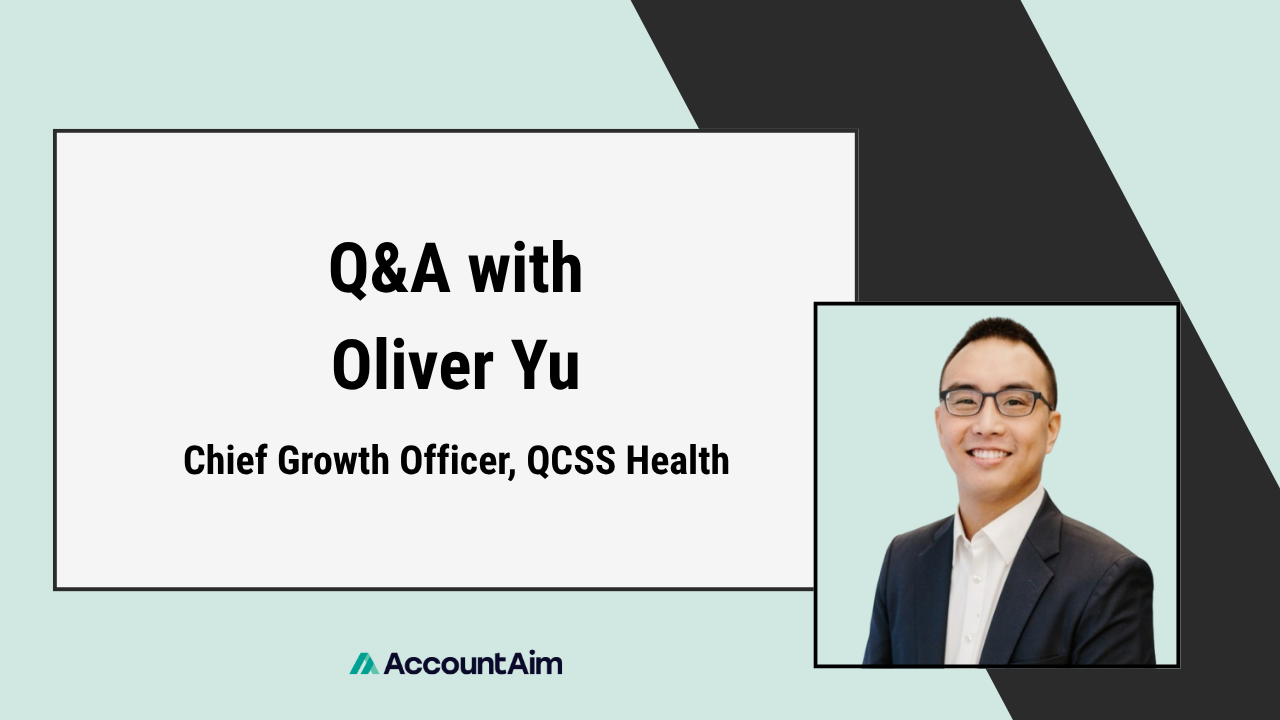

A Q&A with Oliver Yu on onboarding, market segmentation, and earning a seat at the table
In high-growth, high-expectation environments, RevOps leaders face a clear mandate: build systems that scale and drive measurable business outcomes. For Oliver Yu (LinkedIn), that mandate came with real urgency. As head of RevOps at Fusion Risk Management, a PE-backed company, he was responsible for turning strategy into results, quickly and repeatedly. Now Chief Growth Officer at QCSS Health, Oliver shares the thinking and operational discipline that helped him build a high-impact RevOps function from scratch.
Oliver began his career in consulting before moving into strategy and operations roles within tech. He led RevOps at Fusion Risk Management, scaling the team under private equity ownership, and now serves as Chief Growth Officer at QCSS Health.
Q&A with Oliver Yu
How do you define RevOps, and why does your second definition matter for strategic impact?
RevOps, as Oliver sees it, should be the group responsible for moving strategy into execution. It’s not just support, it’s the core of operational alignment.
“I think about it two different ways… The first is the people, processes, and technology that are needed to run an efficient and effective revenue organization. But I have another definition… the team that’s able to turn strategy into reality for a revenue team.”
What led you to transition from consulting into a RevOps leadership role at a PE-backed company?
Oliver originally interviewed for a chief of staff role at Fusion Risk Management, but the PE firm recognized his strategic background and knew that he was a perfect fit to build and lead the RevOps function instead. This tied directly to their value creation plan, and gave Oliver more functional ownership GTM to drive change and shape how the business would scale.
How did you approach onboarding and enablement to drive early sales team success at Fusion?
Oliver designed a two-week bootcamp followed by structured training, capturing the institutional knowledge of the founding team and sales leaders. He emphasized curiosity, fast learning, and trusting early indicators of fit.
“Even as I was learning, I was able to process the new information in a certain way that I saw some salespeople immediately latch onto, which bought me a lot of instant credibility with the sales leadership and larger team.”
“If you put the right processes in place to get someone onboarded, you should trust your gut and understand if someone’s going to be a good fit for the organization longer term.”
What was your framework for effective target market segmentation, and how did you operationalize it?
Starting with over 25 variables, his team tested and refined down to five that consistently correlated with high-value accounts. They then built those tiers into reporting, including win rates, churn, pipeline, and expansion metrics, to drive decisions across GTM.
How do you make sure reps stay focused on the right accounts, even after a segmentation model is in place?
When reps pushed back on territory assignments, Oliver turned to engagement data. If only a fraction of their assigned accounts had been touched, that was the starting point for coaching. The approach reframed prioritization as an evidence-based process.
What’s your strategy for building and justifying headcount growth in a RevOps team under a tight budget?
Each time he added headcount, Oliver could point to a clear set of responsibilities that were at risk of being dropped. He didn’t argue for hires by function, he showed what the business would lose without them and what new capabilities they would enable.
How can RevOps leaders earn and maintain a seat at the executive table?
He gained trust by combining data with direction. By bringing not just problems but proposed actions to the table, he became a reliable partner to cross-functional executives and earned the credibility to help shape strategy.
“I was able to build trust with them because I was able to identify here are the problems that I’m seeing… Here’s what I’m seeing in the data around the challenges, here’s how I think we can solve it, and here’s how I can help you accomplish that.”
Go Deeper
If you enjoyed this Q&A, check out the full conversation with Oliver Yu at YouTube or Spotify.
About AccountAim
AccountAim is the planning and analytics platform built for Strategic RevOps teams. With AccountAim, RevOps teams connect all of their fragmented GTM data, automatically snapshot and see trended changes over time, and build full-funnel reporting — all without SQL or data team support. Learn how Strategic RevOps teams use AccountAim to streamline forecasting, territories, cross-sells and more here.
James Geyer: [00:00:00] Alright, it’s time for another episode of Aim for Excellence, where we are breaking down strategic, operational and career related best practices with RevOps leaders that we admire. I am James, co-founder of AccountAim. We’re the modern data stack built specifically to take RevOps teams for being reactive firefighters to proactive strategic partners.
I’m super excited to be joined by Oliver you today. Thanks for joining me Oliver.
Oliver Yu: Absolutely. Thanks for having me.
James Geyer: Not only is Oliver a great guest to have because he is risen through the ranks to become VP of RevOps and then more recently to Chief Growth Officer Oliver is also an instrumental advisor to AccountAim.
So it’s great to have him on. Oliver, do you wanna share your background a bit more detail for folks?
Oliver Yu: Yeah, absolutely. I come from a generalist background. I started my career in consulting, working across industries and across functional areas, but I really cut my teeth within the tech industry working in strategy and operations.
I started in strategy operations at Groupon actually, after I went to business school. And, after that, made the transition over into revenue operations, working for a pe backed a company called Fusion Risk Management, [00:01:00] and, spent the better part of four years there, building out my revenue operations team and really getting to experience the day in and day out of revenue operations
James Geyer: That’s great. And it’s maybe no surprise then that you were able to rise to the C-suite and to the VP level because of your strategic background. Like we talk so often about, the value of RevOps moving from tactical to strategic. So Excited to dig into your experience with the PE back to company.
how do you define RevOps Personal.
Oliver Yu: I feel like everyone’s got a different definition. I think about it two different ways. The first way that’s more standard is the people, processes, and technology that are needed to run an efficient and effective revenue organization.
And I think that’s generally all encompassing for what revenue Operations does. But I have another definition that I use sometimes, and that’s the team that’s able to turn strategy into reality for a revenue team. I wanna talk a little bit about that when we get to it, but I really think it’s important that revenue operations also view themselves as a true operations group to be able to translate [00:02:00] strategy into execution and work with your cross-functional stakeholders as well, and not just an insights engine.
James Geyer: Yeah, that’s great. So you started in like strategy and ops more generally went to business school. What kind of, intrigued you about RevOps?
What got you into it in the first place?
Oliver Yu: Yeah, it was really interesting. I fell into revenue operations. I knew that I wanted to take on a little bit more ownership in sort of the overall go to market. And when I was in strategy and operations, I was launching new products and new features.
But, it was very small scale in terms of what I was doing. And I knew what I had there was applicable in different contexts, but I hadn’t really heard much of revenue operations at that point. actually, the PE firm that my company was owned by, reached out and they were looking for someone to really help them scale the business.
And at the time I was actually interviewing for a chief of staff role, but after the interview process, they offered me this revenue operations role to start building out the team. And really, once they described what the responsibilities would be and [00:03:00] how impactful it would be in their. Achievement of their value creation plan.
I was hooked. And, from there it was, just sailing along that RevOps journey.
James Geyer: That’s great. And if, one of the sharpest kind of private equity investors out there is tying RevOps to, very strong impacts to their value creation plan. Like proof that RevOps is super valuable.
So that’s actually a really good segue to like working for P Impact company. So at Fusion, you guys were owned by one of the sharpest private equity owners out there. maybe say a little bit more, how did they think about that value
Oliver Yu: RevOps. RevOps is one of the first hires that are thinking about outside of the leadership team.
Obviously you gotta get the leadership team in place when you’re purchasing a new company. But outside of that, the chief of staff role that I had been interviewing for and the revenue operations function were the two things that they were thinking about because when you’re value creation plan is built around scaling, go to market, really oftentimes it’s about.
Taking the company from one stage of growth to the next. And in order to do that, you have to have the right operational processes, the [00:04:00] technology and the people in place. And, for our company, when I joined, we were much smaller and I’d say a lot more earlier stage in terms of our revenue operations processes.
We didn’t have the onboarding processes, and the ability to scale the go to market organization from a people standpoint. that was one of the first things that they brought me in for was, okay we have this hypothesis that if we continue to scale the team, that we’ll be able to scale revenue.
But in order to do that, we actually need to be able to take the information and expertise within the organization and disseminate it across the go to market team. So how do we do that?
a lot of companies as they’re growing, they’re trying to bite off really anything that sticks in the market, right? And they’ll say, if this sticks, I’m gonna take that. If this sticks, I’m gonna take that. But if you’re really trying to focus your dollars and be an efficient revenue organization, you gotta figure out where you’re gonna be the most effective, where your message is landing the most.
And those two areas, the [00:05:00] private equity firms, and really any private equity firm is gonna see that and say, okay. If that is part of my value creation plan, the way I’m going to accomplish that is having the right people in place to set that vision and then execute that vision.
James Geyer: That’s great. If you don’t mind, I’d love to double click into each of those two facets a little bit more.
So the first was onboarding, the second was target market segmentation prioritization. On the onboarding front, you mentioned, collecting and disseminating the best practices and the relevant info. Any learnings from there? What’s the best way to do that or a piece of advice you’d give folks that are thinking about this topic?
Oliver Yu: Yeah. In terms of onboarding, it’s pretty clear. It’s pretty amazing how quickly you can tell if someone is gonna be a good fit for the company on the sales side within the first month or so of them being at the company. And so in order to put them in that best position possible for you to have a true evaluation of that person, you gotta make sure that you have a good onboarding bootcamp.
We were previously led by the CEO was a founder and he turned the reins over to a [00:06:00] new CEO. But how do we take all the information in his head and the other sales leaders that grew up with him and turn that into, okay, here’s how we understand our customers.
Here’s how we understand our market, here’s how we talk about our product, Coalesce that together in a two week boot camp, as well as ongoing training sessions to help them understand how we did things at Fusion. It was really interesting because. As someone that was new to the organization, I was learning at the same time.
But even as I was learning, I was able to process the new information in a certain way that I saw some salespeople immediately latch onto. And those ended up being top performers for us. And those that struggled a little bit and or weren’t really willing to put themselves out there were the ones that we maybe convinced ourselves at first, could be a good fit.
But over the long run, we found, actually, you know what we knew early on, we just didn’t trust our gut. And that was a really interesting takeaway for me, is that if [00:07:00] you put the right processes in place to get someone onboarded, you should trust your gut and understand if someone’s gonna be a good fit for the organization longer term as well.
James Geyer: Yeah. So expensive to keep folks around that ultimately aren’t gonna perform when you can be bringing in someone else, especially when you have very aggressive goals. Tell me a little bit more about those signals of a potentially bad fit or a likely bad fit. Was, did you have a punch list of things you were looking for?
Oliver Yu: Yeah. Yeah. I think an eagerness to learn, ability to process information and the ability to organize that information in their head in a way that allowed them to ask intelligent questions and be engaged throughout. As you can imagine, you don’t need to know the industry.
You don’t even need to necessarily be a salesperson to start and be an effective salesperson down the road. But what you do need is a willingness to learn and a innate curiosity. And I think from a sales standpoint, people maybe take that for granted sometimes, but I. From my standpoint, a hundred percent [00:08:00] of the successful salespeople that I’ve ever met do have that innate curiosity and the ability to process information and distill it down in a way that is useful for them and the other side.
James Geyer: Yeah, that’s like discovery in a nutshell, right? Asking good questions and distilling information so it makes total sense. Okay. That’s really helpful. On onboarding front, the other side was like the target market, priorit prioritization, segmentation. A lot of PE firms get really scientific with a plug and play model here.
What are your learnings here? What’s the best way RO folks can drive this for their company?
Oliver Yu: Yeah. The first big learning is that if you don’t do this, almost certainly you’re gonna be spread too thin, and that’s really not a good strategy for a business As we were analyzing our own performance against the overall market, we were looking at several different factors because there was an approach that the PE firm had in terms of how they would typically go about it.
And we said, okay, what are the factors that make the most sense for us? And we determined that the industry that the account was in was actually relevant for us. How big of a [00:09:00] company it was from a dollar standpoint, a revenue standpoint.
How big of a company from an employee standpoint, what technology stack were they using? And did they have people in the persona that we cared about? we tested probably 20 to 30 different variables outside of that as well, because going into it, our hypothesis was like, why not test all these things?
And what we found after doing the analysis was, hey. do some other variables have impact on our ability to predict whether an account is, an A account, a B account, a C account, or a D account. Sure. But really in the end, if we want this to be impactful for people to really understand what is the key driver behind our target market, we gotta simplify it down as much as possible.
And so that’s how we got down from. Initially, maybe 25 or 30 down to like maybe 10 or 15 that we thought could be good down to the ultimate five that we used. And then ultimately we needed to, roll that out in terms of all of our [00:10:00] reporting and metrics. And that was another big learning is that you can segment your market in a way that, uses this information, but until you really make it part of your operational processes reporting around win-loss.
Pipeline, revenue, churn, upsell. If you don’t look at all of those different metrics broken out by your market segmentation, then you’re doing yourself a disservice because you’re not truly understanding what’s working and not.
James Geyer: How did you measure all of those different factors?
I know some folks look at just win rates. Was that kind of the standard for you guys or did you take any different approaches there?
Oliver Yu: I think win rate is a critical one, and so that’s obviously a standard one to look at. Long-term value, lifetime value is another key one to look at because what we didn’t want were accounts that we were winning that would churn over another couple of years or to even overweight the ones that were a little smaller, right?
Because yeah, maybe we had a higher win rate in sort of these smaller. Accounts, but if [00:11:00] strategically that’s not where we wanted to play, then we didn’t wanna overweight that too. So by looking at win rates. We could take into account where we were winning, and understand why we’re winning, but also looking at lifetime value that skewed it towards the bigger accounts that we wanted to be playing in as well.
James Geyer: Yeah, such a great metric for RevOps because it does cover win rate. It covers like size through a SP and it covers churn in terms of that lifetime. So it’s really great, really insightful. Last question on this kind of target market work is around. Guiding reps like day to day. So I’ve seen some teams fall over, they go through this painstaking work to get to, an A, B, C, D account tiering system, and then they still assign out like all the accounts in the world and reps are still working bad accounts, and it was like a waste of time.
How did you guys get the discipline there to make sure reps were actually focused on those top accounts?
Oliver Yu: It’s tough. When we designed the accounts and the territories for the reps, we went through, okay, here’s how we defined your market. Here are the accounts in there, and here are, the key statistics associated with [00:12:00] each one of them.
inevitably when you’re thinking about, constructing territories, you have reps pushing back saying, Hey, this account doesn’t make sense, this account doesn’t make sense. But ultimately what we wanted to be able to show was to say. There are for some reps, maybe there were a hundred accounts for other reps or maybe 500 accounts in their territory.
And you can push back on a few of these. But let’s take a look at how much activity has actually been occurring for each one of these accounts so that we can truly understand if there is, opportunity for you to continue prospecting and actively being in there. Because if you’re a rep and you’re telling me I don’t have enough territory to be able to hit my quota, which every rep will say at some point or another.
The first thing I’m gonna look at is say, okay, let’s take a look. If you’re telling me you don’t have enough to go after, but we’ve only touched 10% of the accounts, that shows me that there’s a lot of opportunity right now for us to go for the remaining 90%. And yeah, maybe some of them aren’t good for whatever reason, but there’s still so much [00:13:00] opportunity there to continue to expand.
If you’ve gotten to the point where you’ve touched a hundred percent and you’re touching them relatively frequently, then that’s a different conversation and that means that maybe we do need to be thinking about designing territories differently in the future. But truly that piece of information, which honestly wasn’t the easiest piece of information to get either, and so we struggled a little bit with that in our CRM, with that.
Information, you can make a much better determination as to whether or not you’re actually getting traction and you’re actually able to get the production you need out of the territories.
James Geyer: Makes total sense. I suspect we’ve covered, the bulk of it, but anything else that, like in your experience, PE firms wanna look at from a RevOps perspective?
Maybe that’s. Key analytics or just gaps that they’re seeking to fill? Anything we missed here?
Oliver Yu: Yeah, I didn’t talk about as much on the CRM side and I think it’s important to call out that one of the first things they also look at is your CRM organized and used in a way that’s gonna be conducive to [00:14:00] future reporting and future insights.
We, luckily at Fusion had a really well designed CRM thanks to how our, co-founders had structured it, before I joined and before the PE firm bought them.
Pull out this existing CRM and take a new CRM instance and put it in place, put in all the previous information so that going forward you would be capturing the right information and that’s painful, right? Like you can imagine the later stage you are, the more painful that is. But it’s viewed as a necessary first step in order for all the subsequent value creation initiatives to be successful.
James Geyer: Yeah, I will say, I’m shocked to hear you say that the founder led CRM was in great shape. You’re probably the first or second person I’ve ever heard say that. So testament to those founders.
Oliver Yu: It really is honestly. Our COO who retired shortly after the acquisition was the CRM czar of the business.
And he did a really amazing job of trying to be forward looking in terms of what we were looking to do. Now, [00:15:00] that’s not to say that two years after that we weren’t having our own problems with things that we engineered, from that point forward to answer additional questions, but to get to that point about as good of a CRM as you could have.
James Geyer: That’s great. what’s like the 32nd summary on what that CRM should look like or what that PE firm is looking for is to check the box to be like, this is a good CRM to build on.
Oliver Yu: Yeah, a few things. Number one, making sure that the key metrics that you need to be able to report on around win rates, pipeline coverage.
Pipeline growth, deal, progress, stage, duration, average sale price. If you can measure those things accurately, and consistently across opportunities, then you have a CRM instance that’s probably gonna be better than, 90% of what most founders will have within their CRM instance.
The one thing that is critical through all of that is the ability to take snapshots of your data too, because. We were taking weekly snapshots of our pipeline, but [00:16:00] in Salesforce, our CRM, you can only have a certain amount of fields that you use in every snapshot. changing from that weekly snapshot is challenging and already limits you in terms of the kind of insights that you can have.
And that’s one of the things that we were lucky enough to have set up to start, but realized, soon after that. Okay, we probably need to get this a little bit more granular.
James Geyer: Snapshotting is a big reason we started the business.
’cause we think it’s tough to do well and I think it’s part of the reason that you joined us as an advisor. ’cause you agreed. So that’s super interesting. Thanks for all of that detail on working with p back to company. I wanna move a little bit towards like building a team and team management and I’ll repeat myself here and say so many.
Companies are hesitant to hire another RevOps person because, hey, I could hire a sales person instead. And that’s revenue generating. But you worked under a PE owned company who like of any business should be the most focused about every dollar of spend because they really lever these businesses up with debt.
But you grew the team to, I think six at Fusion. So clearly like they understood the value of RevOps, like from you as the leader [00:17:00] of the function. Like how did you think about team growth? What was your mental model for like when should we add headcount and like how and where to put those folks?
Oliver Yu: I had the luxury, of building out RevOps from scratch at Fusion.
And I think what that allowed me to do was to really understand where the challenges were within the RevOps responsibility list. That I wanted to focus on what was a priority and what truly needed some additional support. And I think the reason why a lot of people struggle with being able to get additional headcount for RevOps is because they’re not able to paint the true vision of here’s what I want to use this additional RevOps person for, and here’s why I can’t accomplish that right now.
I think for me, because I started as a team of one and then grew it to a team of six, and every additional person that was adding, I had a very clear vision for what I wanted that person to accomplish. Because I don’t have this person right [00:18:00] now, here are the things that are gonna drop off in terms of what I’m able to accomplish.
I was already running hot, And the business knew I was running hot in terms of my bandwidth. But if we wanted to truly place an emphasis on enablement or analysis or forecasting or any other part of revenue operations. I wasn’t gonna be able to do that justice and still hold my other responsibilities.
So I think it’s really important for you to, as you’re thinking about RevOps, is what is, don’t think about, okay, I just need someone to own marketing operations. I need someone to own sales operations. I need someone to own enablement or analysis and reporting and all of that. That’s one way to think about the responsibilities.
But I do think that a lot of the skills needed to be successful across all those different functions within RevOps are relatively transferable. And so if you end up getting to a point where you don’t have enough bandwidth, think about how you can carve out. A set of [00:19:00] responsibilities that have a similar skillset that you can then plug in and then see how long you can go before you get to the next one.
I’d love to be able to say that, after you get to a certain stage that there’s less scrutiny on getting that additional revenue operations head. But honestly, my experience is that there’s always, especially in a PE-backed company, there’s always gonna be that scrutiny for that additional head, and it’s always gonna be easier to get an additional salesperson, assuming that you’re seeing productivity from the sales team.
Over the revenue operations team just because there’s a number that is specifically tied to a rev.
James Geyer: Yeah, I think that’s all really good framing is to recap, like getting really specific on what they’re doing, what the trades are, and I think when you get specific, you can actually paint the value of that person too.
Hey, if we can do X, Y, Z better, maybe we get, five, 10% uplift in productivity or visibility or something and people can start to underwrite that to an extent of, okay, that’s a worthwhile investment. Versus just another kind of linear head think that’s really well put.
Hiring specific people, what do you look for in new RevOps team members? So we talked a little bit about hiring sales folks [00:20:00] in early signals, but on the interviewing front from Ram’s perspective, what are your kind of criteria that, that you’re seeking?
Oliver Yu: Yeah. From my side, I want someone, the perfect RevOps person is honestly hard to find because you need to find someone who’s the balance of being able to be strategic, but also dive into the weeds, get their hands dirty, and also be analytical.
And I think all of those things are things that I look for when I’m thinking about, a good revenue operations head. Someone whocan be a thought partner with me as a leader within Revenue Operations to say, okay, if we’re trying to accomplish X, this is what we need to focus on in terms of initiatives.
If we’re gonna do that, here are all the people that need to be involved. Here’s where we’re missing from a technology standpoint and here’s the team that we need to get together in order to actually accomplish that. But. Outside of that, then you need someone who is able to then jump into the details, right?
And say, okay, if we’re actually gonna do this, I’m not just gonna be a project manager. I think there’s a [00:21:00] misconception sometimes right now where in revenue operations, if you’re responsible for strategic execution, that you are just there to get everyone to march in the same direction and ensure that you hit deadlines.
But you need to not only make sure that we’re marching in the same direction, hitting deadlines, but also say, Hey, have we thought about this? It feels like we need to be considering this a little bit more because here are the implications of what we’re talking about. So all of that is something that I’m looking for, and I think the ability to learn and be inquisitive and be curious, just like on the sales side, is really important on the revenue operations side because, if you are.
Tied to doing things a certain way, in revenue operations, that’s helpful in terms of maybe bringing some best practices. But what we found even working with the PE firm is that even though they’ve had all these best practices that were going to be helpful, it wasn’t [00:22:00] until we decided, here’s what’s actually gonna work for us because we understand our business, that we were able to actually get the most value out of those best practices.
James Geyer: Yeah, really helpful. And we’re almost at time here, Oliver, sadly. Last topic I wanted to cover with you real quick, is just getting a seat at the table. So we mentioned in the beginning of this recording that you know, you’ve had the good fortune well deserved of advancing in your career up to the VP level and now a chief growth officer.
First of all, like what do you attribute to this from your own kind of personal success?
Oliver Yu: I think that from my standpoint, my consulting experience really helped because I was client facing and consulting. And one of the biggest things that I think RevOps people, one of the biggest challenges RevOps people have when they’re transitioning into, a, CRO Chief Growth Officer role is that they don’t have a number tied to them, and they’re not, they haven’t necessarily been client facing.
So what I was able to do is say, okay number one, I have been client facing and I know how to manage externally. And not only that, I think the fact that I owned sales enablement and [00:23:00] pipeline inspection as part of my role with at Fusion in RevOps actually really allowed me to be successful too, right?
Because even though I wasn’t selling specifically, I knew what good looked like. I knew what a sales rep should be doing. And in jumping to this, leader of the revenue function. I was able to then bring a perspective on what actually a good looks like and provide value in sales conversations too.
And ultimately if you can provide value in sales conversations and also in terms of how the strategy should be set for revenue, then I think that growth from revenue operations to head of revenue is a natural step to do. But you need to be able to take the skills that you’ve developed in RevOps and in other parts of your career and transition that to really what a.
Good, effective revenue leader actually needs.
James Geyer: Yeah, that, that makes a ton of sense. And how about maybe even like a step before that, once you’re at the table, how do you have success? How do you be credible? How did you like get to the a seat at the table with [00:24:00] executives?
Call it like. Maybe a little bit earlier in your career, maybe in the beginning of the days of Fusion, like how did you gain trust and prove yourself to get that shot?
Oliver Yu: Yeah. Oh, that’s a great question. And honestly I would say like that, everyone has a superpower, right? And I think for me, my superpower is being able to develop strong relationships that are based on trust, and also be like a good partner to others.
And so I think for me, that was a really big part at getting a seat at the table is. Building those relationships, not just with my peers at the director of VP level, but also at that C-suite level. And when I was working with the chief marketing officer or our COO or CFO, I was able to build trust with them because I was able to identify, okay, here are the problems that I’m seeing, and I’m not just being subjective about this.
Here’s what I’m seeing in the data around the challenges. Here’s how I think we can solve it, and here’s how I can help you accomplish that. You always hear this from leaders is don’t bring problems. Bring me solutions. [00:25:00] And while I think that’s maybe a little bit shortsighted sometimes, I think in general is a pretty good rule to have as a middle management or upper middle management layer is people want, leaders need to know what the problems are, but if you don’t bring solutions with them, with you to them.
they’re gonna hear that and they’re gonna say, okay, great. Like I don’t really know what to do with that and therefore I’m maybe gonna deprioritize it. But as the revenue operations leader, I came to them with data, with solutions and how I was gonna help them. As someone, not even part of their team that built up the trust.
And pretty soon after that I had a seat at the table to discuss wide ranging issues.
James Geyer: That’s great. Yeah, and I feel obviously better if these solutions are good ones, but sometimes it doesn’t even have to be the right solutions. But just getting like the gears turning and starting the conversation is so helpful.
Oliver Yu: Exactly,
James Geyer: I think a really common thread based on your response and what I’ve heard from other folks who have a similar background and seniority of you in terms of just recapping that is, being proactive and finding issues, servicing them, having trustworthy data. You build trust generally, and like the foundation is there, [00:26:00] you can actually focus on the more strategic and then starting the conversation on the solution front end.
That’s the best way to actually insert yourself to the conversation because you’re driving it. It’s like a hack. So great to see that there are like some patterns emerging. Last question here, before we get into our rapid fire finish. Anything else you’d say on the common pitfalls in RevOps as it relates to having a real impact?
I know you made a comment at the beginning around being the ones taking strategy to actual execution, making it reality
Oliver Yu: Yeah, absolutely. And it’s really change management, right? Because I think, I worked with a fantastic CRO who had, a great vision for what he wanted to accomplish and putting that, vision out there.
But what he really needed from me was someone who could take the reins and make sure that it was going to be completed. And I think a lot of, especially once you get to the VP level, It’s natural to wanna take a step back and maybe not necessarily get as mired into the details, into the weeds.
And, certainly I was able to offload some of my responsibilities to my team, but when it came to true strategic opportunities, I think a lot of team members, whether it’s a VP level or an all the way down to the [00:27:00] analyst level, feel like, okay, if I’m just there to make sure things move along that, change is going to happen.
And that’s just realistically not what’s going to happen. And I think revenue operations. As one of the big pitfalls is you just assume that you’re the project manager and that other people need to take responsibility for actually accomplishing what we wanted to do. Yes, other functions have responsibility in order to make something a reality.
But I think revenue operations’ role is truly to make sure that everyone feels supported enough and understands the prioritization, so that in the end, while they’re executing, you are the one that’s holding it all together and making sure that they all know what they need to be doing and have the support that they need when they don’t know what to do.
James Geyer: Really well put. Great way to cap this final kind of section here is just rapid fire finish, first sentence, first few words that come to mind. What’s the biggest myth about RevOps?
Oliver Yu: I’d say that it’s all just about number crunching and tech stack and CRM,
That’s the first level impact that you can be making in RevOps. But [00:28:00] try and take it a step beyond that because impact and change management is just as important of a part as the insights themselves.
James Geyer: If you could fix one challenge in RevOps, what would it be?
Oliver Yu: You know what? I feel like it would be setting up the correct data infrastructure early on.
It’s never perfect and it’s never going to be perfect, but that’s the one thing that makes everyone’s life easier, early on. And as you continue to mature, I.
James Geyer: That’s a good one. And you’ve already dropped a lot of stage wisdom here, but is there any additional piece of advice you’d give to someone maybe starting their career in RevOps today?
Oliver Yu: I’d say build strong relationships. You can have all the technical skills in the world, but if you don’t have the right functional partners within revenue as well as outside of revenue to utilize the insights and help that you’re able to provide out of revenue operations, then you’re not gonna be an effective revenue operations function and a revenue operations leader.
So I think that it’s really important that you. Build up the trust, and the relationships because that’s the only real way that you’re gonna make the impact that you, your executive team, [00:29:00] and your investors are gonna wanna see out of your business.
James Geyer: That’s great. Oliver, this was awesome as always with all of our conversations.
I look forward to more of them, as you’re an advisor for the company, but really appreciate the time if any folks have any questions for all of us, send them my way and I’ll funnel them towards him and get back to you. Thanks again. This was great.
Thanks.