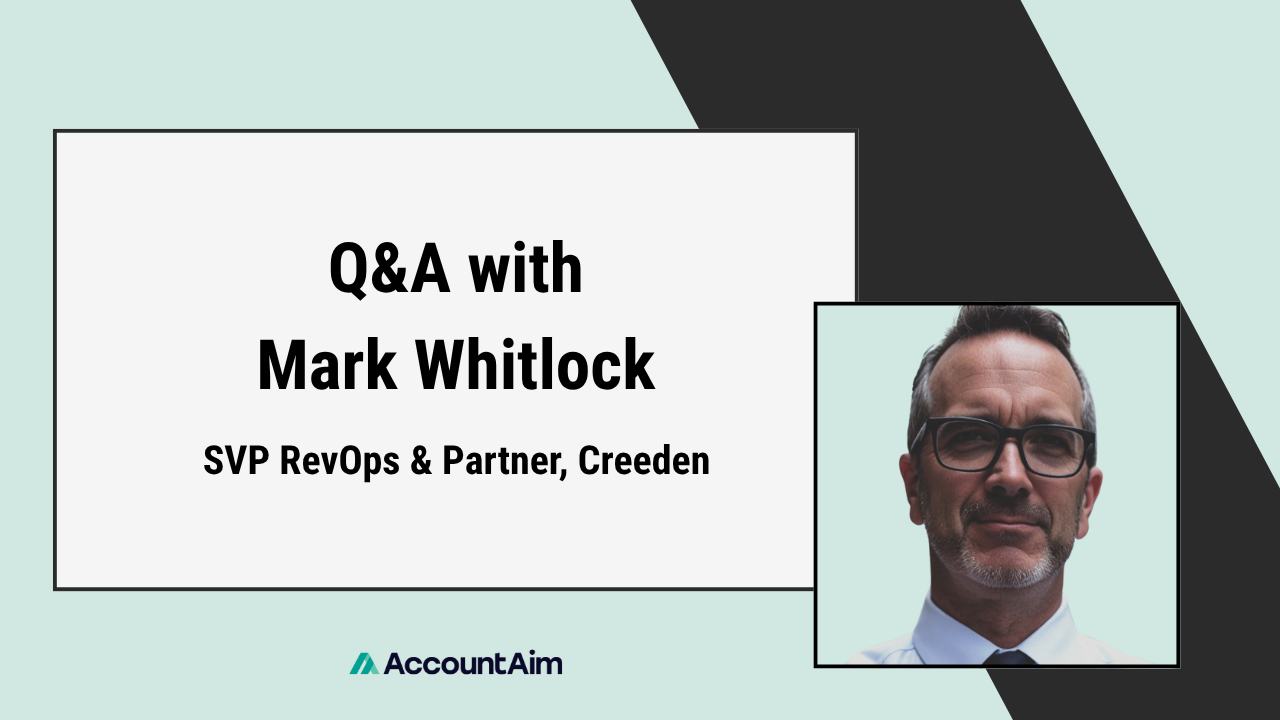

Creeden’s Head of RevOps shares his approach to driving alignment, enabling change, and scaling responsibly in a traditional field sales environment.
Mark Whitlock (LinkedIn) didn’t come up through SaaS. He spent nearly two decades at Ace Hardware and Uline, leading supply chain, product, and systems initiatives before stepping into RevOps at Creeden, a B2B sales organization that works with both large manufacturers and independent hardware retailers.
Creeden isn’t your typical RevOps environment. It’s field-driven, human-centered, and rooted in relationships. But that’s precisely what makes Mark’s approach worth paying attention to. His work shows that RevOps isn’t confined to tech. It’s a business philosophy that can function in any setting where complexity meets growth.
We spoke with Mark about how he defines RevOps in a brick-and-mortar model, how he leads change in a legacy business, and why people remain at the center of everything.
How do you define RevOps, and what does it look like in a non-tech, brick-and-mortar context?
It’s about aligning the business to the customer experience and doing it in the most efficient, scalable way. That includes sales, systems, processes, and the back office. At Creeden, we’re not just managing tools. We’re making sure every function contributes to a clear and valuable customer journey.
“It’s very much about finding the frictionless approach to an ideal customer experience and efficiencies within the organization to make it at the most cost effective manner.”
How did your career in operations prepare you for leading RevOps at Creeden?
My background taught me how things work at a functional level, and how they break. I’ve managed product, supply chain, and IT implementations, and spent a lot of time fixing tactical issues. Stepping into RevOps gave me a way to elevate that work, not just solve problems, but connect those solutions to broader business goals.
Can you explain Creeden’s unique sales model and how it impacts your RevOps strategy?
We’re a two-step distributor. Our reps visit independent hardware stores daily, pitching programs that increase SKU penetration. When those programs work at the store level, we use that momentum to influence corporate buyers.
That means we operate on two fronts: enterprise data and analytics on one side, and local, relationship-driven field sales on the other. RevOps has to serve both, connecting insights across teams and enabling people to act on them.
What are some of the most impactful RevOps initiatives you’ve led at Creeden?
We started by documenting processes, not just for documentation’s sake, but to understand where things break down, where teams get frustrated, and what activities no longer serve the business.
“We’re just going through and documenting the processes, understanding where there’s frustration or friction between teams… Then it’s about eliminating, simplifying, and then automating.”
That’s been foundational. Before we invest in automation, we ask why the work is being done. And if it’s not needed, we cut it. We don’t layer systems on top of inefficiencies.
What strategies have helped you get buy-in from field reps and legacy teams during operational changes?
RevOps has to be sales-minded. That means showing how a change affects revenue, customer success, or individual performance. I don’t lead with, “Here’s a broken process.” I lead with, “Here’s how this helps you sell more.”
And I invest in relationships. I take people to lunch. I meet them where they are. If they don’t trust you, they won’t follow you, no matter how well designed your plan is.
How are you approaching change management, both from a systems and a human standpoint?
We’ve made change a company-wide theme. We’re spending the next two years building comfort with transition across systems, org structure, and personal development.
“We read Who Moved My Cheese as a company… It broke through the technical talk or the business talk to a very basic thing… and gave people a framework for thinking about change.”
We’re also investing in soft skills and emotional resilience. Automation will reduce task work. That gives us room to focus on human capability, communication, adaptability, and team development.
What role does accountability play in how you implement and measure RevOps success?
We have a clear rule: business teams must own what they ask for. If a team requests a system, they own its use and outcomes. IT supports the tools, but it doesn’t lead the initiative.
We define success before we start any project. Sometimes it’s cost or time savings. Other times it’s reduced friction. Either way, we move quickly, test, adjust, and avoid launching for the sake of activity.
What advice would you give to someone starting their RevOps career in a more traditional industry?
Don’t underestimate relationships. RevOps crosses silos, and trust is your most effective tool. Show up, listen, and build credibility before trying to drive change. You’ll make more progress with face time than with dashboards.
Go Deeper
If you enjoyed this Q&A, check out the full conversation with Mark Whitlock at YouTube or Spotify.
About AccountAim
AccountAim is the planning and analytics platform built for Strategic RevOps teams. With AccountAim, RevOps teams connect all of their fragmented GTM data, automatically snapshot and see trended changes over time, and build full-funnel reporting — all without SQL or data team support. Learn how Strategic RevOps teams use AccountAim to streamline forecasting, territories, cross-sells and more here.
Mark Whitlock – Boardroom RevOps
James Geyer: [00:00:00] Hello everybody. We are back with another episode of Aim for Excellence, where we break down strategic, operational and career related best practices with RevOps leaders we admire. Again, I’m James co-founder of AccountAim. I’m super excited to be joined by Mark Whitlock. Today on this podcast, we’ve spent most of our time chatting with RevOps folks in the tech industry about Marks coming from Creeden, which is not quite in the tech industry.
Mark, thanks for being here.
Mark Whitlock: Yeah, thank you very much. I’m very excited and, hope to give you a different perspective of RevOps and how it can be applied in a lot of different ways.
James Geyer: That’s great. I’m looking forward to it. Before we dive in too deep, you wanna just share a little bit more about your background, how you got to Creed and your time at Creeden?
Mark Whitlock: Yeah. It’s kind interesting and I think it, it adds to why. My spin on RevOps is it exists. Started with Ace Hardware. I worked at Ace Hardware Corporate for 18 years here in Chicago. Ran multiple areas in their company, different roles, so inventory, private label, supply chain, implemented, SAP. And so I really came from a technical and a, business background, and then I went to work at another company here.[00:01:00]
In Wisconsin, Uline, which is a, it’s a national company, but B2B company implemented a PIM system there, then came here to work at Creeden and my role at Creedens really been about driving operational improvement. It and a lot of that’s been through like very specific things like technology or process improvement, fixing issues, but it was a very singular approach to it,
add a new system, sit with a team, fix a prob, fix their isolated issue. And, it was very prescribed. And where I think like the benefit of RevOps came is it basically buttons everything together in a nice package.
James Geyer: Yeah. That’s great. And Creeden, can you explain a little bit more about the business model?
I think it’d be helpful context, very different than classic B2B SaaS.
Mark Whitlock: Yeah, so for sure we’re literally, a brick and mortar sales organization, right? So we. We have a national sales force. We excel at that aspect of our business. There’s other reps in, that handle hardware channels, but we’re the only ones that really have true salespeople [00:02:00] in brick and mortar stores, about a hundred stores a day selling our manufacturer’s product.
And that’s really significant in this business because we’re a two step. Model where individual store owners, your mom and pop ace hardware those store owners can make business decisions. So ACE doesn’t have forced distribution like a Lowe’s or Depot. So the model works completely different where we can influence at a store level to affect the corporate level.
And so what we’ll do a lot of times is we’ll bring a manufacturer who doesn’t necessarily have the SKU penetration they want at a store level, and we will deploy our sales force. We’ll go into those brick and mortar stores, we’ll present them with. Sales opportunity deals on programs. And then through the success of that, we can take the story back to the corporate, buyers and look at that program and make a case for why they should stock it in the warehouse.
It’s so interesting you guys really sit in the middle between, as you said, like those big manufacturers that you have to kind of enterprise sale, for lack of a better word, and then the long tail mom and pop shops that you actually have to also sell the manufacturer’s products to, which creates a big RevOps challenge from a [00:03:00] data and kind of process perspective, I’m sure.
Yeah. It’s a really great point. Like we’re an enterprise level data company. Major corporations that we work with. And so we’re handling, from a product information system where we’ve got massive thousand lines of, and about, a big, 40 or 50 manufacturers that can be a challenge, right?
So we’re big on data. We’re massive on, data analytics. We do a lot of, POS analysis and we can really get into the details of it. So we’re going through a, we have a data warehouse. We go through a lot of information. We have a data scientist who works here so that we can bring fact-based results to our manufacturers and to the channels as well.
James Geyer: That’s great. Anything else on the staffing side from the data front? you use the data warehouse and you guys have a home-built CRM you mentioned to me in our past conversation then a data scientist do you have data engineers as well or what does the rest of, the infrastructure look like there?
Mark Whitlock: Yeah, we do. we homegrown CRM and, which is interesting ’cause like we, this is something that the original owner of the business created in the eighties. he pretty much was very revolutionary in his thinking, but [00:04:00] at that time there wasn’t really A universal platform. So built it up and we literally have the ability from a GPS standpoint to know where our Salesforce is at any time, what store they’re going.
James Geyer: We do route planning, then we know where all the retail stores are, so we can do dynamic route planning, the most efficient routes for them to travel when they’re on their calls, and What products they should be selling to that individual store. But yeah, so that’s, our homegrown CRM We got into the weeds quickly, which is, which I love to do, but I’ll pull us back a little bit. I like to ask every guest, like, how do you define RevOps?
It means something different for every company, but what’s your definition of it?
Mark Whitlock: Yeah, it’s funny. It, I would just say it’s changed a lot, right? I think, for us it’s basically, I’ve got a couple definitions, but basically it’s aligning to our customer expectations and then our account experience.
Like we really wanna hone in on that as our core focus, defining the why behind what we do, and then bridging the gap between the sales organization and the business operation really to create like a frictionless, experience. And then on the back office side of things, it’s how do you then deploy [00:05:00] simplification, elimination of non necessary tasks, automation so that you can build up the infrastructure.
So I guess, it’s essentially what we do, right? Like it’s very much about finding the frictionless approach to an ideal customer experience and efficiencies within the organization to make it at the most cost effective manner.
James Geyer: Yeah, I actually think it aligns pretty closely to a lot of definitions we hear, so I think you’re pretty aligned and it makes total sense. Thinking about your business model, the stereotype of businesses that have been around for multiple decades for field sales reps is that they’re resistant to change.
This may not be the case at Creeden, but with this, multi-pronged sales model with all these field reps, like how do you get the field to buy into your goals and initiatives in RevOps?
Mark Whitlock: It’s been very, it’s very interesting and like it is an approach I take with everything. It’s, it really comes down to people.
Honestly, like when you’re trying to make a change, there’s gonna be resistance because one, they’re butting heads with it. I guess from a standpoint of that, it’s about helping them see the bigger vision of it. to me, RevOps was really powerful because it spoke to the dollars of a company, like the revenue gen, [00:06:00] it, it’s literally revenue operations, right?
So salespeople could get that instead of me coming at them and going, Hey, our processes are broken, or our systems aren’t aligned, It was more about, Hey, the revenue of the business is what we need to achieve with the business is critical, and this is how we’re going to do it, and this is why we’re doing it.
Why the customer matters, why the customer experience matters. And then make that the focus point, not the processes or the, people, the friction in the teams, right? It got away from that.
James Geyer: Yeah, it’s, it sounds so simple, but it’s really important ’cause I think so many operators are doers and they like to think in systems and technicals and you really have to pull yourself and talk about why it’s important for the salesperson.
Why is money in their pockets?
Mark Whitlock: Yeah. And it’s really a different it really, ’cause I’m a process operations, functional person, I really had to step back and think about, okay, I need to be relational. I need to be sales minded. I need to approach this from a sales minded focus.
And then I. Live in their world and speak their language. And so that’s what I literally, it’s about going [00:07:00] to lunch and dinner and there’s a lot that can happen at lunch and dinner that can’t happen in an email or just a PowerPoint presentation,
James Geyer: Yeah, put, yeah. We talked about your business model a little bit.
We talked about your definition of RevOps, like creating the ideal customer journey to put it into my work. Maybe not yours necessarily. Yeah. There’s probably so much for you to do. What are the most impactful things for you to focus on in light of the business model in, in your goals?
And like, what are some initiatives that you’re enabling?
Mark Whitlock: Yeah. it’s all about getting results and showing people the results of it. So I started out with, developing the story and the purpose and over time, I took time to communicate that.
’cause I knew it was gonna be conceptually hard for people to maybe, to understand, but, and how it would change their world. But then what I’m doing now is we’re really taking individual teams and doing focused work with those teams where we’re just, Going through and documenting the processes, understanding where they’re having frustrations, where there’s friction between teams and misunderstandings, and really getting back to the basics of why are we doing what, like why are you doing what that like that activity [00:08:00] is.
That’s like the central question of always almost the Simon Sinek thing of like, why, and by asking that it’s I have no idea why I’m doing it. And then we can go back to the other teams and the salespeople who are driving that request and asking them like, why is that important? And then a lot of times it’s not, or it’s like we don’t really care about it.
So then it’s about eliminating, simplifying, and then automating. But at the end of the day, we’re trying to figure out what that why is for a 40-year-old company, 45-year-old company, re-asking the whys But then aligning it back to the customer experience.
James Geyer: Yeah, that’s great. The why having a bias towards like reduction of complexity and elimination, I think is such a good framework for that.
Mark Whitlock: And I think it goes into one of your other questions that you maybe have is like, why are we doing it? So we really see, especially in I would say, we’re in a pivotal role in our company where we’re transitioning a lot of things in the company from ownership to other things.
So with that, there’s a lot of change. And so we’re also looking at how to scale the business. Like we want to take the business from what we have now, and then increase that growth and effect greater than we’ve ever [00:09:00] had before. But how do you do that? And how do you do it in a way that.
Doesn’t lose The customer side of things. So we are very much a people focused thing. We’re interaction. So the human side of stuff. when you really look at AI and some of this other stuff, what that’s gonna do is help remove the non-human, interactive facing things. And we really are looking to then deploy some of that stuff we’re needed.
Like we’re not just doing ai, right? We’re doing. Elimination of things, simplification and then process development, maybe a system or AI or machine learning into it. But all that to say those tasks task work is getting like. I’ll process or simplified. But that the people side of things is really gonna get ramped up.
And so we’re really looking at how do we develop our people, right? So we’re gonna upskill our people, we’re gonna invest in building them into better people when, benefits focus. And then really anything around the soft skills that we typically maybe companies don’t necessarily focus on.
That’s gonna be our bigger focus for a company like ours where we’re sales focused. And so that’s [00:10:00] where we really see. All behind that is RevOps, right? Because It’s understanding what the customer expects. It’s like taking jobs that maybe were highly sales or strategy focused and task focused.
Breaking simple task, focus away and maybe creating automations or systems that can handle it. Get it away from that team and let them be more strategic and then spend money into that.
James Geyer: That’s great. I’m hearing a theme here, related to your first answer around just breaking down or documenting the entire process, the ideal process and seeing what can be automated, what can be eliminated, and just really improving the skills for folks on the areas that can’t be automated or eliminated.
Is that a fair, kind of summary of what you’re doing?
Mark Whitlock: Yeah. And I think the value of RevOps is, it’s the thing that wraps all around it. what I just said isn’t anything unique, right? people have been doing that type of thing all the time, but it’s always to go back to what’s the why behind it.
It’s the customer experience. we have to execute on this aspect of our business. How are we gonna do it? Are we just gonna go, is that team just gonna get eight more people because we just signed four more [00:11:00] lines. Probably not the best effective way because.
Maybe we have really some inefficient things going on already. Let’s go back and delve back into that. Let’s find the efficiencies and then let’s go hire the people if we need ’em. But let’s not just build on top of a bad foundation. It’s, yeah,
James Geyer: I’m totally with you. Yeah. Change management. So I hear a lot of, it was a good summary of some of your initiatives that are in place.
you mentioned earlier maybe the headline of change management of let’s relate it to dollars. But there’s so much more in there around how do we communicate value beyond that? How do we track adherence? How do we drive the habit? Like any tips from your experience on how you drive change management in a business, in an industry like this?
Mark Whitlock: Yeah. I think the biggest challenge is trying to keep everybody aligned to what that is. It’s easy for the executive team and like some of the leadership team to get it, but to get everybody in the business, all the people down to the front lines, understanding that’s a very hard thing to do.
So we’ve been trying to really look at it differently. So we’ve brought in other change is a big, it’s a, it’s our theme for probably for the [00:12:00] next two years that like, we’ve gotta be agile, change pro to change, pro to understanding your role in jobs could change and alter.
But, so we’ve done some things as simple as like we just read the book A Who Moved My Cheese as a company, and we’re having dialogue. That’s a. 20 plus year old book. But it’s such a pivotal thing. We’re bringing in training. We plan to do training throughout probably the midyear this year into next year on just transitions.
And that’s not just business, but it’s life transitions. We have a lot of, this is where I’m saying the power of AI and the power of all this other stuff is gonna give companies the ability to spend into other stuff. And we’re spending it into people, right? So not only just change management is about transition.
So how do you help someone know that Hey, your job today is this, but tomorrow it’s this and you’re still valued. Or even take things outside of work, right? everything’s a blended life, right? I have family members who have cancer.
I have family members who are aging or sick we have peers in our company who have cancer or going through life challenges or mental health challenges We’re trying to be supportive of that and [00:13:00] really help not only build the idea of that mindset of transitions and change, but also empower them to deal with their own life.
James Geyer: Yeah, that’s great. Tell me more about who Moved My Cheese for Anyone not familiar with it?
Mark Whitlock: Yeah, it’s a great book and what I think what the coolest aspect of that is, it’s about, there’s four different types of basically these mice that have different, approaches to dealing with problems and challenges.
And the cool aspect of it is everyone I’ve talked to in the company has it’s such a simple way to explain. How there’s different, basically different personalities and different approaches and different responses. And I think everyone said like at some point I’m one of all four of those.
Like everyone could identify with every aspect of it, depending on the situation and scenario and timing in their life. But it’s just been a great thing where it broke through the, technical talk or the business talk to a very basic thing. And I’ve been stopped five or six times.
Like one people actually read the book ’cause it’s only maybe 90 pages is not, there are a lot of pictures in it, but, so people read a book, [00:14:00] which some people haven’t read books forever. So I thought that was cool. And then, they came back with a perspective of oh, that’s me, like I’m him or haw and like I resist this or, and it’s just been a good framework of conversation.
’cause now they’re open to us then saying alright, this is a business shifted, right? This is how the. The world was this way. Now we’ve gotta shift our business model. And like unfortunately, it impacts everyone. So we gotta look at change. Yeah. So that’s how we’ve applied it.
James Geyer: It’s all strikes me as, a very human and empathetic way to promote change.
It’s a top down message. It’s pervading kind of everything. It’s frequent, it’s getting people to become more open-minded, and that kind of creates the path for you guys to actually go in and make those changes.
Is that a fair assessment?
Mark Whitlock: Yeah, and I guess, we benefited the fact we’re we’re 70 employees, but we’re agile in the sense that’s pretty small. Like now when you get to some of these. Larger organizations that gets extremely difficult and slow, like you probably, you’d have to rethink the approach, but yeah we’re not like doing major things, but these are the things that people can’t, these are the things that, like [00:15:00] people complain about big organizations, right?
Big organizations. They communicate in a way that is not genuine and your leadership doesn’t align. Yeah. Half the time is the leadership doesn’t live what they say. Totally. We have a great luxury of first working on the leadership and executives so that we’re aligned and then we create the message so that we’re not violating our own message.
And then we can roll these messages out. So we have the benefit of time a little bit, But it is, not super significant, but it’s gonna build a culture base so that we want in our company long term. So that’s probably part of why we’re doing it.
James Geyer: you gotta build good culture to make any sustainable difference.
That was a lot of like soft skill. Anything on like the technical or data or system side, is it relates to change management that you guys have in place? Or do you think this is mostly like a human exercise at this point?
Mark Whitlock: I still think it goes back to that. ’cause even, when we do implement a big system, the hardest part is for the people that are asking for a system.
We just did this, we rewrote one of our internal data or basically our master data system and we looked at whether we were gonna buy off the shelf or just [00:16:00] make modifications. We decided to do the modification role. But the biggest thing is people who. Are asking for the system and are asking for the requirements, understanding that they’re the owners of the system, right?
It’s not that the IT team owns the system and that they’re the problem, like if the team that asked for it. Needs it, wants it then doesn’t use it. That’s not acceptable in our company. And I think that’s, we’ve gone through it. There’s been some hard lessons learned that like you can’t just ask for something and then not use it.
And so we, our big thing is about accountability. If you’re gonna come to us, you’re gonna make the case and we’re gonna dedicate time, money, and effort to it. And everyone’s gonna be aligned to it. So we’re really trying to get the business teams. So I always say business led, it supported, right?
There’s nothing my it, I don’t need an IT team, right? Like they don’t exist if there’s no business purpose behind a system. And so it’s really about when we’re talking about technology, that’s the piece of getting people to understand It isn’t technology, it’s for a purpose. And it goes back to the why.
Like why do we, why are we building [00:17:00] this? Okay. Then we’re gonna use it and there’s gonna be a purpose and a and evaluation to it. And it aligns to RevOps as well.
James Geyer: Yeah, makes total sense. My kind of last question on the change my side. How do you measure success of all these initiatives?
Mark Whitlock: I think we define what it is that we’re going to, like what’s the win?
Like we define the win before we start the project. And now some of those things can be minor soft things. It could be relational things, but some of ’em can be truly dollar specific or it can be reduction in. Workload or task, right? we measure, we spend time measuring what’s the, what are we solving, what is the issue, and then evaluating.
’cause we get, like any company, we have, everyone wants something built. So a lot of it is vetting through that, making them substantiate what they’re gonna get out of it. And then we create measurements specific to each one of those cases. and we just make sure that those teams deploy it, own it, and we find the result of it.
And it’s, and we missed at times because we. Sometimes you have to move quick and you have to make assumptions and those assumptions and don’t work out. But, and we’re okay with that. Like we use [00:18:00] this, fail fast as a mindset. We try fast, right?
It’s just about changing the mindset of it’s not a negative thing and there is a, there are factors and steps you have to go through, but let’s not just over. Let’s not over complicate it, not do anything. Let’s try it quickly and learn from it and move on, versus a fail fast mindset. It is essentially the same thing, but it’s, I think that has a negative connotation to me.
I have a hard time saying we should fail more. The spirit is right, yeah. The spirit has to keep going so.
James Geyer: That’s great. And that response relates very clearly to having an owner too. It sounds like you guys are very thoughtful around what are we trying to solve for? Who owns it, who’s actually gonna use it?
What’s the metric? And I think that’s really healthy for prioritization. Cool. Cool. Mark, this is really insightful. I’d love to hear how you’ve thought about change management, just RevOps generally. At Creeden we like to finish with a rapid fire finish. First few words, first, sentence that comes to mind on a few of these questions.
What’s the biggest myth about RevOps in your view?
Mark Whitlock: That’s just another thing or process really. To me, it’s a lifestyle or it’s a foundational part of the company. It’s a culture, but it’s like a business culture.
James Geyer: How would you describe a great ops leader in three [00:19:00] words?
Mark Whitlock: Someone who can grind through, opposition. Someone who’s a bit a bridge builder.
James Geyer: Good. And one piece of advice you’d give to someone starting in RevOps today?
Mark Whitlock: Yeah, I think it all goes back to relationships.
Like it’s a foundational thing. And a lot of times that people are technical, they don’t think relational, but relational will get you farther faster. And especially RevOps is gonna challenge a lot of silos in the company. So you gotta, you’re trying to bridging it. So again, it’s so simple.
Go back to lunch and dinner. Take people out, have a relationship with ’em, find something you can relate to.
James Geyer: Great place to leave it. Mark. Thanks a lot for the time. This is super interesting. Really appreciate it. Yeah, thank you. It was great. Thank you very much.