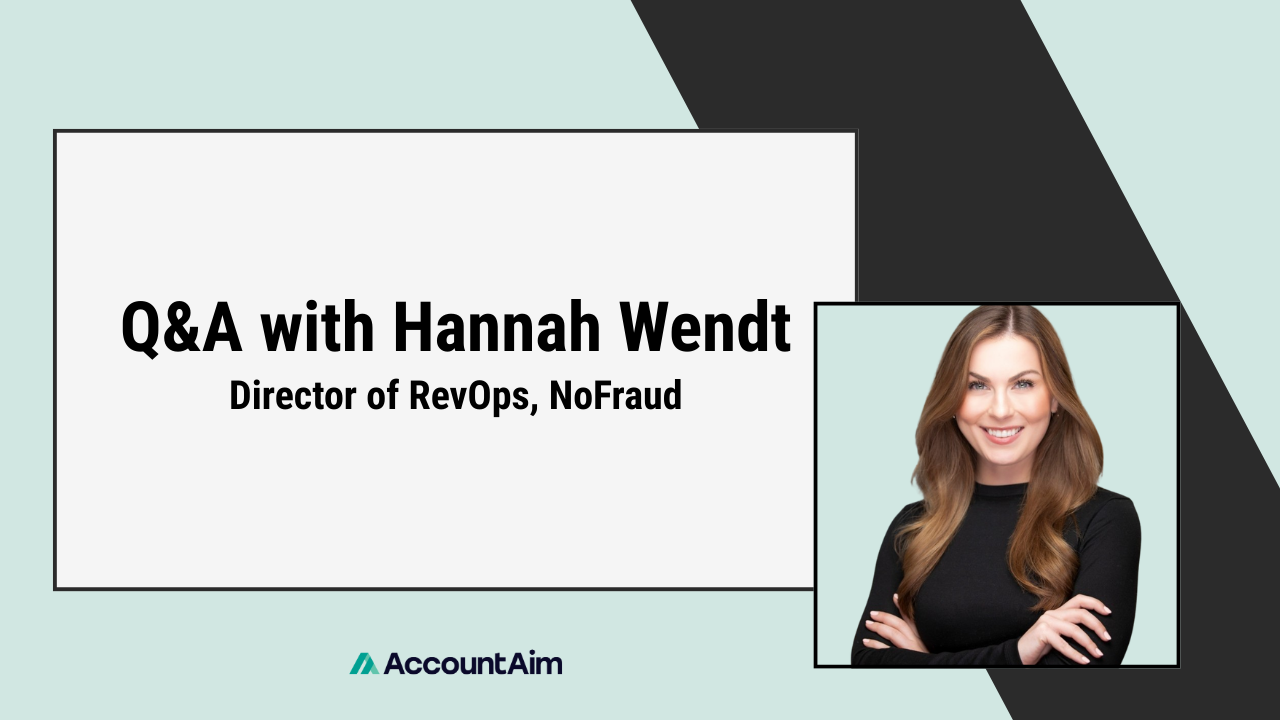

Hannah shares insights on strategically navigating technology shifts, particularly AI, to improve organizational effectiveness.
Hannah Wendt is a seasoned Revenue Operations (RevOps) leader with extensive experience in sales and sales operations. Currently serving as the Director of RevOps at NoFraud, she has built and scaled RevOps teams from the ground up, often starting as a team of one and evolving into a strategic organizational partner. Hannah’s background includes significant experience in the e-commerce SaaS sector, where she has driven impactful go-to-market strategies and operational efficiencies. She is also known for her active contributions to the RevOps community through mentorship, notably with AccountAim’s RevOps Connect program.
Adapting RevOps teams for AI efficiency
Focus on strategic specialization rather than simply increasing headcount as AI transforms operational needs.
“I used to align my team with sales and go-to-market teams’ growth, but with AI tooling, we might not need larger teams, just more specifically focused teams sooner.”
This specialized approach promotes agility, allowing teams to effectively incorporate new technologies.
Proving RevOps value to executives
Clearly demonstrate measurable outcomes to illustrate RevOps’ effectiveness.
“Companies are becoming more supportive of RevOps and see the impact of how much smoother the business operates when you have a high-performing RevOps team.”
Link RevOps initiatives directly to specific business improvements to reinforce credibility and secure executive support.
Building effective RevOps teams
Effective team-building starts with identifying each team member’s strengths and areas for growth, then clearly aligning roles with specific business objectives. During hiring, prioritize not just technical skills but also curiosity, eagerness to learn, and passion for RevOps. Ensuring each new member complements existing strengths and directly contributes to organizational goals helps foster a cohesive, high-performing team that can quickly adapt to evolving business needs.
Cultivating mentorship and continuous learning
Create intentional opportunities for mentorship to foster professional development.
“You have to create the space on your calendar, literally create the space, to set aside time to learn. Few things are better than live training.”
Provide structured mentoring, regular training sessions, and dedicated learning opportunities to enhance your team’s capabilities.
The importance of technical skills for RevOps leaders
Technical proficiency, particularly in tools like SQL, is increasingly critical for RevOps leaders. Mastering these skills allows leaders to efficiently analyze complex datasets, uncover actionable insights, and make data-driven decisions with confidence. SQL proficiency specifically helps bridge data gaps between disparate systems, enabling clearer visibility into business performance and operational effectiveness.
Balancing strategic and technical responsibilities
Maintain active engagement with technical aspects while fulfilling strategic roles. Balance strategy with hands-on involvement. Regularly working with technical tools and systems keeps RevOps leaders connected to the practical realities their teams face daily. This balance enhances leadership credibility, ensures strategic decisions are grounded in operational experience, and provides tangible, practical insights that directly benefit team performance.
Personal growth for RevOps professionals
Continuously assess your skills and actively seek feedback. Specific strategies include:
- Regularly soliciting peer feedback and engaging in self-reflection.
- Creating dedicated time blocks for learning and skill development.
- Approaching new tools and technologies with openness and a willingness to start from the basics.
- Taking structured training sessions or certifications, particularly in emerging areas like AI and data analytics.
Embracing these practices supports sustained career growth and enhances adaptability in rapidly changing environments.
Go Deeper
If you enjoyed this Q&A, check out the full conversation with Hannah Wendt, at YouTube or Spotify.
About AccountAim
AccountAim is the planning and analytics platform built for Strategic RevOps teams. With AccountAim, RevOps teams connect all of their fragmented GTM data, automatically snapshot and see trended changes over time, and build full-funnel reporting — all without SQL or data team support. Learn how Strategic RevOps teams use AccountAim to streamline forecasting, territories, cross-sells and more here.
James Geyer: [00:00:00] We are back for our latest episode of boardroom RevOps, where we’re bringing you valuable tips from RevOps experts so you can make to the C-suite. I’m James, co-founder of AccountAim, the next gen BI solution for RevOps teams. I’m joined by Hannah Wendt today. Great to have you on. Hannah,
Hannah Wendt: great to be here.
James Geyer: I’m excited to cover an interesting theme today. A little bit meta to learning within RevOps and, but before I do you wanna share your background in a bit more detail for folks?
Hannah Wendt: Sure. I have spent most of my career in. RevOps and the e-commerce SaaS space. Started out my role in sales and quickly transitioned from sales into sales operations into revenue operations primarily through my love of Salesforce.
James Geyer: You can ask 10 people get 10 different answers, like how do you define RevOps?
Hannah Wendt: Yeah, I agree with that. I think a lot of people say marketing, sales and cs, but for me it’s really. Connecting the dots more than just that. It’s cross go to market, product and finance. And then really it’s the systems and process and data across those three different larger, departments.
James Geyer: Why it’s such a hard [00:01:00] job that’s like basically like the entire business, I feel like, but when RevOps touches the customer journey, I feel like that is just the reality.
Hannah Wendt: At the end of the day, if you’re aligning to the customer buyer journey, it ends up being across everything.
James Geyer: Yeah. It’s, it’s. I think why RevOps is so interesting though, I have the opportunity to be like the most strategic role in the business because of that. But double-edged coin I guess. But okay. So we’ll dive into learning here shortly from a couple angles, like how you drive learning, as a manager of a team, but also, like how you continue to learn and grow.
As a manager it’s a little harder to do. You don’t have the time, like an icy, but to set the stage, I wanna talk about managing a RevOps team first. And so you’ve been in a few companies now. Growing in seniority over time. It looks like you’ve led RevOps function in a couple of these. Like what’s your philosophy for building a RevOps team?
I know that’s a really huge question, touch component pieces here, but I would love to just start with do you have a mental model for how you even think about it?
Hannah Wendt: Yeah. I think it, for me it starts as I’ve led a lot of lean RevOps teams, right? So I’ve been a team of one, I’ve led teams. of five or six people.
And I think at that size and stage of [00:02:00] company, it really starts with understanding who’s there assessing strengths and weaknesses. And then also I think it’s the kind of self-awareness to assess your own strengths and weaknesses. So for me, with my background in sales and sales operations, typically like my first hire is marketing operations if that person doesn’t exist at the company, right?
And so I think it’s a lot of that. And then as the company grows. I think that’s where you’re, you start with a lot of generalists, right? Teams of one, teams of two, three. And then I really think aligning into business partners has worked well for me. And then eventually, hiring a systems expert underneath, across all of the business partners.
Are there any signs or signals that start to tell you oh, it might be time to invest another hire here?
I think this has ch maybe changed a little bit within, the wave of AI and, the do more with less go to market efficiency focus.
I used to probably say, I would really try to align my team with the sales and go-to market teams growth. And I feel like there’s, a lot of different ratios out there on when to do it. But, for the [00:03:00] most part I think there’s a lot of, exciting things with go to market AI tooling that I think might warrant actually not larger RevOps teams, but more specifically focused RevOps teams sooner.
I think it does vary based on the needs of the business. I try to really understand what impact are we trying to have and do we have the team in place to drive that impact. Usually through an annual planning process,
James Geyer: That actually segues really well into a question I wanted to ask you.
RevOps, I don’t believe this, but I guess technically it might be true. Folks will say, RevOps isn’t revenue generating. And like at a lot of companies, there will be inherent pushback of we might wanna hire another sales rep instead of, another RevOps person because.
they’ll create us more revenue. And I get where people are coming from with that. Like in your experience, maybe it’s that, maybe it’s something else. Is there pushback from leadership on growing the team And if so, how do you get past it?
Hannah Wendt: Yeah, totally. It starts with the spreadsheet, right?
And a spreadsheet, a sales rep has a quota and they’re magically gonna hit that quota. I think there has been, maybe earlier on, I think especially when I was a team of one, it’s was really [00:04:00] difficult to advocate for that next headcount, right? ’cause it’s like. Scaling yourself. But I think as time has progressed, companies have been more supportive of RevOps and see the impact of how much smoother the business operates when you have a high performing RevOps team.
I might be, lucky. I’ve really tried to align myself with companies like when I’m interviewing, it’s really important that they understand what RevOps is and are bought into the function. ’cause it just helps me drive a high impact, team.
And, it aligns with what the business wants. And so I think. Over time, more and more, go to market leaders are seeing RevOps is truly their right hand and are embracing it as a function.
James Geyer: That’s great. And actually, to take a slight detour, I think that’s such an important thing.
Like any tips for how to assess that in a, like interviewing Ariel?
Hannah Wendt: That’s a great question. I think it’s, I really ask a lot of questions, I think, to go to market leaders. I think understanding, if they’ve worked with RevOps teams before, [00:05:00] understanding, asking questions about, what did they work on?
How was your relationship with RevOps, I think can help, give you a lot of insight into what they expect and how they perceive RevOps as a function.
James Geyer: That’s great. I really like that. Okay, cool. So we talked a little bit about like building the team, some of the structure when to hire.
Switching gears a little bit further, like goal setting on a RevOps team. A challenging thing to do because there’s so many, things going on at once. Like how do you approach that for your teams?
Hannah Wendt: Yeah, I think sequencing is so important because RevOps touches all of the departments, right?
And so you really have to be close to your go to market business partners and try to understand what they’re focusing on. And their initiatives are going to be, because you’re gonna sign up for twice as much stuff if you’re signing up for your own projects and initiatives as well as what they’re focused on.
So I think as, as much as you can sequence that work, and what I found really helpful is trying to tie out everything on the RevOps MO roadmap into an overall company initiative. So for us, at NoFraud we really are focused on maximizing go to market growth. Driving [00:06:00] operational efficiency and then proving our value early and often to our customers.
And so if I can organize my work into those initiatives, I think it helps me better align my work with my go-to-market partners as well.
James Geyer: I think that ties perfectly to making the case for more resources as well. It is if we’re already working on these, top level initiatives that are really important for the business, I’m framing up RevOps to support those.
Here’s why bring on extra resource will actually guide those. I think that’s how it all comes together nicely. So that makes a lot of sense.
Hannah Wendt: Some of the work we work on is very project based, right? And so you really have to take, before you start a project, take that extra step to understand how are you gonna measure success and how can I,
prove the ROI back to the business on this impact. And so it’s not something I’m perfect at. It’s something I’ve gotten a lot better about and I think about a lot as I’m building that roadmap. How are we measuring success? And then going back to measure, what the benchmark was before we started a project and what result did we drive?
James Geyer: That’s great. I think that’s such a good habit to get into and easy to not do because there’s so many things going on, but I think it’s really important. Okay. Awesome. So we’ll [00:07:00] move into like our core theme of this discussion around like learning. And I wanna start around, like fostering a learning environment for your team, like as a manager, which is hard to do in RevOps.
’cause again, there’s so many things to do. People use the adage like, no one goes to school for RevOps. It’s a lot of learning by osmosis. So before we dive into that actual learning piece, like to set the stage, as you think about hiring, what are you looking for when you hire RevOps folks on your team?
Hannah Wendt: Yeah, I think there’s like pretty specific things I work for, look for, and I think it’s all around. Their curiosity eagerness to learn and this their overall passion for RevOps. I think so many other of the hard skills within RevOps, obviously you need to be systems minded and have a technical aptitude, but a lot of those things you can coach and mentor.
But I can’t make you passionate about the work. And so that’s usually the main focus is it’s a really like black and white, yes or no.
James Geyer: You mentioned like you can teach some of the technical skills that not everyone will have, and there’s a lot of them.
how do you think about the gaps in those you hire? Is there a 30, 60, 90 day [00:08:00] plan or is it more opportunistic about how to close it? Do you take a mentorship model? Do you have any best practices there?
Hannah Wendt: Yeah. I think it goes for both, just not net new hires. ’cause obviously you get to bring in that talent. But also, if you’re inheriting a team, there’s a lot of, mentorship there too as well. And I think it starts with understanding where they want to go in their career and focused on, aligning, the work they’re working on with their career path.
So I think I found a lot of success in. sitting down with my team understanding, they might not wanna be a director of RevOps, they might wanna be a director of Yes or go be a marketing leader. But how can we align on, where they’re at today? What skill sets would both benefit RevOps but benefit their career?
And I think that helps drive buy-in. It helps drive excitement around the work we’re working on. And then meeting quarterly. I think like a lot of times you reflect on this in annual reviews, you reflect on this in off cycles. But I like to set up quarterly cadence with my team. Call it a quarterly pulse, and we talk about their career, talk about their growth areas, and [00:09:00] use that.
And it feeds back into the roadmap, right? is the stuff they’re working on this quarter aligned with where they need to grow and where they want to grow?
James Geyer: I love that. That’s a really comprehensive and holistic view of that. Something, you mentioned to me, which is actually the genesis of the theme of this podcast, when we were chatting previously, was around creating space for folks to grow too.
can you just elaborate on that kind of philosophy of yours and how you think about that for your team?
Hannah Wendt: Yeah. I think it’s both in my team and myself, right? You’re never going to learn a new tool or learn a new skill in your little 15 minute time blocks between meetings, right?
And so you have to, create the space on your calendar. Literally create the space, to set aside time to learn. And that might be independent learning. I have had people on my team wanting to get certified in Salesforce. They’re going to block out time to focus on prep, like going through practice tests and questions.
But I oftentimes also find and try as much as I can to make space to do working sessions, because I think there’s a lot of times where, that there’s few things better than live training in my experience. And so as much as you can make [00:10:00] time, either you and your team or even your team working together to carve out those working sessions, to work through new problems, or growth areas, I found that really helpful as well.
James Geyer: Awesome. I think that’s such a thoughtful way to approach this to it and, it’s so easy to get stuck in the data and the stress of RevOps You as the leader of the RevOps function, giving the air cover to your team, I think is, really admirable and something that everyone should strive to do.
it’s actually really, it sounds easy, but it’s actually not easy.
Hannah Wendt: Yeah, it’s definitely challenging, but it’s very rewarding. There’s nothing more exciting than I. I’ll use, I’m a huge Salesforce nerd, so I’ll use Salesforce as an example. on my team, one of the skill sets we were focused on last year was learning flows.
And so there are a few things more exciting than watching someone not know how to build a flow to building a flow on their own. it almost brings you back to the joy of when you first learned it, that celebration when whatever automation you put in place actually works.
I think it helps motivate the team. It’s exciting. it reminds me why I do what I do.
James Geyer: Awesome. That’s great. You just gave a few great examples of [00:11:00] what I would call the macro of learning and development, like all the tasks that happen. How about the micro, so one-to-one, you’re mentoring someone on your team, what’s your approach to being a good mentor in that relationship?
Hannah Wendt: Yeah. I don’t think anyone’s a perfect mentor. I try to emulate. Good mentorship I’ve seen in my career, right? So I think I try to think back to, really strong mentors or really strong managers or leaders I’ve worked under or, as peers. And I try to emulate that. And I think it starts also with coming into it with empathy and being humble.
Really listening, understanding where they’re looking to focus, right? I think a lot of times mentorship can be very broad and, these are the large areas of focus for you to get to x place in your career. And I think where I sit as a director who’s still very hands on keyboard, I think the value I give is more in the specifics, right?
So if you are new in [00:12:00] your role and trying to prove out value. Let’s focus on a RevOps charter and I can give you a template I have and let’s work on that together. So I think getting more tactical, but first listening, identifying what they need, is where I feel like I’ve been able to provide the most value as a mentor.
James Geyer: That’s great. So to summarize, active listening, make sure you’re actually focusing on the areas that they are struggling with or are looking for mentorship, and then getting into the tactical, getting out of the, cliches maybe to act. How can you actually solve this problem based on your experiences?
Hannah Wendt: Yes, exactly.
James Geyer: That’s awesome. I think it’s working because I emailed you yesterday from RevOps Connect after one session, and the mentor, the mentee that we matched you with, said they already felt like they were on the up and up to solving all of their problems. And so I think your approach is working at least for some, if not all.
Hannah Wendt: I’m excited about that.
James Geyer: The last question I have around the team aspect of this is as a team continues to grow, it’s hard to scale. You, Hannah, the boss, you’re just one person. Like the culture of learning and mentorship becomes really important too. Anything else you would add there on the cultural side of things to be [00:13:00] thinking about?
Hannah Wendt: I think, ideally it starts with a lot of working sessions with your boss, right? In RevOps, there’s so many different areas of specialization and there’s so many people on the team who have what they’re the best at. And so I try to really foster that, within the team with, show and tells or lunch and learns
My team just put a really awesome. Whatever, and let’s showcase that and it would be great for someone else on the team to learn that. So I try to do that. And I think it does also feed into this overall positivity, motivation. I think people get, excited to present work that they’re proud of.
And so as much as I can try to cultivate that, I think that really helps just, broaden the reach that I can have, not just with, me and my time.
James Geyer: Yeah, that’s great. And also it seems like it has like a adjacent benefit of just recognition and like driving a performance driven culture too, in a very positive way.
Because you’re highlighting the great work everyone did. So if I haven’t, been risen to do a lunch and learn in a while, I might be really motivated to do this next project really well or knocked it out of the park. [00:14:00]
Hannah Wendt: Yeah, I think that’s my overall management or leadership strategy is like leading with a carrot instead of a stick, if that makes sense.
Like how do I motivate you to do your best work? Maybe that comes from my background. I was a cheerleader back in the day. I’m not sure, but that’s definitely my overall leadership or mentor style.
James Geyer: I love it. Do you find that carrot is different for everyone that you work with? And if so, like how do you suss that out for folks?
Hannah Wendt: I think it really is, I think it goes back to that career path and career goal, right? Where I’ve been surprised by this. I think, I would, when I was in RevOps, I very much. wanted to keep climbing the RevOps ladder, right? I wanted to be a manager, then a senior manager, then a director.
Now I, wanna be a vp. But, across managing, different teams, I’ve seen a lot of people want to go in different paths, right? They might wanna focus more specifically on the systems side or, go into CS or go into marketing, go into bi. And so I think, embracing that and embracing where they really wanna [00:15:00] lean in, where their strengths are.
Helps a lot.
James Geyer: That makes a lot of sense. Cool. I think that’s amazing, feedback on the management of the team aspect. But let’s turn to you as a leader, like we mentioned the very beginning of this call, get really busy, really hard to have time to invest in yourself.
Any advice just to start around like growing as a leader, like things you’ve been able to do or try to think about to continue growing on your own?
Hannah Wendt: I think for me, my biggest growth areas or areas I’ve focused on is really, I got into leadership young. I was a director at 25, and I just brute force grew by being the best I see.
I could be. And I had a lot of learnings to do on delegation and people management and so that, that’s been a lot of my areas of focus is How can I empower the team to take this work on? And I’ve slowly gotten better and better at that.
It’s still an area of growth, but, I think a lot of the other soft skills, a lot of the soft skills I focus on with my team, I’m still focused on [00:16:00] for myself. you’re never going to be the best at stakeholder management. You’re always gonna continue to work on that skill. Same with communication, right?
You can constantly get better and better about communicating at different levels within the org. Even being proactive, right? Like you can ever be too proactive. So a lot of the same things I’m working on with my team, I’m working on with myself, and I think that helps it help us feel like we’re in the trenches together, like we’re both working on this.
James Geyer: How do you solicit. That evaluation? Is it 360 degree feedback? Is it a self eval? Like how are you taking time to assess?
Hannah Wendt: I think peer feedback is really important. I think at no fraud, we have a pretty good culture of, jumping in and giving each other feedback right away, right? That radical feedback.
And, but then I think it takes self-reflection, right? If you just take that feedback and don’t do anything with it. To carve out time to self-reflect. And I think this ties in with the career path and goals and growth opportunities. You can leverage the feedback you’ve given to help understand where are my growth [00:17:00] areas and how do I need to improve or focus on them so that I can get to X in my career.
James Geyer: Yeah. Final topic here on learning. Probably no surprise to anyone listening ai. Tell me you’ve been like dabbling in SQL AI tools. I know you’ve been like back nose to the grindstone. Give me your take on the importance of getting back into, I see a learning mode with this big wave of innovation.
Hannah Wendt: Yeah. I think it is so important and I will say it is so hard, right? I think, you’re so comfortable and used to the tools you’re used to. We’ve, been working in pretty much the same tech stack for five, 10 years plus. the biggest thing I’ve had to tell myself is it’s okay to be a beginner, right?
And I think you see a lot on LinkedIn and social media, like these very elaborate play tables, right? And the first clay table you build, you were not going to post on LinkedIn. and you have to be okay with that. And you have to be able, be okay being a beginner at these new tools.
honestly, that’s been the hardest shift for me is allowing myself to be a beginner. SQL I think was another area where it [00:18:00] was a crawl, walk, run scenario I had to slowly learn how to do it. But there is this momentum that builds up once you start to allow yourself to do something at a very beginner level.
At least for me, I get tunnel vision, I get excited, wanna keep figuring out the next step. And so you have to give yourself the grace to get into that, flow. Yeah,
James Geyer: gimme your take on why it’s important. I think the AI one is probably fairly obvious, but tell me about SQL for example.
Like obviously it’s clear to me that you are a fairly technical person. You made the comment that you’re, a spreadsheet person. I see your eyes light up when you talk about flows. But like, why is it important for you as a leader now to be like getting in the nitty gritty with sql?
Hannah Wendt: Yeah. I think it is what’s gonna separate the good from the great RevOps leaders. Honestly, not just sql, but ai, I think, a lot of times you hear you need to be more strategic to have a seat at the table. You need to focus on, being in more strategic conversations.
And I don’t know about you, but I’ve seen a shift in a lot of the revenue operations leaders I follow on LinkedIn and speak to. [00:19:00] They’re all getting back in the systems, right? because with this wave of AI, there’s gonna be a whole new tech stack. And so if you want to, understand it and be able to hire and mentor a team in this.
Kind of in five, ten years, it could be a whole brand new tech stack. Yeah. You do have to lean in and embrace it. And so I think it’s shifting more from, you really do have to balance the strategic and the tactical and carve out time to get back in the systems. And so for me, SQL is an area to help.
Learn and utilize data in a more unified way that I think is gonna be the foundation to a lot of, AI workflows, right? Unless you only wanna focus on AI within one specific system, it’s really helpful to be able to understand and connect data across multiple systems.
James Geyer: I think, my final question for you is around future systems and tech stack, has your thinking changed on foundational systems? I recognize it’s still very early in this, but do you have any prognostications of where the world might be going?
Hannah Wendt: I’m very much still thinking about this year, this quarter, like a [00:20:00] lot of us are. But I do think where my head’s at with a lot of AI tooling is I’m really trying to. Learn in a low cost or low commitment way, It’s like we’re dating, we’re not getting married. So I’m looking for a lot of tooling that has proof of concepts, free trials, month to month so I can get my hands on this tooling, understand it.
So I’m not making a, a large budget decision for the business on a tool that might be, legacy in six months with how fast things are growing.
James Geyer: Yeah, I think that’s a good approach. Cool. That covers learning for us. I just have two quick rapid fire questions for you. First things that come to your mind to wrap us up here.
If you could fix one challenge in RevOps, you’d snap your fingers and it goes away forever, what would it be?
Hannah Wendt: I think what I would fix is then fixable, but just the constant competing priorities or the pivots. It’s inevitable in the business, but I think that change management is one of the hardest pieces in RevOps.
James Geyer: A hundred percent. I think I would probably pick the same thing.
Hannah Wendt: Yeah,
James Geyer: if you could describe a great RevOps leader in three words, how would you describe [00:21:00] them?
Hannah Wendt: I think curious, lifelong learner and problem solver.
James Geyer: Great summary for this conversation. Hannah, thanks so much for spending time with us today.
I think this was really interesting. It’ll be really helpful for folks who are just thinking about expanding their team or are already in it and overwhelmed. So thanks a lot for sharing your, experiences and expertise.
Hannah Wendt: Awesome. Thank you James.