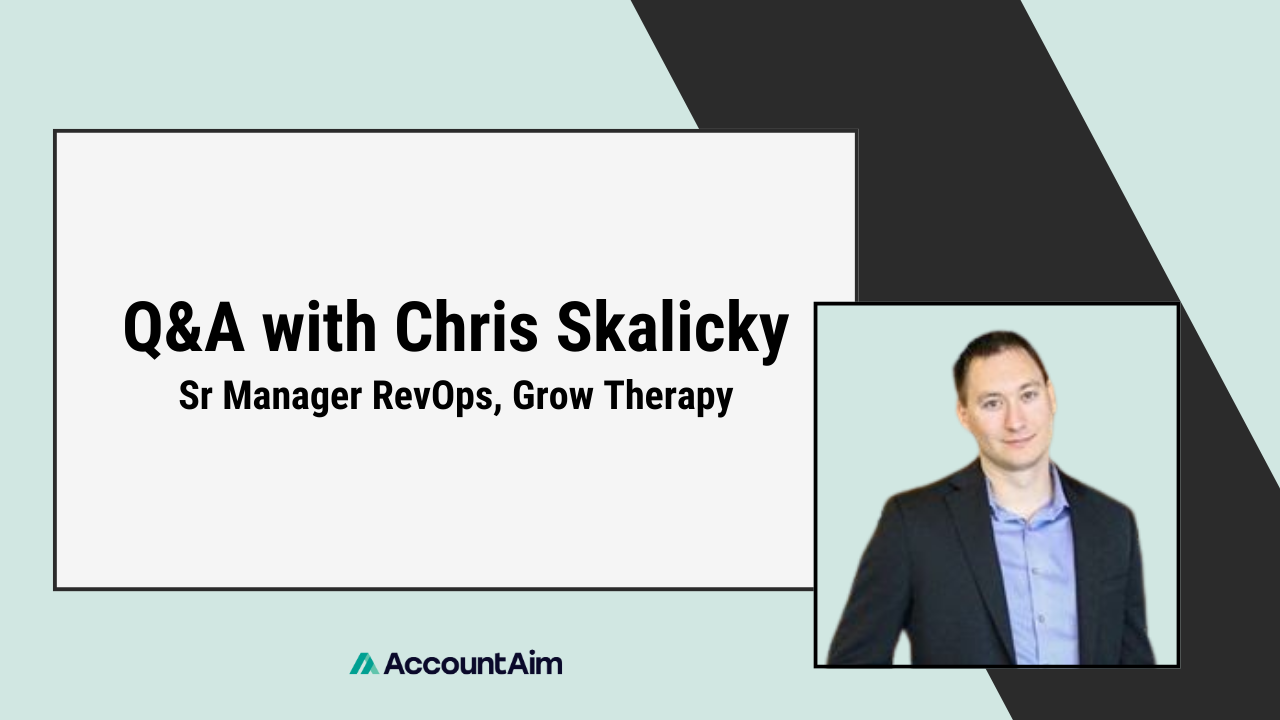

Grow Therapy runs a uniquely complex operation: a three-sided marketplace connecting payers (insurance companies), healthcare providers, and clients seeking therapy. As Sr Manager of Revenue Operations, Chris Skalicky leads sales operations, marketing ops, and L&D ops to keep that ecosystem in balance. In this conversation, he offers practical, direct guidance for aligning diverse stakeholders, choosing the right metrics, and building systems that scale without breaking.
How do you define the role of Revenue Operations in a complex marketplace business like Grow Therapy?
“To me, revenue operations is really about being an architect… making sure that we are all going in the same direction, that we are all working synchronously and working toward the ultimate goal, which is attributing everything we do to revenue.”
Think of yourself as the architect. Your role is not to lay every brick yourself, but to design the blueprint so every team understands the structure they are building toward. Sales, marketing, recruitment, payer contracting, they each have their craft, but without someone aligning them, their work risks becoming disconnected. Your job is to ensure the “roof” lands on the “walls” and that every decision is tied back to one outcome: driving revenue in a coordinated way.
What unique challenges does RevOps face in serving multiple stakeholders, payers, providers, and clients, and how do you address them?
In a marketplace, you are running three businesses at once. You have to keep providers, clients, and payers in balance. Too many providers without enough clients, and you risk disengagement. Too many clients without enough providers, and you create wait times and poor matches.
You need to manage those levers constantly, slowing provider recruitment when supply is high, ramping client acquisition when demand is low, and ensuring payer partnerships keep care affordable. On the payer side, you have to operationalize complex contracts and claim submissions so payments move quickly. If you can see all three sides and know which lever to pull, you keep the marketplace healthy.
How do you identify, align on, and measure North Star metrics across different parts of the business?
Start with your mission. For Grow Therapy, it is expanding access to mental healthcare. From there, define long-term metrics that support it, then set shorter-term goals that keep you moving toward that vision. Some you will plan during strategy cycles; others will emerge when the data or feedback exposes a gap.
Use both quantitative data, such as conversion rates, time-to-credentialing, and match quality, and qualitative feedback from surveys, user research, and customer communities. Numbers show you where to look, conversations tell you why. Keep channels open for fresh perspectives; sometimes the most valuable insight comes from someone seeing the problem for the first time.
Can you share an example where a small operational change had a significant impact on customer experience and revenue?
“We found out we were sending something like 400 emails during onboarding… people got on the platform and just ignored our emails. We cleaned a lot of that out, shortened things, and made them more targeted… and that actually increased our conversion by 10%.”
We audited every touchpoint, cut the noise, and targeted communication to the right person at the right time. That single change lifted onboarding conversion by 10% and improved engagement with compliance deadlines and product updates. Sometimes the most impactful move is removing friction, rather than adding another process.
What principles guide your approach to building and scaling HubSpot effectively?
“Slow is smooth, smooth is fast… establish governance early… permissioning is huge… you have got to say no to stuff and keep the backlog. Sometimes you just have to go after the number one thing and fix the rest later.”
Put governance in place immediately, set permissions, control who can make changes, and protect data integrity. Without that, scaling only amplifies the mess.
Say “no” when you need to. Keep a backlog of requests, but focus on what will materially move the business. Build with the end in mind, ask if it will still work in five years or if it is just a “for now” fix. Hire people who deeply understand the platform, can translate business needs into technical solutions, and communicate well enough to challenge stakeholders when needed. That is how you scale without burning out your team or your tools.
How do you balance responding to new business demands with improving existing processes?
Accept that nothing you build is permanent. There is no perfect system, only the best system for your current conditions.
When new priorities emerge, address the most critical first, but document what you are deferring. Be transparent about trade-offs. Schedule time to revisit and improve those deferred items. Leading RevOps well is about managing both the “what” and the “when.”
Go Deeper
If you enjoyed this Q&A, check out the full conversation with Chris Skalicky at YouTube or Spotify.
About AccountAim
AccountAim is the planning and analytics platform built for Strategic RevOps teams. With AccountAim, RevOps teams connect all of their fragmented GTM data, automatically snapshot and see trended changes over time, and build full-funnel reporting — all without SQL or data team support. Learn how Strategic RevOps teams use AccountAim to streamline forecasting, territories, cross-sells and more here.
James Geyer: Alright, we are back for our latest episode of boardroom RevOps, where we’re bringing you valuable tips from RevOps experts so you can make it to the C-Suite. I’m James, co-founder of AccountAim, the RevOps BI platform. I’m joined by Chris Skalicky today. Great to have you on Chris.
Chris Skalicky: Yeah, man. Excited to be here.
James Geyer: One of my favorite things of getting to talk with and sell to RevOps leaders every day is geeking out on kind of unique business models and the nuances of how RevOps supports them. And that’s definitely the case here with, uh, Grow Therapy, which is where Chris works being a three-sided marketplace, I’m in an impressive HubSpot build to support it.
But before I kind of jump right into things, I’ll pull us back a little bit. Chris, do you wanna share your background in a bit more detail for folks just to kind of level set?
Chris Skalicky: Yeah. So came from primarily a sales background, worked in retail sales, BDR account executive. I worked my way all the way up to a VP of sales for a smaller company.
And uh, I was always just really frustrated with the process and why we do things this way. We’ve always done ’em this way, trying to improve those things. So, uh, made the switch into operations, uh, like seven years ago, eight years ago now, and I really wanted to get back in healthcare at the time. So been with a couple of healthcare startups since then and, and have been at Grow Now two years and a little bit.
And I lead our revenue operations, so, which includes sales, operations, marketing ops, and L&D ops, uh, at Grow.
James Geyer: Awesome. And I’m excited to hear more about Grow specifically just based on our kind of previous conversation. It’s so interesting. But before we do, you mentioned some of the like functions that roll up into RevOps, but how do you define RevOps as a whole to start with?
It’s a kind of a nebulous term.
Chris Skalicky: Yeah. So to me, revenue operations is really about being an architect. So, you know, you’ve got all these different teams, all these different functions, you know, everybody, and they’re, they’re experts at what they do. So if you’re building a house. You have expert bricklayers and you have roofers, and you have framers, and you have electricians and plumbers, and they’re all experts in what they do, and they can all come out and do a great job, but if they don’t know that they’re all building the same house and that they’re all building towards one specific thing, you have.
Piles of pipes and you have piles of wires and you have, you know, like roofing material that like, makes a cool roof, but like, that’s not on top of a house. So, you know, RevOps to me is just sort of the architecture around making sure that we’re all going in the same direction, that we’re all working synchronously and, and working towards really the ultimate goal, which is attributing everything we do to revenue.
James Geyer: I love the metaphor. I, my mind instantly went to, uh, you mentioned plumbers, and that has to be the CRM hygiene of things. Like, it’s just, it’s too, too clear to me in my mind. So you’re doing RevOps for a marketplace business. It grows a three-sided marketplace. Tell the listeners a little bit more about Grow, like what is the business model?
I think it’s important for us to cover that because it is so unique.
Chris Skalicky: Yeah, so for us, I mean it’s really, uh, we have three big sides, which is payers or insurance companies and those, um, types of providers. And then we have our actual healthcare providers, so those would be a licensed clinical social worker or psychologists or psychiatrists, lts, any of those that are actually conducting therapy on the platform or doing med management.
And then, uh, we have of course clients. So clients would be anybody seeking therapy through the platform, through the marketplace. And then we’re slowly starting to dive into a, another piece of that, which would be, uh, a referral business, which is pretty cool. So having providers like a primary care physician that you go see, refer you to Grow if you need therapy.
So just more in pursuit of our mission, but now a fourth sided platform.
James Geyer: A fourth dimension. Yeah. It’s become like a, a cube, if you will. Okay, so we have payers, we have the therapists and the social workers. We have the consumers. We might have the referring physicians, is it a B two Z B2C acquisition of the consumers who are receiving the therapy or is it B2B like through employer benefits, for example?
Chris Skalicky: So that’s really kind of where like that, that referral space is, is more in the B2B. Right now we’re directly like a B2C, so it is an individual consumer coming to the platform through a variety of. Acquisition channels, and then that’s the same on the provider side as well. It’s individual therapists that wanna start a private practice for themselves, but don’t want that administrative burden.
So we function kinda like an MCO where we take care of all that stuff for them, but they administer care themselves.
James Geyer: So impressed with all that you guys are doing. So last question on business model, how do you monetize that across all of those different kind of stakeholders?
Chris Skalicky: Yeah, so the main revenue drivers for us is billing.
So when a client comes, they input their insurance information or they can do cash pay to you. We do allow for that on the platform, but most of our, our patients or clients do insurance. So you come and you put in, you know, I have United and here’s my member ID and here’s my group number and all that stuff.
And then once you actually go through, you see a therapist that takes that insurance, the therapist then bills a certain CPT code, just like any other, uh, medical visit. That goes to insurance, insurance bills back, and then we have pre-negotiated rates, so we’ll take a little bit and then we pay out 70 to 90% back to the therapist.
James Geyer: Okay, got it. So with, with all this going on, um, how in the world does RevOps serve a marketplace business like this? And that’s a really broad question, so I’ll take us a little bit more specific and a little bit, but just gimme like the mental model first of all. Like how do you guys tackle this?
Chris Skalicky: You know, I think really it’s, it’s about understanding where North Stars are.
What’s the things in each of these categories, what’s most important to each of those main stakeholders on the external side, and then internally for each of the teams that’s serving them in whatever perspective way. And we just start there and work backwards, what’s most important, and then just prioritize things.
You know, we try to create as many cross references and reduce data silos as much as possible so we’re all working from the same sort of point of reference and, and that that helps.
James Geyer: Okay. Makes sense. And to give a little more detail, like how do you guys align on those North Star metrics? Has this planning sessions with GMs of each side of the marketplace, or like how do you guys like tactically get to those North stars in the priority?
Chris Skalicky: Yeah, I mean, that’s a good question. So a lot of times it’s something that. We’ve either discovered that that needs to be a key focus, maybe for a short term, if it’s, you know, an H1, H2 kind of goal or one year kind of thing. But broader out, uh, we have an awesome executive leadership team, uh, that’s thinking, you know, five years down the road, 10 years down the road and what those things are gonna look like.
And we do a really good job of making sure that we align everything short term and long term generally. Short term being one to five years long term past that to, you know, our, our mission to expand the access to mental healthcare. And so everything always goes back to that. That’s sort of always the end of our planning sessions is whatever we’ve decided that that’s the thing we’re gonna go after at whatever speed does it really help us accomplish that mission?
And at what speed do we need to go after it.
James Geyer: I, I love that. And I really like the first element of that where you mentioned it might be something that we found. I think that’s like. You know, we talk a lot on this podcast and with prospects and customers around, like how do we elevate RevOps to really be like a value added function?
Because still today there’s a huge spectrum of some amazing RevOps teams that are doing really good, valuable strategic work and some RevOps teams that are still amazing folks, but their role is kind of relegated to like, you know, CRM admin, much more tactical kind of order taker. So how are you guys like finding these things that need improvement?
Is this Yeah, I’ll leave it at that.
Chris Skalicky: Yeah. So. I think a lot of it is to step back and reflect on things as they operate. So you, you build this machine and then you start to see it break down in certain sections from, uh, maybe retention or something like that, right? We’re, we’re constantly having this, so maybe that’s time we need to like, refine an ICP or improve product if, if that’s the feedback that we’re getting.
So trying to collect just multiple data points and then looking at things, kinda stepping back and looking at totality. You’ll start to see commonalities across your, your customer journey. The important for us, and we do that quite frequently across all the different sides of the platform, different business leaders and things inside the company.
We do a lot with user research. I.
James Geyer: Hmm
Chris Skalicky: tons with our, our providers and online community that’s exclusive to our providers, and it’s an amazing place for us to get feedback about what’s working well, what they liked, what they didn’t like, and yeah, we just hire people that really care about making it awesome for ’em.
And, and that’s really been a, a big game changer for, for me coming to Grow, is that everybody’s working in alignment. So there’s really nothing that we won’t do that that. Improves the process. So sometimes it’s small things and sometimes it’s an idea from a brand new associate person that came on and it’s like, that’s a great idea.
We should do that. And then, you know, that turns into something that really moves our business forward. I.
James Geyer: You’re at it again, even in our first conversation, uh, if I wasn’t, you know, co-founder of AccountAim, you would make me want to go apply to grow because everything you tell me about Grow sounds like it’s going so well.
I’m sure there’s so many, you know, skeletons in there from like an honest perspective ’cause it’s never easy. But, uh, it sounds like things are running pretty well and it’s a great group of folks there. But you mentioned in that last answer two things that are near and dear to my heart as the founder of a, you know, RevOps bi business that was analyzing the customer journey and using metrics to understand where things are falling over.
Um. You know, you guys have kind of these dual customer journeys, I imagine, on the consumer side and the provider side, you know, we’ll throw in the referral side in the future as well. Like how are you setting up your metrics and measuring the customer journey holistically? Like what’s the process at Grow to kind of do that systematically?
Chris Skalicky: Yeah, so I think from a, a measurement perspective for some things, so like the payer side and the provider side, it’s really time-based, right? So like, how fast can we get them, or at least it was originally, how fast can we get them? Through this entire process, through credentialing, speaking of providers, that that takes a long time.
Our payer contracts are incredibly intensive and you know, if you’ve ever seen an EOB for yourself, imagine doing a contract with a company that does those. It’s incredibly complex. It takes a long time, and there’s a lot of nuance and detail to every single one is different. So in those we’re measuring, you know, time, like how long is, you know, start to finish in each stage looking at conversion down funnel from each one.
And then looking at what’s, what’s the biggest opportunity? Like what can we actually effectuate and change, uh, into how much? So we measure things like, um, obviously like time conversion, rate, revenue generation from a certain change. So if we make a change, we’re looking at how much did that contribute positively or negatively.
Hmm. And trying to track attribution back that way, and sometimes in time reference too. So we can do more, we have more operational leverage if we can do things faster with more automation or through AI tools or automated comms, things like that. And then from a, a metrics standpoint, you know, there’s a, there’s a million things you can measure, but I think we get so much in the weeds of measuring like every tiny little thing that sometimes you sort of miss the bigger picture.
And so one of the things that we look at is like end for our customer journey on the provider side, where we’ve done a lot of analysis particularly is like the sort of end to end, what’s that conversion and then what’s their success once they’re actually on the platform. And we’ve sort of launched them through the entire recruitment process, which is the hardest part.
Takes sometimes months. And then onto their like, so from the beginning, what was their mindset? How’d they feel? We asked them these questions in discovery. And then based on that, like then how are they acting once they’re on the platform, can we follow up with them and surveys and things like that. And really understanding like what that feels like for them going through it.
So you kind of put yourself in their shoes. So we sort of do this backup and we look across this whole journey and we say, is there any sticking points? Like is there friction or unnecessary friction? Looking through all those things. And then we just kind of look at it holistically as opposed to always focused on the micro.
Mm-hmm. The micros great and you can make some tweaks there and get some quick wins and sometimes some, some pretty big wins that that filter up. But I think a lot of times you’ll, you’ll, you’ll win one or 2% there, one or 2% here. And what you want to do really is start to figure out how you can scale that.
Uh, and make bigger impacts, uh, across each of those different customer journeys. So that comes from kind of stepping back and saying like, Hey, like if we just made everything easier, we did a re-haul of our comms, for example. We found out we thought we were doing really good, conversion rate was high, everything like that.
We did a, an audit of our communications and we were sending something like 400 emails from like start to like finish of the sales. Like it was a crazy amount. And then what we found was when we, when people got on the platform, they just ignored our emails. They would unsubscribe and they wouldn’t, they wouldn’t know about, you know, product announcements or, Hey, your license is expiring from credentialing, stuff like that.
Mm-hmm. They just would ignore everything because we just bombarded them so much. And so we had our marketing ops person go through it, clean a lot of that out, shorten things really concise, really make it really only applicable to the people who needed to see it and only at the time when they needed it.
And that has actually increased our conversion by 10%.
James Geyer: Wow, that’s a big win.
Chris Skalicky: Yeah, that’s a huge win. And it’s just, and, and it’s having downstream effects into billing and revenue and all that. Down, down, down, down, down. So our providers are very thankful that we’re thinking about not just getting them all the information, but only getting them what they need, only when they need it.
Um, and in a, as succinct of a format as we possibly can. So that, that’s really improved their whole experience. And that’s not something that you would normally measure. Yeah. But we found out over time like, Hey, we’re sending too much email. So. Stuff like that is, uh, another way that RevOps can kind of marketing ops, you know, all of us together can kind of work together and improve these journeys.
James Geyer: So much good stuff in there. I love this specific example and a few highlights to me from what you described, or one, a great data foundation, like what you described there around, you know, tracking. Change over time of the customer journey and tracking the impact of some of your initiatives to see if they actually helped.
A lot of that we do at AccountAim. See that worked for a lot of companies. I think it’s very universal, regardless of the business model. But you also mentioned tying this to some qualitative information as well, which I think is really important. Like data can surface some issues, but you often need to kind of figure out or confirm the root cause with like that anecdotal qualitative evidence as well.
Um. Uh, which I think is really amazing. I’m, I’m curious, like, are a lot of these reviews, some of them could be ad hoc, I imagine, but are these metrics like what I’ll call operationalized across the business? Like we talk a lot about cadences sometimes. So are you driving this through a cadence with certain leaders every week?
Or like how do you guys get in like the habit or motion of like reviewing these things?
Chris Skalicky: Yeah, so departmental leaders are looking at these a lot of times daily. We do a weekly sort of roundup where every departmental leader, we have a, a channel where everybody shares sort of the highlights, the biggest things, you know, plus or minus week over week, uh, or if it’s a longer term, you know, month over month, uh, and give a little bit of context to those.
But it’s a quick read. Uh, even with all the departments we have, uh, different leaders, uh, posting different things. It’s a pretty quick read and it gives us everybody a good pulse about what’s happening in other parts of the company. So it just depends on what it is. But yeah, we have a really, really strict review cycle and cadence around a lot of these things.
And then the, the more esoteric things, the, the more ethereal things we tend to, um, to try to schedule those in. Uh, sort of our review ahead of our review cycles. Uh, so in like an H1, H2 format. So right now we’re doing a lot of our H2 planning is sort of finishing up. So my team’s done all these reviews of these journeys, April and May.
So we’re a little bit ahead. So we can report to departmental leaders and say, Hey, we’re seeing this thing. We might want to address that in H2. We’re seeing a change here and we think there could be some leverage here. We’ve seen this steadily decrease or steadily increase, whatever the, the particular metric is.
That way we can actually plan roadmap with them what they want to tackle for that next half year. Or quarter.
James Geyer: Great example of like RevOps having influence through data. I really love it. Last question around metrics and kind of business model. So I’ve already gushed about like your, your marketplace model.
Any metrics specific to that? I’m trying to think of the differences of doing RevOps in a marketplace versus a traditional B2B SaaS business, which I think a lot of our listeners are probably in. Like, are you guys doing any things around like matches or like, uh, you know, acquiring customers on the B2C side or any unique insight around how to think about like RevOps for a marketplace business?
Chris Skalicky: Yeah, it’s, it’s the same, but it’s like three different businesses. Mm-hmm. So it’s, it’s, it’s like a, just a normal, if you think of a normal SaaS sort of model, you just have three businesses and you control all of that. And so there, there’s a lot more that you don’t have as much control over. So we can’t make therapists and, and clients match, uh, but we can do things to influence that, right?
So we work on our algorithms, we work on our matching technology to, to, to help, uh, make sure that that’s, if we surface more information to clients so they can make a better decision. All things that we think and, and have researched to know that those help make the matches and, and make a better relationship the first time.
And then the things that you. Can’t control that happen. You, you just try to impact those. A lot of the metrics are the same, like lifetime value and, and CAC and trying to controllers. We just have three versions of it all coming in from different places, providers, payers, and, and then also on the client side that we’re trying to, to look at and then balance those.
Right. So, and it’s never a complete balance for us. One thing that we have uniquely in a, in a. A situation like ours is mix, right? So you can’t have too many providers and you can’t have too many clients. Mm-hmm. You gotta like control the mix. And so that makes operationally a little bit more intense for our platform teams and then our recruitment teams, right?
So we have to put the brakes on something if we’re getting too many providers and then maybe ramp up something on the client side if. If we feel like we could improve that mix. And then of course, on the operational side for the insurance, like payer side, there’s all sorts of things that we do that change those levers up and down.
Operationalizing things like claim submissions and things like that. So there’s a lot there, um, that, that we have to monitor and, and look at. Luckily, we have our hands in a lot of that as a, as a strategic partner. Uh, and it’s sort of the, the people who know where the levers are, but our partners, like in the RCM team take care of a lot of the insurance stuff, which is great, but they ca they take care of the, the bulk of that, uh, from an insurance perspective and, and some of our other strategic leaders throughout the company, they’re gonna kind of know what to do and they’re just gonna ask us for like, our kind of heart check on it if we have any operational advice or sometimes we will build out whatever it is that they end up.
Wanting to put into place. So yeah, it’s, it’s, it’s really similar to, you know, any of the other businesses I’ve worked in where it’s just sort of a straight line, B2B, B2C, uh, it’s just we have, it’s just triple the work is what I’m hearing. Yeah, we just have all of it. So no big deal. It just feels like three different, I was just talking to my, a new associate that I hired and, and she was previously in consulting for HubSpot, and um, I was like, yeah, it’s just the same thing.
It’s like you have three different businesses that you’re working with. It’s just still like consulting. You just have health insurance now.
James Geyer: That’s great. And you actually gave me the perfect segue. The other topic I wanted to cover here as we are coming up on time is HubSpot. And so I think you guys are still HubSpot shop, if I remember.
Chris Skalicky: Yep.
James Geyer: Um, I think, you know, from talking to folks at the company, like you guys have a pretty sophisticated HubSpot build or scaling with it. Well, I’ll start at high level again. What’s the secret to scaling with HubSpot if there is one? Like how have you guys thought about this?
Chris Skalicky: Slow is smooth. Smooth is fast as the adage goes.
Honestly, really, it’s. Established governance early. That’s huge. As soon as you come in, usually sales ops or RevOps is, is a little bit late to the party. That’s that’s generally. True. You gotta establish governance really, really fast. Permissioning. Not everybody can be a super admin, even if they really, really, really want to.
And try and get a hold of that so that you can then start to actually clean up the data, clean up the workflows, make sure things are operationalized, and, and in a format that is scalable and repeatable. Uh, so I would say that is, is a big part of it, just from a real HubSpot perspective. Also, when you’re.
In the thick of it, you gotta say no to stuff. You know, Reid Hoffman and, and Chris Yeh. Wrote that book. Blitzscaling, uh, in one of the rules is like, let fires burn. Like, sometimes you have to, like, you just have to go after the number one thing and like, yes, that’s a problem, but I’ve gotta go after. You know, what’s gonna keep us on this growth track?
But making notes of those things, making a plan to come back to it at some point and, and fix it. You know, it’s like, yeah, that process isn’t great, but it works. Make a note. Go on to fix the real thing and then come back to it. So. Keep the backlog. Yeah, yeah. You gotta, sometimes you just gotta kind of just go, go for it.
But yeah, and also, like, hire really, really good people, like test people. You know, we, we do a pretty rigorous hiring process and testing on our, our people as they come in, uh, from an operational perspective. But they’ve made all the difference in, in helping us grow really, really, uh, foundationally strong and, and into scale.
James Geyer: What are the top couple things that you’re seeking in like a RevOps hire on the hiring side?
Chris Skalicky: Yeah, so technical competencies is huge, obviously. Uh, we need people who really, really know the system. Uh, for us, and this isn’t always the case, but um, a lot of times we need people that have multiple years of experience.
Lots of HubSpot certifications, lots of use inside the system. They’ve gotta know how it works in and out. So HubSpot is great because it’s not like Salesforce when in a lot of ways, but. Salesforce instance is completely different. Basically, HubSpot is HubSpot and it’s just how you use it that’s slightly different.
Your nuance is is only just icing on the cake, but mostly HubSpot is HubSpot. If you know one input and you just know the technology really, really well. You can generally operate in pretty much any space you can onboard with us really quickly and make a big impact. So that’s a big thing. Also, we have to have expert communicator, have to, because our job so much is, is strategic initiatives and helping our stakeholders understand what their goals are, what they actually want, not what they’re asking for.
So really being able to communicate those things and communicate change is super important.
James Geyer: Yeah. What they actually want, not what they’re asking for is, uh, it sounds so simple, but it’s so sage. Yeah, your, your VP of experience, Chris said that, you know, your team has built, done a really good job of building strategically in HubSpot.
I know this is probably kind of in line with what you just described as scaling with HubSpot, but like what does building strategically in HubSpot mean to you?
Chris Skalicky: Yeah, so for kind of, uh, Steven Covey quote, right, build with the end in mind. Begin with the end in mind, and that’s how, so we build with the end in mind, like we are always thinking about scale.
We’re always thinking about what that looks like. Five years from now, is this gonna work or is this gonna only work for now? And we have to make those decisions and sometimes you have to build for now, and that’s okay. But just knowing that that’s what it is, not thinking we’re gonna build this huge crazy enterprise level business on SMB architecture is one thing.
So we have to really understand that also. Being okay, and, and this is something that I really love about Grow, is we have a culture that it’s okay to not be the yes man. They hire me to be a strategic leader and a thought partner. And sometimes that means stepping back a little bit and saying like, Hey, we should take another look at this.
Like I. I know this is a huge initiative, but I don’t think it’s well thought out from a implementation standpoint. We’re gonna need more time. We don’t have the resource, whatever it is, to just challenge those preconceived notions, even if it’s, you know, leadership wise, respectfully, of course. But if they hired you for a purpose, they should value your opinion.
And if you’re the guy who knows how the system really operates and has the best view of the customer journey, then you should be the person that they look to to say, Hey, this maybe is something we should take a second look at it. And so I think that, yeah, for us has helped us be really strategic,
James Geyer: really well put.
Last question for you. You talked about building for scale, being able to push back on folks on certain things and then building for scale, not always building for the perfect end state because it’s always a bit of a trade off. We talked a little bit previously around like the challenge of balancing new demands as like your RevOps team continues to do good work and is seen by the company as being very helpful.
So you get a lot more demands in versus finding time to improve existing processes or get through that huge backlog that sounds like you probably have, you’re jotting things down. How do you prioritize between those two things? If you possibly have a, a way to think about this? ’cause
now it’s always really hard and I think for us it’s, that’s a good question.
Chris Skalicky: I, you know, I think for us, like we know. Going into anything that, um, like nothing’s gonna be the permanent solution. Like nothing’s gonna like fix everything. There’s no magic bullet. There’s no magic thing that’s gonna make everything okay. And so we have to really understand that as we go. We’re gonna learn along the way.
Like there’s gonna be challenges, there’s gonna be things, but, but we’re just gonna have to do the best we can with the information that we have and like, operate with that assumption and try and flush out as much as we can ahead of time. And then. You know, work through those operational challenges sort of as they come about.
Mm-hmm.
That’s really kind of, to me, one of the big things that, that we’ve had to learn is, you know, kind of kill your ego and just sort of be, you know, where, be in a place where you can be okay with this is good enough for now, but it’s gonna, it’s gonna have to change in the future.
James Geyer: Awesome, Chris. Sadly, we are at time.
This has been awesome. I loved hearing about the business model, how you guys use data to understand the customer journey and improve it, and how you thought about building on HubSpot and scaling. Thanks a lot for coming on, man.
Chris Skalicky: Thanks, man. Really appreciate it.
James Geyer: Of course. Cheers.