
Revenue operations (RevOps) is moving quickly from a support function into a central driver of growth. But as teams scale, they often wrestle with the same tradeoff: how do you keep up the pace of execution without creating complexity that slows everyone down?
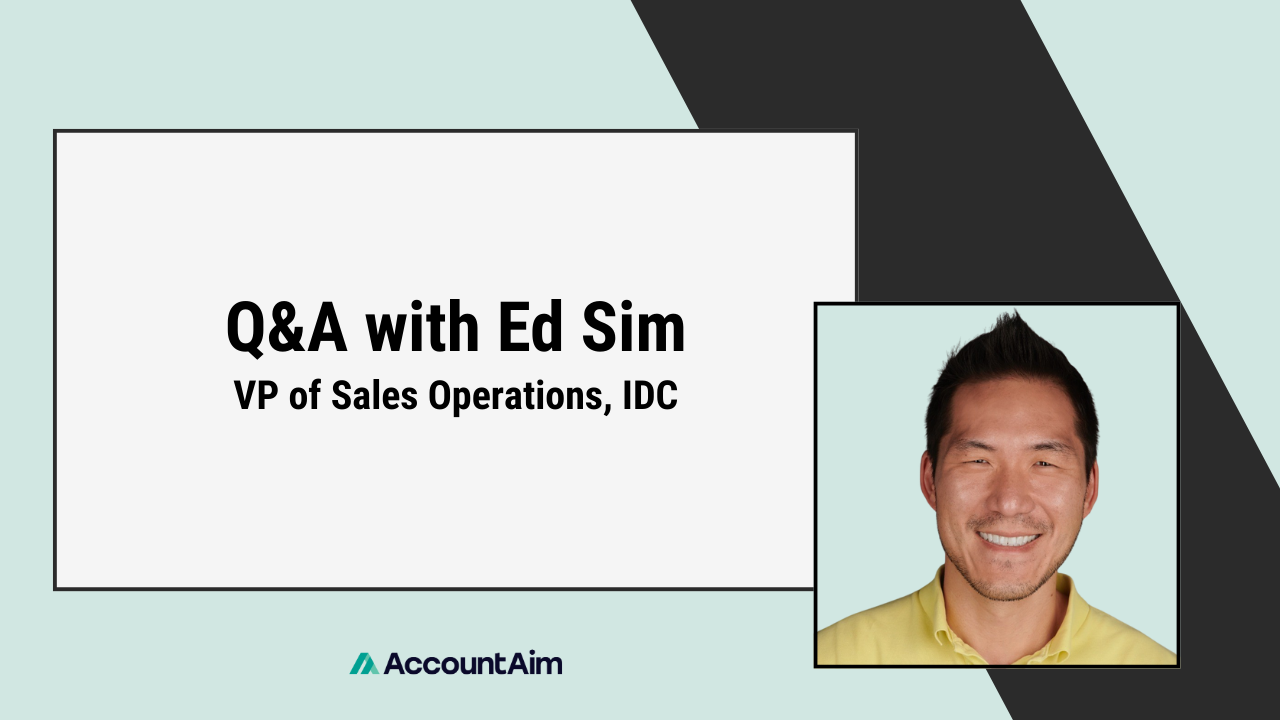
Ed Sim, VP of Sales Ops at IDC, has seen this challenge play out inside some of the largest and fastest-growing companies in tech. In this conversation, he shares how to structure RevOps teams, avoid hypergrowth pitfalls, and build a career that lasts.
Ed has led RevOps inside high-growth technology organizations, building systems and teams designed to support rapid scaling. He focuses on how operators can earn trust across the business, balance speed with durability, and prepare themselves for long-term impact.
How is RevOps typically structured inside large tech companies, and what lessons can smaller organizations take from that?
When you look inside big tech, RevOps responsibilities are often split. Sales finance handles planning and reporting, while sales ops drives execution. Beyond that, companies tend to organize into three modes: field-aligned “chief of staff” roles supporting frontline teams, a centralized “mission control” responsible for systems and reporting, and scaled operations that design standardized processes.
The lesson for you in a smaller organization is to stay clear on ownership while avoiding unnecessary silos.
What’s the right balance between speed and scalability when building RevOps processes?
You should resist the urge to over-engineer too early:
“Sometimes this may mean you do a mockup in spreadsheets… you’ll spend three months in spreadsheets… But what the three months gains you is prototype and proof of concept.”
Spreadsheets are your way to test, learn, and pressure-test ideas with real users before you commit to durable workflows. They give you the flexibility to model scenarios, adjust variables on the fly, and identify friction points in a low-risk environment. Once you see consistent adoption and results in this lightweight format, then you can confidently translate the process into your core systems knowing it will hold up at scale.
In periods of hypergrowth, what risks or pitfalls should RevOps leaders watch out for?
“A hallmark of a rapidly growing company is lots of people being added very quickly… and this results in a lack of clarity on who owns what problem…, and they all have a different approach.”
The risk is more than the duplication of effort. It is the erosion of trust and speed when multiple teams try to solve the same issue in conflicting ways.
You can often spot this early if you see overlapping project charters, competing dashboards, or stakeholders getting conflicting answers to the same question. As a RevOps leader, you should watch for signs like repeated escalations, redundant requests for the same data, or multiple teams using different tools to solve the same process gap. These are signals that ownership is unclear and alignment is breaking down.
What skills and habits help RevOps professionals earn credibility and influence across the organization?
“Early on… just identifying the problem and then bringing quick solves and being seen as useful will get you a lot of credibility very, very quickly.”
Your credibility starts with running toward problems, then expands as you build relationships that bridge gaps across the company. Network building here means setting aside time to connect with peers in sales, marketing, finance, and product, learning how their processes actually work, and identifying where handoffs break down. When you map these connections, you start to see the hidden dependencies that others miss, and you position yourself as the person who can close loops, resolve friction, and keep everyone aligned.
How can storytelling and stakeholder ‘pre-wiring’ improve tough business conversations?
Effective storytelling is really about shaping the conversation before you are in the room. When you share data and context with stakeholders in advance, you can anticipate objections and build alignment early, making the actual meeting smoother.
Think about this the way a consultant would: you earn influence by quietly aligning people ahead of time, showing them the logic of your recommendation, and giving them a chance to weigh in before the group setting. By the time you step into the meeting, the conversation is less about debating the data and more about guiding the group toward the solution you have already socialized.
What career advice would you give RevOps professionals who want to maximize their long-term impact?
Think about your career in stages. You want to maximize your 40s, and that starts by building a solid foundation in your 20s and 30s.
In your 20s, rotate across functions to build empathy and pattern recognition, experimenting with different roles to learn how the pieces of go-to-market fit together.
In your 30s, start sharpening a particular specialty where you can excel, while still broadening your leadership experience and building a network across the company.
By the time you reach your 40s, you should be crystallizing that specialty and aiming to be world-class at one thing, so you bring unique value to senior leadership while still drawing on the breadth of your earlier experiences.
Go Deeper
If you enjoyed this Q&A, check out the full conversation with Ed Sim at YouTube or Spotify.
About AccountAim
AccountAim is the planning and analytics platform built for Strategic RevOps teams. With AccountAim, RevOps teams connect all of their fragmented GTM data, automatically snapshot and see trended changes over time, and build full-funnel reporting — all without SQL or data team support. Learn how Strategic RevOps teams use AccountAim to streamline forecasting, territories, cross-sells and more here.
James Geyer: All right, it’s time for another episode of boardroom RevOps, where we’re bringing you valuable tips from RevOps experts so you can make to the C-suite. I’m James, co-founder of AccountAim, the RevOps BI platform. I’m excited to chat about an interesting topic today. Uh, RevOps within big tech, and there’s probably no better person to chat with today than I met, at least than our guest.
Ed Sim, who’s currently VP of Sales Ops at IDC, but has basically worked at the Mount Rushmore of Big Tech. Apple, Twitter, snap, Facebook, Coinbase, you name it. Uh, great to have you on, man.
Ed Sim: Uh, great to be here. Thank you.
James Geyer: Hopefully I haven’t stolen all of your thunder by rattling off, uh, all the amazing places that you’ve, you’ve worked at.
Is there any additional color to kind of add about your background so folks can get acquainted?
Ed Sim: No, I mean, I would say, I think I have the unique perspective having done RevOps or sales ops in some shape or fashion across all of those companies. And one of the things that I’ve seen, it’s like when I talk to people that haven’t worked in big tech, it’s not like we’re running into different problems.
But what I have noticed though is there’s sometimes a slightly different remit. I mean, every company’s a little bit different in terms of what RevOps is and what is not. One thing that I’ve seen in a lot of big tech companies, it’s not true of all of ’em, but it’s true of many of them. They often have a sales finance team, which works hand in hand with sales ops, and there’s often like a splitting of, of who does what.
And so for instance, like when I was at Twitter, sales, finance did the compensation and
whereas
sales ops did the territory plan. And so that dynamic was somewhat unique in terms of the skillset or the, the remit would be split between those two teams. But generally speaking though, even if you have like a go-to-market finance team, they may be doing things like projections, cost modeling, you know, outcome and the like.
There’s, there’s no question that sales ops is there to make the sales team successful. They’re there to help build a muscle, but to help them get to the next level.
James Geyer: Super helpful background. I think maybe we’ll touch on that, kind of like working with sales finance as well throughout the conversation. So you’ve worked at all those companies I just listed and they were at like kind of slightly different growth stages and, and scopes.
I imagine. Is there kind of like a common thread across your career of where you focus or is it, is it all fairly different?
Ed Sim: Uh, so I would say what was true of most places with the current exception of where I am today, it was joining really during the hyper growth phase. So, you know, joined Twitter right before the IPO joined Snapchat.
Before the IPOI went over to Facebook to join a, a rapidly growing team. I mean, obviously they had an IPO by that point. And, you know, there’s certain dynamics when you are in that stage because there’s a lot of like uncontrolled growth, like things going very, very fast. A real bias towards speed. And it takes a fair amount of discipline and maturity to say, Hey guys, let’s slow down and build something that’s gonna last for the future.
And so on one hand it feels like you’re, you know, you’re throwing wet blanket on things. But in reality, like I think further down the line, you can pause and and look back on what you did, and you can say that process for better or worse, is something we architected back. And if it’s for that reason that we’re not just throwing bodies at the problems, that we’re not just living in Google spreadsheets, there’s actually a workflow that we can take advantage of in Salesforce.
James Geyer: I’m curious, that kind of touches on like speed versus scale to an extent as well. I kinda wanna unpack this a little bit later, but since you brought it up, like how, how do you think about that in like the world of big tech? You know, Facebook know for move fast and break things, you don’t wanna be a web blanket.
Like how do you, how do you manage that internally?
Ed Sim: They sit, you know what’s funny is like move fast, break things. That was very much with coding in Sure. And uh, one of my really good friends who’s the head of product at Spotify ads used to have the same, he’s like, if you ever ship a product and you have no P Zeros on launch day, you didn’t add enough features.
You know, and very much like you wanna take that right level of risk. And what I would say then is about like, you know, the idea between hyper, you know, scale and, and moving fast is like, you have to think of the right level of risk. And oftentimes where I like to go is people sometimes over-engineer and they build too early.
Mm-hmm. And as a consequence, when you build too early, you don’t build the right thing. And so what oftentimes ends up happening, and my my kind of rule is, is like, what is our MVP. What is enough for us to get the process moving? And sometimes this may mean actually you do a mockup in spreadsheets. Mm-hmm.
Sometimes you’ll spend three months in spreadsheets doing a process that you know, deep down should be in a workflow, a dashboard, Salesforce, something like that. But what the three months gains you is prototype and proof of concept. And what it does is it also tells you what things are really sticking and what things are not.
So that when it comes time to build things, you know exactly what matters to the team. You know exactly what resonates. And this was a point, you know, I know that we had brought up, uh, discussed it. Another point was, we, you always have to be really careful about Salesforce bloat because very quickly you’ll hear, I wanna solve this problem.
I wanna solve that problem. And I, I joke that all Salesforce bloat was paved with good intentions.
There was a reason why you did it. There was something thoughtful, but something broke down and maybe you were a little bit over your skis or you had a, a best case in mind. And those are the things to really be careful about.
And so that MVP, the, the dry run of the process, even if it’s a few months in spreadsheets, you learn a lot about.
James Geyer: That really resonates with me too. I think, uh, I’ve been really surprised, you know, doing the, the founder thing with AccountAim and how much company building is paralleled with just like good RevOps practices too.
So MVP is spot on. You don’t wanna over build. I think like on past podcasts, we talked about doing good discovery basically with the sales reps or the go-to market functions so you can actually understand what they truly need versus what they’re asking for. So it’s, it’s super interesting for sure.
Ed Sim: And to that end, like sometimes you don’t know until you try it.
Yeah. I mean, you could, you could have like, you could study it to pieces and think, ah, we’ve got the optimal, we’ve got the perfect requirements. But until people start playing with it, until you start feeling the questions, until you get the feedback, you know, you, you don’t really know. And so oftentimes it’s better just to be resilient and nimble than it is to be extremely thorough front because no one has to crystal ball
James Geyer: totally.
We were talking a little bit about, uh, things kind of like breaking, you know, if you don’t have p zeros after you shipped, like you, you didn’t build enough. Um, these companies you’ve worked with, you mentioned, uh, a couple of them, if not all of them, were kind of in, you joined around hypergrowth periods.
Um, I imagine this, I think you and I have talked about in the past around joining for like big growth sprints and things like that. Like I’m curious from like a RevOps perspective, I imagine that leaves a wake of chaos. Like what typically breaks from a RevOps perspective at, at a big growing company.
Ed Sim: Yeah, typically, you know, I, I think this may be changing going forward with the event of ai, but something that we, like a hallmark of a rapidly growing company is lots of people hypergrowth, lots of people being added very quickly, and sometimes lack of clarity on who owns what problem or even what the problem is and the right way to go about solving things.
And so then what ends up happening then is you, you know, you’ll notice that there is some issue that needs to get solved. A bunch of people get hired sometimes in parallel organizations, and they all think they own it, and they all have a different approach to how they feel that they need to get at it.
And so what I think really matters in that moment in time is like over announcing just doing what you can to drive the alignment, be super clear, add value where you can, but then also just be coordinated with one another. Because I’ve been in plenty of situations where at best, you know you’re creating alternate solutions.
At worst, you’re actually creating like political systems against each other that just don’t work out in anybody’s favor. So knowing what the problem is, who else is working on the problem, building the alliances, and really just getting the work to the right spot.
James Geyer: Yeah. I worked in, um, one fairly sizable tech company in, in a past life, and man, it was hard to navigate internally between the different departments and bureaucracy.
And so I think like. Well, you said makes sense, but alignment is so hard in practice. I’m sure you’ve felt like any tips or tools that you’ve experienced that work well for like go-to-market alignment at? At scale, I’ll call it, or just in a big org at least?
Ed Sim: Yeah, it’s a good question because there’s a lot of wrong ways to do it, and I think the wrong way is to spend lots of time in meetings.
I think the right way to do it is just. Let your work speak for itself and just identify and run to the problems. And I think there’s this delicate balance, and I know we’re gonna get into this a little bit more of like being helpful and being useful and they’re not always the same thing. But I think that early on, especially in a period of hypergrowth, like just identifying the problem and then bringing quick solves, being seen as a useful mammal will get you a lot of credibility very, very quickly.
But then what I think it does is it builds you the credibility. It builds you the seat of the table. And so then what I think it naturally ends up happening is in all but the worst organizations, and I’ve been in some, some, some of those, which I will remain nameless for today’s conversation. Like, people wanna help each other, you know, they don’t wanna just, uh, you know, they’re not there for the game.
And so when they see that you’re helpful, they’ll realize they’ve got plenty of work to do, and so other work to do. And so they’ll let you, they’ll make space for you, and they’ll coordinate with. And I think just having that dialogue, creating enough space that you are doing, building the alignment, I think that’s really the key to it.
I think a big part of it too is like, especially in a newer company where the connective tissue is still forming. Dedicating enough of a time to actually do that networking network. And I don’t mean networking in the classic sense. I mean that like network building, like determining what the connective tissues are, determining what the processes are, where the handoffs could be, what everyone’s responsibilities are.
Um, and the thing is too, it’s like I would also say the main point that I’ll make here is don’t overcook it. Very similar to what I mentioned before, because one thing that I did see is every three to six months, which team owned stuff would always change. You were overly committed to it, like you would just lose because you were just, you know, too stagnant.
But if you’re just kind of cool with like, you’ll see processes move, you’ll see PE people move, but if the relationships are robust, like you won’t skip it.
James Geyer: Yeah, that’s great. I think that’s the biggest difference that I’ve seen too, is like the importance of relationships in bigger companies too, just to get things done, identify problems, and the like.
Let’s take a step back. We kinda dove right in, which is awesome. Um, but I wanna talk a little bit about, like, call it maybe the anatomy of like RevOps and big tech. And so I’m curious even like, what does RevOps even look like in the biggest companies? You, me, you mentioned the sales finance distinction earlier, which is helpful, but like, can you maybe like compare and contrast your experience or like the, the through points of what RevOps looks like in these big orgs to maybe help a listener decide like if this is interesting to them?
Ed Sim: Yeah, yeah. Typically speaking, the largest companies that I’ve worked with will generally split. Their, their RevOps or sales ops teams kind of in the three areas. One is what you would call like a field sales ops team. And this is like largely based in terms of like what your go-to market is. They’re largely aligned to your go-to market.
So for instance, you have a field sales team in the uk, one in Singapore, one in, you know, uh, the us. If you have like a partnerships team that is its own channel, then you have that or resellers. And the idea there is that they’re largely mapped to the sales. Leaders and they very much are the chief of staff or the COO to the sales leader.
So that’s one major field and that has its own unique set of skills, um, that is more tightly business aligned. There’ll be a second group, which is largely what I would call like centralized. Like some places like in startups, they’ll call it like go to market strategy, but in the bigger companies, they may call it like Central or Facebook calls it mission control.
And the idea is, is like stuff that scales and goes to all the teams is really set here. So you know, say CRM management, data governance. Maybe core analytics, other like maybe contracts, deal desks tend to sit here. And the idea there is it’s agnostic. It’s a force by for the entire organization.
James Geyer: Mm-hmm.
Ed Sim: And you wanna do it global. And then thirdly is insofar as your company has say more of like a scaled ops function. Like this could be oftentimes, like, you know, in, in the ad world, there’s a lot of like insertion order processing. Or maybe ticket, re responses to customers, like stuff that just, you know, is, is more of a high value, low touch, you know, low, low complexity kind of thing, tends to get them centralized.
And then this could be anything from like, MA agents themselves reported to this, or you have BPOs that you’re using to then, you know, manage that
James Geyer: is super helpful. Is there, and then of course this is contextual and depends on goals and geography and the like, but do you have an opinion or perspective on.
Where you’d recommend folks spend their time? Is it based on their existing skills, their interests? I’m sure it’s a combination of both. But if someone’s like kind of trying to make the most of their experience, do you have a view?
Ed Sim: It’s a good question. And having sat in all of ’em, um. You know, there’s value in just rotating across all of them.
Mm-hmm. And what I would say is part of it too, it’s like you don’t know until you try it. And you may have certain, like if you’re, for instance, more on the technical side, that naturally will incline you to the, the central or the strategic operations side, especially if you want to do stuff like Salesforce.
But I do think you gain a lot by sitting in all areas because you gain empathy, different skill sets, different things. And that may also be the self-selecting thing for you. But I do think that like, especially if you love RevOps. Sitting across all these different areas will give you a real appreciation and real empathy and a real ability to to climb the ranks better.
James Geyer: Yeah, that’s a cool thing of like bigger companies too, is the ability to be a little bit more mobile, I think. Um, so that’s, that’s a good call out for sure. You used the term, I think, go to market strategy for one of those teams. We get, I, I hear from folks a lot that like, they of course acknowledge a lot of the tactical work that has to happen in RevOps.
Like many jobs, they also really want to have some strategic element. They want to feel like they made a difference on like business outcomes, business decisions. Are you finding that in big tech? If this is the case for RevOps, I guess like where have you seen RevOps plug in with like quote unquote strategic work, which admittedly is a pretty like nebulous term.
Ed Sim: Yeah, it is. And so if you define strategy as what you don’t do or, or maybe a slightly different way, is how do you allocate precious resources? Everyone is doing strategy. There is an element of like, well, am I doing the sexy stuff? And what I found in practice is the best operators are the best strategists, are the best operators.
Mm-hmm. Especially in a, a RevOps type of role. Because the thing is, the reason why I say that is to do strategy, especially in this kind of a role, you need to be able to have a good sense of what’s going on on the ground. Yeah, otherwise you’re just some, you know, random consultants who doesn’t have the business context.
But on the flip side, if you’re in the process, you could be the most detail oriented person, but if you don’t get the larger strategy, then what’s gonna end up happening is you’re gonna go down the wrong rabbit holes. You’re gonna overcook certain things. And so really the ability to kind of fluently go from your high level strategy, understanding the business context as well as what really matters.
And understanding like, like what are the key pivot points? Who is the key person? What is the key process step? What is the one conversation that you know needs to happen in order for you to feel good about that deal closing? Then pulling that up and taking those insights back and forth. And so the truth is, is like anyone that tells me, oh my, my job is too operational.
I would say you’re not being creative enough. And what I would actually say to most people, most RevOps folks are overlooked. You know, I think it’s just because you’re so close to the business, sales team will go to you for everything. It’s very easy to lose control of your destiny. It’s very easy to lose control of your diary.
And one of the things I coach my team extensively on is always hold back 20% of your time. 80% of your time could be heads down work, but you know, if you’re not taking 20% and actively carving it out and saying, this is, I, I, I wouldn’t call it idle time, but this is a hold back time. You’ll find yourself constantly in deficit because what’ll happen is you won’t be able to pause and think, oh wait, this seems to be a recurring problem.
We have this problem every single month. I can come up with an answer. Well, guess what? That strategy, you are strategic. With that extra 20%, you can have things like, well, oh, all those trainings that I forgot to do, you know, I can handle those. Or, you know, I could just have a little bit of slack time for me to just take a deep breath, you know, take a walk and think a little bit more about like how I’m gonna affect the business in a more strategic way.
You’re not gonna be able to do that if you don’t have holdback. So, uh, the other place that I like people using their holdback time is, you know, if 80% of your time, like if you’re a fan of Stephen Covey, he talks about production and production capacity and the fact that you have to balance them both. If you’re spending 80% of your time create, then you should be spending 20% of the time sharpening the saw, making yourself better, making yourself able to do more tomorrow than you were able to do today.
And that can mean anything from a new relationship. A new technical skill, maybe you know, other, other, anything you can to make you more productive tomorrow. And you’ve gotta be holding that time back or otherwise, like you’re gonna be a straight line.
James Geyer: Yeah. That’s so good. I think it sounds very straightforward and almost obvious, but I think so many people miss it and it’s so important to be reminded.
Do you, this might be kind of a silly or obvious question and response, but like any tips on carving out that. 20% time, like I feel like there’s always competing requirements, right? Especially if you’re kind of like mid-level, you might feel like you just have the weight of the, the world on you keeps getting put on your plate.
Like how, how do you coach your team to do it?
Ed Sim: Yeah. I think the key to it is, is you have to block the time. Really. There’s no other way around it. Like you have to block the time and you have to hold that time as sacred. And one of the common things that I’ll hear from people is, well, what if I get an urgent request and I have to take a meeting?
Well, first and foremost, I would like to tune your definition of urgent, right? ’cause there’s plenty of things that will come through across your desk and you will think that it’s urgent and you have to drop and it has to hit your block time. I would challenge that, like, it’s obviously very different if the CRO comes crashing down or, you know, it’s end of month.
But then what I would also say then is like, I acknowledge too that it’s like there may be certain points in the month that just naturally leave themselves for more open time. Mm-hmm. And so, mm-hmm. First and foremost it’s like, like anything that you value and prioritize, like any big rock in life.
You’ve got to put the time there and respect it. And if you don’t respect it and you have to move it, prioritize putting something else in. And if you are chronically in a place where you don’t have time, that’s a conversation with your manager to say like, Hey, I am just in way too many meetings, or I have way too much work here that I don’t have enough time to really be investing and, and building capability.
You know, that nomenclature may not be obvious to everybody, but the idea that. You want to be doing, like, you know, more strategic work or you want to preserve space, I think most managers will resonate with, especially if you frame it in the term of say, like stretch opportunities, training or other things like that.
James Geyer: Well, this so clearly ties to your, um, other point, which I loved around being able to zoom in and out. So like you have all this tactical work you need to do, but it needs to be in pursuit of like actual business impact and goals, right? And so if you can go to your manager and say like, Hey, I don’t think the work I’m doing is actually leading to.
I don’t know, revenue growth to, to make it really simple or efficiency or whatever. I think that’s a good framing of the conversation too. And I think on that, that point you made around zooming in and out. I also wanted to add, I think you nailed all of it, but I think being able to deliver the right level of detail to stakeholders is super key as well.
As you think about like all of the information you’re looking at, how do I go translate it for folks?
Ed Sim: Yeah. And you know, that’s a tough one too. And so very much like storytelling is an art form and for whatever reason, I think that RevOps, I think. It’s interesting, like when I, when I’ve gone through the RevOps circuits, you hear a lot about Salesforce and pipelining and, and such.
What I find interesting though is storytelling is not as key of a a thing. Yeah. And I wonder if that’s, you know, we’re leaving, you know, fruit on the vine there and it perhaps matters more for certain teams, more than others. Like, you know, again, like I don’t mean to throw everything into the go to market strategy team.
But oftentimes because they’re making the decisions about which channels to focus on or what approaches to use, maybe they have to do more of that work. Mm-hmm. But even as a RevOps person, like a territory or channel sales ops person that is working with a sales leader, sometimes your hardest decisions are telling them that they are under allocated on some of their key accounts.
The storytelling behind that is very much a nuance, uh, and it’s a skill that you have to develop.
James Geyer: I love that. Any specific examples or tips on like that, that actual conversation from your experience?
Ed Sim: So many books have been written on, you know, the art of storytelling. I would say if you just sort of start with the framing of what’s in it for them
James Geyer: mm-hmm.
Ed Sim: How do I, what’s in it for them and how do I relate to them in their frame? That’ll probably take you 80% of the weight. To take the empathy and to pause and say, if I put myself in their shoes, what things are they gonna think about? What things are they gonna care about? What data points are they gonna see?
And they’re gonna say, I don’t believe. Yeah. Right. Because I do think like the, the art of it is, is if you know that it’s a data point, then no one’s gonna contest. You can quickly flash it up and move on. But if it’s something that you know is gonna result in defensiveness reaction, then actually, and this is something you learn from consulting.
You don’t have the debate in the room. If you have the debate in the room, it’s like a courtroom you’ve already lost. You need to get all, you need to have all the pre-wiring done up front so that when it comes time, the key people in the room who need to reinforce your point already know the story, are already prepared to speak up, and then land credibility to your point right up front in there so that you’re not having a fight then and there.
James Geyer: This is why we have you on, I feel like this is like a big company. I don’t wanna use the word politics, but it’s, it is like consensus building too. And especially if, you know, you’re right, like this stuff is actually so important to facilitate change and not end up in, um, in unproductive.
Ed Sim: Yeah, yeah. No, but I think, you know, the core group analogy I think matters a lot because, you know, we’re taught to, we’re conditioned that, you know, the flashy moments all happen in the courtroom, but in reality, like a lawyer will tell you that, you know, a courtroom is maybe 5% of their time, 95% is prep.
In a very similar way, if you’re gonna have a big presentation, all your prep, all what really is gonna land is what happens at up upfront.
James Geyer: That’s great. Um, we only have a few minutes left, sadly, ed, I, I think this has been great. I wanted to just spend a, a few minutes on like some of your reflections around like your career.
Um, yeah. Hopefully not to embarrass you, but you’ve been very successful, you know, leading sales ops at, at a big company, and you’ve worked at all these other great companies as well. You’ve also, you kind of touched on it earlier, but I know from our past conversation you’ve moved across various go to market functions, you know, people analytics strategy.
You started as a consultant. Like what are the lessons you have around like the broad scope you’ve taken as it relates to like career growth?
Ed Sim: Yeah. You know what I would say is, I remember early on in my career when I was fairly young, like just a few years out of business school, an older colleague once said to me that you really wanna make sure that you maximize your forties.
I thought that was very odd, very, very odd. And he made the comment that like, and I’ve had this reinforced through the years by many older mentors, forties are a very, very key year for you because, or the key decade because it’s a time when you’ve built up enough credibility and business expertise, but your energy level isn’t tanking.
And so you have that like good mix of ability and energy and your, your forties can really make a big difference for what you accomplish. For your financial state, what you’re able to, you know, build for your family. And so what I would say is like, you definitely want to explore, try things, but as you start to emerge, like in your late thirties, early forties, really start to coalesce something in your mind of this is the 1%, I am the top 1% of this one area.
You can say it with confidence and when it comes time for you to interview and negotiate your salary and your position, that you can say with, with, I am one of the best people in the world in this area. And if you can say that like a, it’s gonna open doors for you because your message will be super clear when it comes time for you to recruit, when it comes time for you to, you know, talk to headhunters or anything like that in terms of what you want.
But then just in terms of your ability to land then on the ground and, and have that confidence to say, I can change something here. I might not have all the context. I might be new to the organization. I might not know the industry, but I’m in the top 1% in this area. I’m here to kick ass.
James Geyer: I love that first.
That makes me feel really inspired at sitting at 32 when I wake up and feel that, uh, that I’m, I’m getting old. It’s good to know the forties of the decade that matters. Um, but I also wanted to, um, uh, tie that into, so how, how does that. Make you think about the different things you’ve done. Is it the sense that like you have learned more so you’re gonna be more prepared, um, for that decade?
Or that you, by doing these things, you’re understanding what you’re like? Top 1% are?
Ed Sim: It’s full. I would say it’s full. And it’s also to a little bit of maybe a permission structure for those that are in their thirties and feel like, oh man, I don’t have it figured out, or I’ve hit, had hit my pay yet. I mean, I, I remember one of my mentors told me that in his last year of working, he made more than his first 15 years put together.
James Geyer: Oh my gosh.
Ed Sim: You know, and it, it, it happens like, ’cause you hit those leverage points and when you hit those leverage points and you know exactly what you are and what you’re good at and what your storyline is. Then, you know, you can really lean into those moments. And so what I would say is like, you know, in your, in your twenties and thirties, especially when you’re, you know, you’re cheap.
Like, here’s the problem is like when you get, when you have like 15 to 20 years of experience, people don’t wanna take risks on you. You’re too expensive. Early on in your career, you can kind of meander around, especially if you’re in the internal job market. You might not have any experience in X, Y, Z thing, but because you have a good strong internal reputation, the hiring manager will bring you on board and you’ll do something.
Mm-hmm. Completely different outside of your, your wheelhouse. I’d say use those opportunities to continuously develop what your core skill is. And depending on what those core skills are, you know, like lean into those. Like, uh, there’s a great quote from Walter Peyton, which is, if you’re good at it, you can, you tell people that you’re good at it, but when you’re great at it, people tell you that you’re good.
And so like start paying very close attention to what things start to resonate, what you get credit for, you know, and continue to experiment. And what I would say is like, uh, there’s something to be said also as well, you know, there’s that the concept of like the 10,000 hours of practice, but those 10,000 hours, they need to be very deliberate.
And oftentimes being deliberate means doing it in a very, like, you’re doing the exact same thing, but you’re doing it in a very conscious way. Which means you’re, you’re not just going through the motions. You’re being very, very thoughtful about it. You are trying slight deviation. You’re actually reflecting after the meetings and you’re writing down notes about what you can do differently.
You’re being very active about your relationships. You’re, you don’t do the spreadsheets the exact same way. You know, you try new things, you know, and you improvise and you’re open to new tools or AI and the like. And so, you know, those are the things that really matter that make the difference between, uh, you know, there was a great saying, which is there are people that have that work for 20 years and have one year of experience live 20 times, and then other people that have true 20 years of.
James Geyer: Yeah, that’s a really good question to reflect on. I think, I know we’re gonna shake out on this based on, uh, your take just now, but how should folks, or how do you think about like in your career? You know, there’s, there’s kind of, you can chase titles, which I hate to use the word chase, because sometimes it just makes the most sense and you’ve affirmed it and all these things versus learnings from meandering or even just when seeking new roles.
Should I, should I shoot for that next level up?
Ed Sim: Yeah. So I have two answers to this, and they, they come from two different mentors. So one was a business school professor. Who made the observation that people that tend to get to the highest career title quickly tend to do in a straight line. And what I mean by this is like, you know, not to pick on accounts, but let’s just say you start off as an auditor.
You know, you do internal audit and then you go up, you become director of accounting, then you become VP of accounting, and then you become Chief Accounting officer. You may get there in 15 years, especially if you’re a crack accountant, but guess what? You are never doing anything else ever again.
James Geyer: Yeah.
Ed Sim: You are an accountant for the rest of your life. But then you’ll see other people that say, you know what, and this is kinda what I was saying before with the, the experimentation. You, you do a rotation in marketing and you try accounting. You go to finance, you do sales, you, you do product management, you kind of do this, and then you go up level and then you hop around and then you go up a level and you try, you know, you do a stint in, uh, internationally, expat assignment.
You know, you try something completely different. And what ends up happening then is you build enough of a broad base and enough of a context. And your, your pattern matching becomes so good that you are useful in basically every sit situation. Mm-hmm. You may not be the expert, but you’re useful and you can help drive decisions at that point.
And the observation that, uh, my business school professor made who himself was a former Fortune 500 CEO, was the people that tend to make it who get there fast focus. The people that get the farthest
tend to take their time and they stay.
James Geyer: Okay.
Ed Sim: The other comment was, uh, from the. The VP of people at Twitter.
James Geyer: Mm-hmm. Yeah, that’s really thoughtful. That’s a, that’s a great model and really practical. I love it. Um, thinking through big tech and we’re almost time, just got a couple more questions. Uh, I appreciate taking the time to chat. Internal brand. You, you mentioned you made a comment on like internal job market reputation, whether it’s big tech or not.
How should RevOps folks think about building their intern? Mm-hmm. Mm-hmm. Yeah, and that’s being strategic, kind of coming full circle and being a business partner and flexing up and down. And I also think data becomes really important too. So if you’re gonna spot those patterns, you have a good grasp of it and, and all that good stuff.
Ed, sadly, we’re out of time. This is full of wisdom. I feel like I just went through a therapy session, which is awesome. So thanks so much for spending the time. It was a really fun conversation.