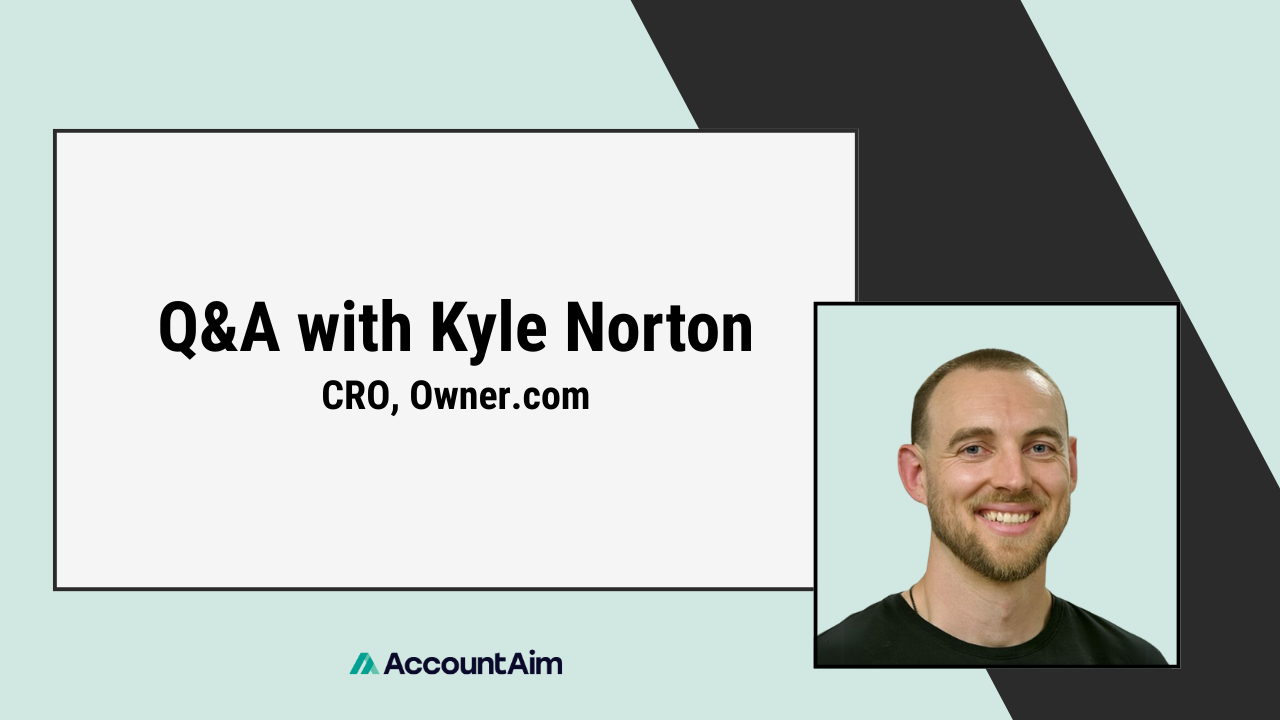

Kyle Norton Q&A
Revenue Operations has shifted from tactical support to a strategic growth driver. Few leaders have navigated that evolution as deliberately as Kyle Norton, who has built and scaled go-to-market organizations with RevOps at the center. In this conversation, Kyle shares how the “ChatGPT moment” shaped his perspective on AI, why he invests heavily in RevOps and data talent, and what it takes for RevOps leaders to earn a seat at the executive table.
Kyle is currently Chief Revenue Officer at Owner.com, where he leads go-to-market strategy and revenue operations. Before that, he held senior leadership roles at companies such as Shopify and League, building and scaling sales organizations that blend technology with operational rigor.
How did the “ChatGPT moment” shape your approach to applying AI in go-to-market operations?
“When ChatGPT came out, it broke my brain. In that first year, it was really just wandering around in the wilderness and I wasn’t very structured or strategic in terms of how I thought about using AI in the business.”
That period of experimentation eventually gave way to a framework: build a strong data foundation, automate repetitive work, and then introduce targeted AI use cases where they can drive measurable value.
Can you explain the pyramid framework you use for structuring AI adoption in RevOps?
“At the base of the pyramid is your third-party and first-party data. Then you automate the repetitive, low-value work that eats up a rep’s day. Only at the top do you bring in targeted AI use cases, and those need clear constraints or else they fail in the white space.”
This pyramid keeps AI grounded in fundamentals. Without reliable data and streamlined workflows, higher-level use cases will not succeed.
What are some of the most impactful AI use cases you’ve implemented across sales workflows?
Practical applications have proven the most effective:
- Lead scoring to identify the accounts most likely to convert
- Call transcription that flows directly into the CRM
- Workflow automation that reduces repetitive tasks
- Coaching simulations that scale skill development
- AI-assisted buying experiences that meet prospects where they are
Each one creates leverage by removing low-value work and giving sales teams more time to focus on revenue.
Why did you decide to invest so early and heavily in RevOps, BizOps, and data talent?
Supporting hyper-growth requires infrastructure. By bringing in RevOps, BizOps, and data leaders earlier than most companies would, the business avoids bottlenecks and builds the capacity to scale efficiently. Embedding these functions deeply into operating rhythms ensures they are not just support, but drivers of growth.
What qualities do you look for when hiring leaders in RevOps and related functions?
Great RevOps and BizOps leaders think in systems and stay curious about emerging technologies like AI. They ask how tools can create leverage, rather than just chasing the latest trend. They also demonstrate strong cross-functional communication skills, the ability to translate data into action for different stakeholders, and resilience in fast-changing environments. Just as important, they bring a servant-leadership mindset, approaching their role as enablers of others’ success rather than gatekeepers.
What advice would you give RevOps leaders who want to elevate from reporting into true strategic partnership?
“That’s the one thing I would say to the RevOps folks listening that wanna really operate at that senior level and feel like they have a seat at the table: get deeply aligned with the priorities of that leader and find ways to get that team closer to their number, because everything downstream of that will sort itself out.”
Earning influence means shifting from producing reports to bringing forward insights and recommendations directly tied to the CRO’s goals.
Go Deeper
If you enjoyed this Q&A, check out the full conversation with Kyle Norton at YouTube or Spotify.
About AccountAim
AccountAim is the planning and analytics platform built for Strategic RevOps teams. With AccountAim, RevOps teams connect all of their fragmented GTM data, automatically snapshot and see trended changes over time, and build full-funnel reporting — all without SQL or data team support. Learn how Strategic RevOps teams use AccountAim to streamline forecasting, territories, cross-sells and more here.
James Geyer: Welcome back for our latest episode of Boardroom RevOps, where we’re bringing you valuable tips from RevOps experts so you can make to the C-suite. I’m James, co-founder of RevOps, the RevOps BI platform. If you consume any SaaS related media, you’re probably familiar with today’s guest, Kyle Norton.
Kyle is the CRO at Owner.com business management platform for local restaurants that is growing like mad and just raise a big series C. Kyle, welcome. Thanks for joining me.
Kyle Norton: Thanks for having me. Looking forward to it.
James Geyer: Yeah. Kyle’s reputation is one of the more operationally savvy CROs, and so I thought it’d be interesting to kind of step into his thought process around ops, how it relates to RevOps and also ai.
Um, and so maybe we can start, Kyle, like, I wanna dive into like how you think about resourcing, organizing ops, both RevOps and BizOps to drive AI and go to market. But before we dive into like those weeds, maybe like. Taking a step back, and I’m gonna make this question intentionally broad, like how do you even think about AI as like the CRO of a, you know, series C company?
Kyle Norton: Well, that is a very broad question. I think like many, that chat GPT moment happened and it broke my brain. I just kept thinking of like all of the different things that were now possible. And like you said, I’ve been very systems engineering oriented, very operationally oriented throughout my career. And so this was in particular an exciting moment for me because it just felt like I was.
Getting access to a completely new set of tools. But in that first year, it was really just wandering around in the wilderness and I wasn’t very structured or strategic in terms of how I thought about using AI in the business. I think we had good intuition and or we were just lucky and we used AI in a few places that were correct sequentially.
Like we really focused on AI for our data foundations. Both, both first party and third party data. And now in retrospect we’re, you know, approaching three years into this phase change. I think I, I have more, I have more distance to, to look at things and have a, an opinion of, of how companies should be applying ai.
But for, for us, it was very much looking at our data foundations, looking at how we use AI to understand who we should talk to in the market. What was happening in our sales cycles, in our, in our customer journey. And then we started to, to place some thoughtful bets on use cases. The first thing was internal tools.
We built our own ML models for lead scoring, propensity to buy deal size. And then data lane, which is a third party data provider, was one of our first big bets. And that had, you know, a dramatic impact on our ability to, to prospect because we got. Leads enriched at a ridiculous rate for mobile phone numbers and, and contact accuracy.
Then we layered momentum on to automate a bunch of stuff, like what are all the things that are. That a rep is spending time on that. We think we could be automated in a completely new way because AI just lets you do so many, so many more. Gen AI specifically. So many more unique things. And then we layered on Avara, which is like an AI sales simulator.
’cause coaching is, is a big part of what, what we prioritize. OneMind now is like our in-market experiment to give a an AI. Avatar native customer experience, so like more of our buying journey. And so we’ve been in market for a few months with like really exciting results, but that’s our first like market facing.
Use case, which I think is different than many people. And then Pavlov is like customer journey experimentation, um, throughout our onboarding and post-sales journey. So there’s a few different things, but like mostly behind the scenes, which I think is different ’cause everybody just wants to do the AI s
James Geyer: Yeah, definitely.
I want to cover that as well. But, um, this is super interesting and I think you mentioned a lot of things and I think a lot of folks are still maybe where you were at a couple years ago doing that kind of like. Wandering in the forest of like, I know I should be using AI, but I don’t exactly know how. So if I were to kind of summarize what you just said, it sounds like that the two main categories, if I were to bucket them, would be like, on the data side, how can we get access to data that was maybe hard to analyze before or just hard to obtain like that, that phone number data.
You mentioned just like time savings of like repetitive tasks that we want to automate. Is that the kind of the mental model that you think about in terms of like the, the things that AI can do well?
Kyle Norton: Yeah. When I think about the pyramid. So for us it’s the, the bottom of the pyramid is data foundation’s first party, third party.
Third party is, do you understand your market? Do you understand what accounts in your market are the best fit for you? And can you enrich them to deeply understand them for outreach and, and sequencing purposes? Then can you get high quality contact data? And then can I find mobile phone numbers for people in the US specifically, like there’s no privacy.
You can get, you can get anybody’s cell phone number. Uh, so for outreach purposes, that’s tremendously impactful. And then from a first party data perspective. What is happening throughout our customer journey and how do we better structure that data so that we can make better decisions? And so that’s the, the momentum piece of it.
And so that’s information from any customer. En engagement call could be a BDR call, a demo, an onboarding call Postsales, and being able to capture way more information than you could ever ask a rep or a CS person to enter manually into Salesforce. So that’s the foundation. Then the next thing is.
Automating as much as you can. That’s like low value and very repetitive and mm-hmm. And time consuming because then you can, then you can give your opportunity to do more of the valuable parts of their job. So we always say like, RGAs over everything, revenue generating activities over everything. So how, what can we strip out of people’s day to day to let them just like do more sales, do more customer success?
That I think is a really amazing place to start, because again, like. AI is, is just like purpose built for that use case. You can start with the AI SDR thing and like you’ll get some good hits in the first like couple months, but then unless you have the right instrumentation and the, you know, the quality of growth marketing team and a data team and a RevOps team to like really like operate this machinery, what you see is those results wane really fast because you’re just getting a bunch of hits because you’re carpet bombing your message across the entire market.
And yeah, maybe it’s a little bit better that with ai, but like that fatigues very quickly. And so I think like the internal foundations are, are where people should start. Like even avara for the AI sales sim. You know, like what do you really wish that your teams did, could do way more of. That’s repetitive and like time consuming.
It’s like doing training, doing coaching. You can’t, you can’t have a manager coach every single rep for two hours a week, but you can definitely have a rep go spend a couple hours in the sim working on the, the skills, but again, because you can contain it, we, we constrain those sims to like very specific instances.
We, we, we. Constrain them to like not, Hey, sim a demo. Yeah, no, no, no. Sim like how do you open a demo? The agenda, what are the first two questions? How do we ask for the business at the end? How do we set next steps? And so they’re in like really discrete chunks. Uh, and, and AI works well there ’cause it doesn’t have to.
Get super creative in like a big decision space. That’s where I find that a bunch of AI stuff goes wrong is when there’s too much, too much white space for it to operate within.
James Geyer: Yeah, I think from our past conversation, like I even just remember you being really thoughtful around what you should be looking at for the team, like the process, you’re very data driven and systematic and I think that’s where a lot of people get AI wrong.
It’s like they just wanna throw AI broadly at a problem space and you really have to understand like. What you’re actually trying to replicate very specifically. And so I wanna get to like resourcing here shortly, but I guess like how do you, do you have a threshold for when a certain process is AI ready?
Like I’m thinking to some of like, maybe like the momentum use case. Like did you have to have a certain sales methodology, like, like tuned in to figure out what you’re gonna capture? Like, and any like foundational stuff you have to kind of know before you implement ai,
Kyle Norton: you want your like data basics to be there.
I would say before you throw a bunch of stuff on. ’cause AI is just a, it’s a pattern recognition machine. And so if you’re giving it bad patterns and there’s like, and there’s too much ambiguity, or the data’s a mess, then AI won’t be nearly as impactful. But you definitely don’t need like a refined sales methodology in place, or, or tons and tons of structure.
I think if you. If you have a consistent use of Salesforce and the reps have like a pretty good adherence, then you can write prompts to pull out specific information out of those call transcripts and just print them into Salesforce fields. Like that was the basics of how we used Momentum to start. And you just have to crawl, walk, run, and yeah, like as you get more and more sophisticated and you know, your methodology gets tighter now, you know, like at the end of a call through throughout the whole call, like we have.
Word by word scripts. And so if it’s a new rep that’s learning our system, we can understand like how, how closely have they adhered to our scripting down to the word. And, and, but that’s not possible like that. That’s not possible when you’re, you know, founder led sales. You’ve got two reps just doing all sorts of like different things.
Yeah. But you can, you can always find something in there. But I would just be thoughtful, I think. One of the other mistakes people make with AI is it’s very reactive. And so they, they see something cool on LinkedIn or somebody reaches out to them, or your buddy’s using some tool, so you take a demo, you’re like, yeah, this is great, like, let’s do this.
But unless that. Vendor or tool is tied to one of the important things in your business. It’s never really gonna get a lot of traction. And so I encourage people to be thoughtful about like, what are the priority? Be proactive instead of reactive. Be proactive in saying, what are the biggest priorities in my business?
Where, where are the areas that I need to improve? And then go out and say like, how are people solving this with ai? And a great place to start is like, ask AI how to solve that problem with ai. You can brainstorm and then reach out to folks and, and you know, if you have a bit of a network, you can text your, text your network and be like, Hey, look, I’m, I’m looking at this.
Like, how have you solved this problem? Not all problems need to be solved with AI as well. Yeah, definitely note that. Um, super helpful. Yeah. That’s how I think about it.
James Geyer: Yeah. Super helpful to hear how you guys are actually doing it at Owner as we think about like what it takes to do this. You started to touch a little bit on like the data side, but even pulling back from that a little bit, like from a RevOps BizOps perspective, like what does it take to, to do this?
Well, we can start with team and organization. We can continue on data, like maybe wherever you think is, is most important from like a RevOps perspective.
Kyle Norton: Yeah. So. You have to know what game you’re playing. Like we were, we hopped on the call and you were talking about your bootstrapping and like, that’s not the game I’m playing.
Like we are very much, very different. Not playing a bootstrap game, but we’ve grown from two to well over 50 million ARR in, in like a little over three years. But we’ve raised a bunch of money, um, along the way. And so my approach isn’t gonna be everybody’s approach and you have to understand like who look.
How are you approaching your business and you want congruence between your business and fundraising strategy to your go to market, to then how you think about resourcing Because, you know, I, I only left Shopify because I believed Owner had the opportunity to be, you know, a giant generational company and we can make a dent on the world.
And so we’ve been playing that since, since I joined, well, even before them. So I invested really heavily in RevOps much earlier than would be the norm. Same thing with BizOps and data, like our BizOps and data team is massive compared to what you’d think a like a 300 employee series C company would be.
Uh, same thing with RevOps. Like the RevOps team. It’s like full-time people. It’s like six people, maybe seven. And then a bunch of contractors doing dev work. Same thing with the data team. The data team is like, is a bunch of people, you know, we just hired a full-time GTM AI lead. We’ve got a, we’ve got an analyst dedicated to just my part of go to market.
We’ve got a data scientist started that that’s just focused on this. Like there’s a lot of resources, but that’s because we are building the business for big, big scale. Tho those headcount numbers won’t necessarily scale as the business scales. We’re making an upfront investment to get really efficient.
Even though you would look at it and be like, man, you got seven, seven RevOps people and you only have like 30 sales reps. Like that seems, that seems overweight. But when you look at the efficiency on a per rep basis of our team. When you look at the growth, when you look at, you know, the ROI that those projects drive that come outta the RevOps team, it makes, makes a ton of sense.
You have to have an open-minded CEO and the credibility to make that case because it can definitely go wrong and, and skew your CAC and LTV CAC pretty badly. You know, we get a really good return and we have great leadership. Both those teams, that’s a prerequisite. But yeah, so we’re very, like, we’ve resourced it heavily and it’s, and it’s now, you know, we just hired a head of go to market architecture, like a senior Salesforce architecture person, and he come, he came in and he is like, he’s like, you know, I never expected like, but your documentation’s really good.
And actually the, like, the systems aren’t on fire. And you know, it’s like, it actually, things are super solid and usually the story is like, you know, somebody. Like a senior technical person joins and it’s like, oh my God, we have to rebuild everything and Yeah. Start over fire. Yeah, you, you basically have to start over, but we don’t have to do that.
So now this person gets to come in and build. A bunch of things on top of it, which is a significant advantage for us growing from 50 to a hundred to 200 500 million ARR. ’cause we’re not gonna have to do like big rebuilds, big re platforms long way. Yeah. But with doing it because. We’re playing for a really big outcome and we’ve been okay to spend the money up front and it’s, and it’s all worked.
James Geyer: Yeah, I think listeners will be so jealous. I chat with people every day where it’s one, maybe two RevOps folks at a series B or C company, and I think folks often just don’t invest and it’s really painful for the RevOps folks. And there’s a lot of issues that arise on the go to market front too.
Kyle Norton: And it seems crazy to me, right? Yeah. Like, it’s like it’s it, for me, it’s so obvious, but, but it’s very much my orientation to be like systems, systems oriented. The payoff has been there. So I don’t know, like either, either that leader doesn’t have the credibility to make the business case or the founder can’t see it, and you need to introduce them to other people, send this podcast to them to help make your case.
But yeah, I think, uh, it, it’s, it is, those two teams are a big competitive advantage for us, just like systems and architecture. And infrastructure is, is, uh. It’s a, it’s a competitive advantage if you do it right.
James Geyer: Yeah. Anything you needed to change to support ai? I know I think you mentioned like a go-to-market AI analyst potentially.
I know you have a big data team. A lead. Yeah. A lead. Yeah. So how, how’d you think about like augmenting the team for AI specifically, if at all?
Kyle Norton: So that person has just started. So we’ve done all of this without dedicated AI people. I have like from the very beginning. Being, beating the AI drum and saying like, Hey, look like this is, this is a massive competitive advantage or opportunity for us.
I want to go take it. And so I set the expectation with the. With my senior leaders that like they need to be learning, they need to be staying up, up, uh, upfront, up to speed on stuff. And I wanted to be investing aggressively. So we didn’t put a bunch of resources in place to do AI stuff. I think we invested heavily in the team.
In general, we have a lot of data. We, we have a lot of data support. ’cause the AI stuff won’t work without great data foundations, as we’ve talked about. And honestly like, it’s, it’s been everybody, it’s been me. It’s being the SLT members, it’s been our RevOps and biz ops leaders. Everybody is trying to think in a way that is AI first as, as much as we can without chasing like.
Without chasing vapors and just like applying AI to stuff just for
James Geyer: the sake of ai. Yeah, totally. This is super helpful and you open me up for a plug of RevOps. If you don’t have the resources to invest in big data team, consider RevOps. Get your data in order.
Kyle Norton: There you go.
James Geyer: You’ve hired a bunch of people, Kyle, and so I’m curious, um, I think, you know, RevOps, I, I talk chat with folks every week that are kinda looking for their next gig.
You know, how do I make a good impression? Like what kind of person are you seeking on your RevOps team? Are there certain traits you’re looking for, um, in making these hires? So,
Kyle Norton: uh, now you gave me a layup. So I interviewed my, I have a podcast called the Revenue Leadership Podcast. I talk about this topic a lot, and so I get a lot of messages, people being like, Hey, like you should bring your VP of RevOps on.
Like, I wanna do that. And I, and I’ve, I, uh, declined to do it ’cause I just thought it would be, feel like shameless uh, Owner self-promotion. But then somebody else, Jessica Asher actually. Who is a, a frequent listener, like sent me an, an email and was like, you need to have Steve on, like, he would like, everybody needs to hear how, what you’re doing.
And so I interviewed Steve on my podcast and we go into like this in massive depth. So if you want 90 minutes from me on how to build a RevOps team, listen to that. I will say, so the question is, is what I look for in a RevOps leader or how should people think about a search,
James Geyer: what you look for? Like if someone listening was interviewing with you, um, how can they make a great impression or like what even are you digging in on?
Kyle Norton: So I spent a lot of time asking about AI and what are people doing and using to, uh, to accelerate their business with AI today. Um, and then I want to talk to them about like, and like, talk to me about your personal use cases. Like what do you, what do you do day to day in your own workflow? Because if you’re not, if you are not at the forefront, uh, on this stuff, it makes me question your level of like curiosity and.
Um, and just like it gives me a feeling like you’re gonna get left behind. And so it’s very much a, a requirement for me. Now, I wanna see people who, who are systems thinkers and can break a problem down. I don’t just want technical RevOps folks that know how to like, do the Salesforce stuff. Really like, the reason Steve, who’s my VP of ops is so good is, is.
You know, it’s not just about like taking requirements and building stuff that the business needs. It’s about being a strategic partner to those functional leaders to say, okay, like, tell me why you need it and how are you thinking about the problem set? You know, like, how are we sure that this is the root cause?
And we use this opportunity solution tree framework to try to get to the, the, the heart of a problem. Um, and I think the other thing that, that I really wanna see is like. So it’s the problem solving and business acumen outside of just the RevOps stuff, an interest in ai. And then you need a certain, the philosophy is really important to me.
So Steve articulated this well on, on our podcast, but like he and I think the best RevOps leaders inherently believe that people want to do the right thing. And I’ve worked with some RevOps leaders who do not believe that, you know, they think that you need to like box the rep in and you can’t let them do a bunch of stuff because you know they’re gonna be lazy or they’re gonna make the wrong decisions, or they want to cut corners.
But like we genuinely, genuinely believe that people wanna do a good job. If you can take friction outta their way for them to do a good job, they will. And I just think this mindset. Pervades like everything else that you do, your design decisions and how you problem solve and what you, the tools that you build, because I think people feel it.
Like I think when you don’t trust when, when your RevOps and business systems imply to your team that you don’t trust them, they will act in a way as if you don’t trust them.
James Geyer: It’s self-fulfilling for sure.
Kyle Norton: Yeah, it’s, it’s the weirdest, it’s like the weirdest thing, but, you know, I, I, and it seems like a little woowoo, but I genuinely want a team of people that are, that have this servant leadership mentality and are trying to do and build things to make the reps lives better on a day-to-day basis and help them do the right things.
And they are of that mindset because you, you feel that everywhere because this like. Your tech stack is like the water you swim in as a rep, and if it’s high friction and gives you a low trust sense, that will be a big part of the culture of your team.
James Geyer: Yeah. Is there anything you do to cultivate the positive culture that you’re talking about of, to me it kind of sounds like I’m sort like a, A one team mentality between RevOps and AEs.
Like I know some folks put RevOps on like some element of variable comp to like along incentives, like anything like that that you do, or is it really in that kind of selection process upfront?
Kyle Norton: The selection process, definitely. I think like having, having your RevOps teams deeply embedded in all your team rhythms.
So in our SLT meeting, we’ve got the head of RevOps in that meeting and the head of BizOps in our functional team meetings, the functional, uh, the functional leaders are there from BizOps enablement and RevOps. And so there’s a, there’s like a very deep embedding. And so when you take, like I just got off a team, a call with our launch leadership.
Jen, who is the launch RevOps manager, is just a part of that team. She’s not like the RevOps representative that, that’s like in their meeting. Like she is very much just, she is just as much a part of the, of the launch leadership team as, as one of the launch managers that’s actually managing people.
And so. I think that like deep embedding, uh, makes a big difference. And then the third thing is, uh, you have to build empathy. So like ride-alongs are a really good way to do this. So, you know, all of your functional RevOps people should be spending time like beside a rep, you know, sit down. And Steve, who’s the VP does this himself.
He, you know, this was like, oh man, five weeks ago now. ’cause I was still in Toronto. Was there for like a full two days and just like went and, and sat beside different reps and watched their workflows. And we like learned all of this stuff. We’re like, oh, like we were, we were confused and frustrated because the reps didn’t do this, but like, they didn’t even know because it wasn’t in their onboarding materials and there’s no like trigger to alert them of that thing.
And so you just, you know, like it. Makes you go from like, oh, like what the heck’s going on? Like, why aren’t these reps doing this thing to like, oh, this was all our fault. Yeah, it’s not, yeah. It’s not fault. their fault
James Geyer: They’re not lazy. Yeah.
Kyle Norton: Yeah. And like you just have to sit beside them and like watch them work to really understand.
There’s a few different ways you can build empathy, but like, you know, that that, that like real world empathy building is
James Geyer: Yeah. That’s great advice. So many more questions. I feel like you could talk for hours about this. Sadly, we’re at time. Anything I should have asked, but didn’t Kyle related to RevOps AI or do you think we covered it pretty well here?
Kyle Norton: I, I will say one thing like, so James McKay, who’s a friend of mine who runs, um, uh, what’s the name of his company, ven. Yeah. ’cause it’s supposed to be Rev venue, so it’s like Ven, he is, is a RevOps consultant. And, and this is like when I’m doing advisory people asking me, like, this is the, the guy who I send people to, uh, he wrote this article like on, on the Pavilion newsletter that was like quite critical of RevOps and he’s like, why isn’t RevOps being taken seriously?
And it’s like, you know, it’s our fault and he got a lot of heat for it. But I, I really think that he was, he was getting at something true where. You know, the craft of RevOps I think needs to elevate itself in a big way and, and get out of. The place where, you know, they are, they’re like an infrastructure team or reporting and, and analysis function and try to be a strategic partner to the business.
And like
James Geyer: proactive. Yeah.
Kyle Norton: Deeply embed themselves. And this was the point he was making that people didn’t really like, seem to seem to catch. They just were a angry, but like how do you, how do you elevate your lens to be. Focused on the exact same things that the CRO or the CEO or the CMO, et cetera are focused on, and how do you become an enabler of those things and try really hard to find the word to try to try to find a yes or a yes and or push back in in constructive ways.
I think this is the biggest difference between. You know, a person that’s gonna sort of cap out at a director level or a manager level versus somebody who, because you see the great people that CRO brings them to every single spot. Yeah. Like I was with a CI was talking to a CRO of one company two weeks ago, and she was talking about how she was on her third stop with her now VP of RevOps.
Steve’s been with me for like almost 10 years. Like those people. Are there and they get brought along this journey and walked into a job because they know how to unlock their, their executive partner and they know how to be in like absolute lockstep with that individual. And so that’s the one thing I would say to the, the RevOps folks listening that wanna like really operate at that senior level and feel like they have a, a seat at the table is like, just get deeply aligned with the.
Priorities of that, um, of that leader and find ways to get that team closer to their number because everything downstream of that will sort of sort itself out.
James Geyer: Yeah. Such a good place to end it. I mean, the kind of mission of this podcast is, you know, tips and advice to make it to VP of RevOps, and I think you’re spot on with that.
We’ve heard it from other folks who have made it. It’s like, how do you become really valuable, become proactive? I think everything you just touched on is like the, the perfect, um. Playbook to do that. Um, so Kyle, thanks so much. This was awesome, man. I know you’re super busy. I really appreciate you stopping by.
Kyle Norton: Yeah, thanks for the invite.