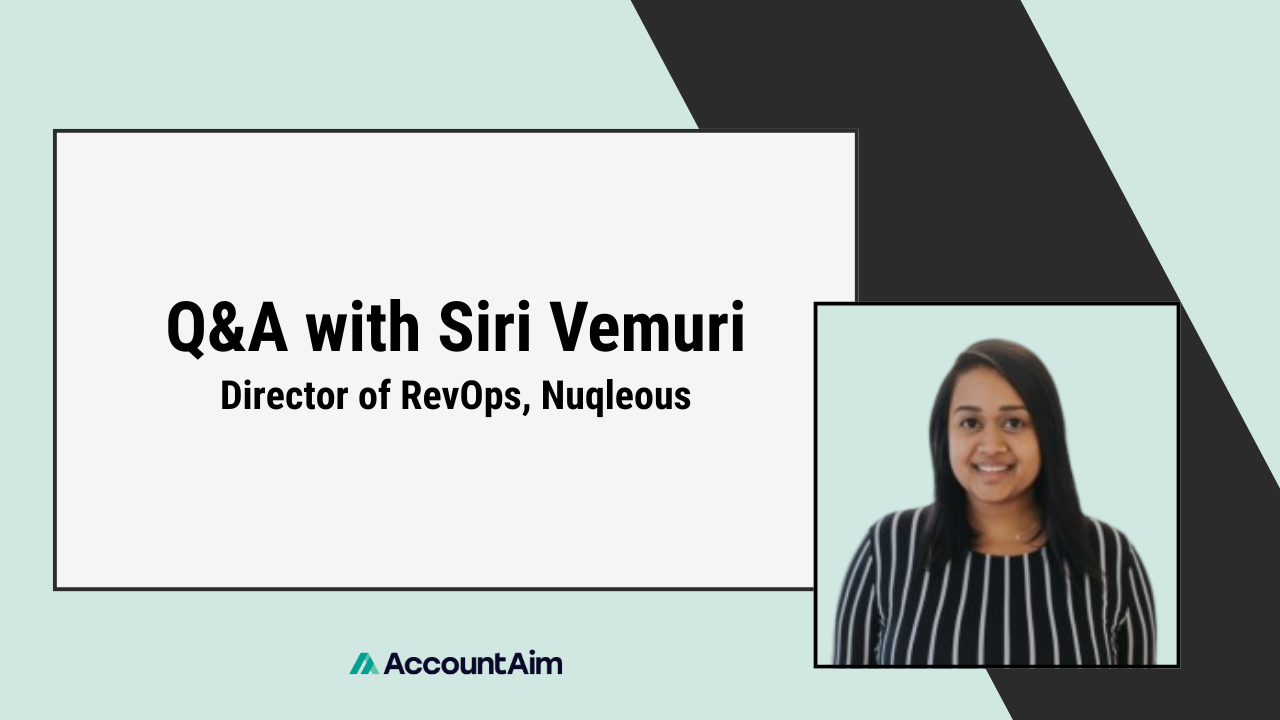

A conversation with Siri Vemuri, director of RevOps at Nuqleous
Siri Vemuri, director of RevOps at Nuqleous, believes that great operators earn their credibility by understanding what it actually takes to sell. Her philosophy is simple but bold: every RevOps leader should “run a deal” at least once. That firsthand experience, she says, separates theoretical strategy from operational empathy.
Siri has built her career at the intersection of data, systems, and go-to-market strategy. Before joining Nuqleous, she held roles across sales operations and business systems at several growth-stage SaaS companies, where she specialized in scaling processes for revenue teams. Her background gives her a unique mix of analytical rigor and frontline awareness, which shapes how she leads RevOps today.
Why every RevOps leader should “run a deal”
“It’s significantly harder to develop the structures and processes that we need to be successful in RevOps if you don’t know what’s going on, and the only way to really know what’s going on is to sit in their seat? Walk a mile in someone’s shoes.”
When you actually sit in the seller’s seat, you stop guessing about what’s broken. You see where the systems help and where they slow people down. That experience changes how you prioritize projects and conversations.
Our job is to make sales reps successful. RevOps isn’t successful if sales isn’t successful. So being able to walk a mile in their shoes, understand what they’re going through, develop that empathy for why it’s hard, that’s what you learn while you’re doing the job.
What running a deal taught me about system design
“I got lost because I was architecting to manage up and not to manage down. Some of the things that I designed worked really well for the PE reporting deck, but not quite as well for the rep perspective. Actually sitting in seat as a sales rep, updating opportunities, adding notes, I was able to refine it so it worked from all angles.”
When you’re building or refining Salesforce, you have to remember who’s living in it every day. Even small things like whether a field is inline editable can make or break adoption.
Don’t make decisions based on what is easier for you to output reports, without realizing that change might make it harder for reps. Flipping that makes a huge difference.
Managing up vs. managing down in RevOps
There’s a constant tension between designing for executives and designing for reps. Managing up means building the infrastructure that gives leadership confidence, clean data, consistent metrics, predictable reporting. Managing down means building something reps will actually use.
If your dashboards impress investors but your sellers avoid Salesforce, you haven’t built a functioning system. The best design happens when you bridge those two needs. Running a deal makes that balance obvious.
Why sales skills matter in RevOps leadership
“The skills that make really successful sales reps are the same skills that will elevate someone from being a good RevOps manager to a seat at the table with the executive team. It’s that ability to be curious, ask the right questions, and communicate in a way that people want to hear.”
If you want to be credible in leadership conversations, treat every interaction like a discovery call. Listen for what the business actually needs. Communicate your recommendations the way an AE builds a proposal, clear, confident, and grounded in evidence.
You’re selling ideas, change, and confidence all day long, whether to a CRO, a PE partner, or a frontline seller.
What private equity stakeholders actually care about
“They don’t care about CRM architecture, but they care about what the architecture is going to output. They care about win rates, competitors, timelines, how we’re going to get to this number, how confident we are in that plan, and how we’re mitigating risks.”
When you’re talking to PE stakeholders, lead with confidence in the plan, not the technical setup. They want clarity on execution, accountability, and risk. Everything else, the systems, the automations, the data quality, matters only in how it drives those outcomes.
How to build empathy and credibility as a RevOps leader
“Even if you’re not immediately jumping in to run a huge sales deal yourself, you can position it as sales enablement, shadow someone through the entire sales cycle, be on every call. You might not do the actual selling to start, but you can do everything else.”
If you want to build trust fast, start there. Observe every step of the process. Watch how sellers move from lead to close. You’ll start to see patterns and friction points that no dashboard will ever surface. Once you understand that lived experience, your recommendations carry more weight because you’ve felt the impact yourself.
Go Deeper
If you enjoyed this Q&A, check out the full conversation with Siri Vemuri at YouTube or Spotify.
About AccountAim
AccountAim is the planning and analytics platform built for Strategic RevOps teams. With AccountAim, RevOps teams connect all of their fragmented GTM data, automatically snapshot and see trended changes over time, and build full-funnel reporting — all without SQL or data team support. Learn how Strategic RevOps teams use AccountAim to streamline forecasting, territories, cross-sells and more here.
James Geyer: We are back for our latest episode of boardroom RevOps, where we’re bringing you valuable tips from RevOps experts so you can make it to the C-suite. I’m James, co-founder of AccountAim, the RevOps BI platform, and have a great guest today as Siri Vemuri joins to share a couple hot takes actually, and we’ll get into that.
But great to have you on Siri.
Siri Vemuri: Thanks James. Uh, happy to be here.
James Geyer: I I met Siri a few months ago and was super impressed from our conversation and just about her, like, breadth of scope of work in Nuqleous, really taken on a lot. I’m sure we’ll cover that. Um, but why don’t you just share a little bit more about your background so folks can kind of calibrate a little bit.
Siri Vemuri: Yeah. Um, so I am currently the director of RevOps at a SaaS company called Nuqleous. And I came into this position, probably a similar to a lot of people within RevOps where when I started my career, I had never heard the concept of RevOps, but I was working in operations at, uh, one of the largest banks in the country.
And I really loved the structure and process and things that I got to work on there, but I wanted to see what the small tech startup world was like. So then I actually switched over into a. So a sales role at a now PE-backed, but then pre that, then founder owned a tech company and that was about 20 million ARR when I joined.
And loved working in sales, loved being customer facing, working with people, solving problems, but really wanted to get back to my strategy ops role. And through that job discovered RevOps and it was the perfect combination of what I loved about sales and being able to utilize my sales experience and, uh, what I’d learned in seat there.
Along with everything that I had done in operations and strategy in the past, and kind of pairing those things together, plus our, at that time, the director of RevOps, uh, I think he was just getting annoyed of me saying, Hey, we should do this, we should do this, we should do this. And he was like, well, why don’t you just come work for me and do that?
James Geyer: That’s great. I think you actually teamed me up for our first topic, which is your hot take. Um, that every RevOps leader should run a deal. And so you, you said this to me in the past, like, why do you feel so strongly about this?
Siri Vemuri: Yes. So this is definitely a hot take that, um, I actually brought up at a RevOps, uh, networking event a couple days ago, and I didn’t realize how hot of a take this was.
So apologies to anybody who was offended, but in general, like, so this really came from the fact that it’s significantly harder to develop the structures and processes that we need to be successful in RevOps. And like overall from a managing management reporting structure, if you don’t know what’s going on and the only way to really know what’s going on is to sit in their seat, right?
Like walk a mile in someone’s shoes. So I think where I’ve seen a lot of tension and friction between RevOps and. Or sales ops or ops in general. And salespeople is always like, oh, well, salespeople, blah, blah, blah, blah, blah. Salespeople fill in the bank blank with whatever, you know, negative connotation you have there, but that’s just not necessarily true, right?
Like sure, there’s, I’m sure some set of salespeople who are genuinely not very good salespeople. A maj, they have a job at your company. You know, like you guys hired them for a reason, and our job is to make them successful, right? Like RevOps isn’t successful if sales isn’t successful. So being able to walk a mile in their shoes, understand what they’re going through, develop that understanding, empathy, all of that for why it’s hard, why they can’t necessarily update CRM five minutes after every call.
Why? There’s sometimes ambiguity with different sales stages. Why that path to partnership is a little bit too complicated for customers to understand, you know, why the pricing package is, uh, you know, more, needs, more nuance than what it currently has. Like, all of those kinds of things you learn while you’re doing the job.
So, uh, I think it, it, everybody should run a deal.
James Geyer: Yeah, that’s great. I think you touched on a lot of things. You’re kind of hoping to learn through that as well in terms of like a lot of the outputs. So I think if memory serves, you did this at Nuqleous, right? This is kind of where those hot take came from.
So I think again, if, if I’m remembering correctly from our past conversation, you’d kind of already built like a lot of RevOps infrastructure at this point. Like what changed once you kind of started, you know, ran a couple deals at Nuqleous, like you mentioned a few learnings you had, but then like how did you take that to your RevOps role and and make changes?
Siri Vemuri: Yeah, absolutely. We had, so I, I, I had stood up, um, a lot of the, the RevOps functionality already, but there was a lot of, I wanna say like maybe nuance that I was missing. So for one example would be our CRM. So when I joined Nuqleous, uh, one of the first things that I did was, uh, stand up Salesforce. So. We had, uh, HubSpot as our CRM, that’s also another hot take switching from HubSpot to Salesforce.
But that was the, it, it is the right move for, for where we are as a company. And going through that process, I had a lot of ideas. Like I came from PE backed, uh, SaaS company. Um, I worked at, you know, these like large enterprise companies, so had a lot of ideas about how Salesforce needed to function. Um, to basically be able to output what I knew a PE company would ask for.
So like working backwards from like, Hey, this is generally the monthly reporting deck that I’m gonna need to do. Wasn’t sure which PE firm we’d be working with at that point, but in general, you know, they kind of ask very similar things. So how am I architecting for that? But where I kind of got lost was that I was architecting to manage up and not to manage down.
Yeah. And so some of the things that I had designed worked really well for being able to output that, you know, PE reporting deck and not quite as well for the rep perspective. And so, um, actually sitting in seat and actually going through the process as a sales rep, updating the opportunities, added in my notes, et cetera, uh, I was able to take, you know, an already good process.
And really refine it so that it worked from all angles, uh, instead of, you know, being more for one side or the other.
James Geyer: That’s great. Maybe there’s one or two specific examples of like the difference between managing the CRM and RevOps infrastructure for managing up versus down, or if there’s not a couple examples, like, I’d just be curious to hear your mental model for the goals of managing up versus managing.
Siri Vemuri: Yeah, absolutely. Let me start with the goals maybe. So the goals for, for managing up really is around those value-based metrics, right? So like what are the things that people need to know to understand the trending of the business, not just the results, but like, are we trending the right way or the wrong way?
Um, and then also what you as the RevOps person who understands the data and the structure, et cetera. I think are the most important to focus on, to fix, to change those trends. So like pretty macro level things, right? Like the, this is the trend and these are the items that I think we need to focus on to fix it.
So that is like a very macro perspective in terms of the decision making. The reps are in a very micro focus, like they care about their one deal that they wanna close this week, or you know, maybe five or so, but still like a. Significantly smaller portion, but they’re the ones that are actually updating every individual field.
So even very, very minute. Things like in Salesforce, some field, some field types are in line editable and some field types are not in line editable. And I had made some decisions on the type of field that I was using based on what was easier for me to output the reporting because I was like, Hey, I want it to look in this certain form, so I’m gonna make this field this type.
Without thinking through the fact that if I make it this type, then it’s no longer in a in line edible for a rep when they are looking at it in a list view or report view. Um, so flipping that and saying like, okay, I understand that, you know, we ask a lot of our reps and the goal is really to get the best data that we can out of them, right?
And to get the best data that we need out of them, we have to make it as easy as possible for them. So, you know, I feel like it sounds kind of silly to like be talking about inline editable fields this much, but it made a huge difference. Right? Yeah, it makes sense. Yeah. I’m happier. My VP of sales was happier.
Um, and I was happier and my leadership was happier ’cause they’re getting better data. So that’s like an example of kind of how I designed for up versus down.
James Geyer: Yeah, it’s a really good one. It’s funny, they’re like, the two things are so at odds. I feel like when you’re preparing board metrics, especially for sophisticated PE owners, they want a ton of detail, a ton of data points, but then the sellers like, you gotta streamline that as much as possible.
And it’s, it really is a friction point because like the board is obviously steering, you know, helps steer the future of the company, but like these sales reps need to execute and hit plan today. So, um, I don’t know if that trade off will ever go away, but definitely a tough one. Um,
Siri Vemuri: yeah, absolutely. And I think you used the term friction point and it, there is friction there, but I think.
Our job as RevOps is really to reduce that friction, right? Like we’re the, we’re the glue, the touchpoint insert word that reduces friction. Um, and these kind of like little changes, I think add a lot of value to show the reps that like, hey. We’re on your side.
James Geyer: I think that goes a long way for sure.
Anything else Siri to say around like empathy towards sales after stepping in and running a deal, like I’ve actually felt this as someone that came from finance operations background now doing sales as founder of AccountAim. Yeah. I have so much more empathy for sales generally, and I could go on and on about it, but I’m curious like where, what you kind of feel in that regard.
Like any specific points that you really like, empathize with reps more on.
Siri Vemuri: Yeah, absolutely. I think people get a lot, get focused on how rep, how reps get all the glory. You know? It’s like, okay, you win a deal and like the sales rep, they get this commission check and they get like the shout out on the company, slack channel, town halls, whatever.
But they also bear a lot of the brunt, you know, like when you’re not doing well, like they’re getting hammered by the VP of sales or CRO, depending on the size of your company. It is a very stressful role to have, you know, like a sort of like hanging over you at all times with your quota and that structure, like that incentive, good or bad, is gonna change people’s behavior.
Right? And we all know that also as RevOps, we’re constantly using comp plans to change people’s behavior. But I think really understanding that that is a stressful position to be in, to never really have like a hundred percent job security, you know, is, uh. That’s just a, that’s just a tough place to be.
So we gotta be a, you know, bring a little kindness to our roles and our interactions with people.
James Geyer: Yeah. This is great. I think a lot of good takeaways for supporting your hot take of that everyone in RevOps should run a deal. Here’s the tactical question and Oh, I see. You might have something. Sorry,
Siri Vemuri: one more comment on that front.
The other like kind of hot side of why I think it is. Why you should do it. So this is like for the company, right? Like you should run a deal so you see the sales rep’s perspective so you can do better for your business. My other flip side of that is that maybe also a hot take, but the skills that make a very, very good successful sales reps are the same skills that will elevate someone from being a good RevOps analyst, manager, et cetera, to a seat at the table with the executive team.
So it’s that ability to be curious, ask the right questions, like understand, you know, what your, your prospect’s problems are. How to connect the dots of like how you can solve that problem, that ability to communicate succinctly in a way that’s go, that’s approachable, that they want to hear from all of that, just general presentation and like personableness, like those are all of the same skills that are gonna take you from just being like.
Somebody who spends all day in Excel to somebody who is taking the value out of what you found in Excel and presenting solutions to your C-suite, your board, your PE firm, whomever.
James Geyer: I think that’s so spot on. I think discover, like doing discovery of your own users is, is a huge thing. But also, well, I kind of think of three things and then probably just repeating what you just said, but I just agree so much discovery to understand what actually needs to happen.
Actually figuring out what people really need, not what they say they need, but then also like. Redirecting folks when there’s like an endless amount of requests, right? It’s kind of like being in the sales, or like solutions engineering seat as well. It’s like we can’t exactly do that, but we’re gonna work our way around it, either with something else or maybe with a little smooth talking as well.
Siri Vemuri: Yeah, yeah. Or like, you know, we’re gonna put on our roadmap and like, let’s figure out our 3, 6, 9, 12 month strategy. Like, how are we gonna be partners for the next five years instead of the next five weeks, you know? Like all of that. So yeah, absolutely. So I think that’s like the, I don’t wanna say selfish, but like more the personal development side of it as well.
If you run deals and you get good at those skill sets, you’re gonna be good on either side.
James Geyer: Yeah. Last thing on, on this topic, someone you know, maybe listening and maybe they’re. Either scared away from this completely, or maybe they’re totally bought in and they want to go do this. Like I think you might be, uh, it might be easier for you because you do have sales background previously.
How can someone in RevOps like actually get permission to run a deal? Like what worked for you?
Siri Vemuri: Yeah, absolutely. Um, when I took my three, whenever I took my first sales role, I had never actually worked in sales before, right? Like I had was coming out of operations at. I think, um, yeah, at, at a te a, a finance company, the way that I approached this role and getting into that position for the first time was really around how all of your interactions are sales.
So I was like, okay, so maybe I haven’t carried a quota, but I worked directly with X, Y, and Z stakeholders and I got their buy-in in these kinds of ways, and I’m good at that because of blah, blah, blah, blah, blah. So I think it’s really like back to what we were saying, you know, it’s kind of both sides of the coin.
Of how do you describe to other pe whoever you’re asking for authority from, whether it’s you know, your CRO, your CO, your VP of sales, but tell, like explaining to that person how you already are in a sales position so they can trust you because of the interactions that hopefully they’ve had with you.
And you can say like, Hey, you’re my stakeholder and this is how, you know, our relationship has gone. Let me go do that elsewhere. Um, and I also think it’s a great opportunity to shadow. So even if you’re not immediately jumping in to run like a huge sales deal yourself, you can also position it as sales enablement.
So, hey, I want to shadow this person through the entire sales cycle beyond every single call because it’s also a coaching opportunity. It’s also a sales enablement opportunity, and it. You know, I’m gonna use it from this enablement perspective. So I think that’s another like kind of mini way to step your way in there.
James Geyer: Yeah, I love that. And you could also even take on, like you unsexy does this filling in the CRM for the rep after. So you might not do the actual selling to start, but you can do everything else. Right?
Siri Vemuri: Exactly.
James Geyer: That’s great. Um, I wanna switch gears a little bit. You made a couple references to I’m working for PE backed companies also getting a seat at the table.
I was super impressed when I heard, um, in your roles that you have. Had a literal seat to the table with these investors, like the vistas of the world, the Great Hills and firms as well. Which for, if folks aren’t familiar because are very good, sophisticated investors. Um, I feel like it’s unusual for someone in RevOps to literally have a seat at the table with the investors.
Like, how did this come about for you?
Siri Vemuri: Yeah, absolutely. It’s definitely one that they believed in my skillset, my leadership believed in my skillset because they knew they could put me in front of these people. Um, because I had come from a sales background and could carry myself, et cetera, all pats are like really re leading back their teams, you know, having, having that skills that already helped, but really being the person who could answer questions.
So being so, uh, connected to the data that I was able to build the trust with them where it was like, Hey, this question might come up, or they might. Wanna know more about X, y, and Z deal, or this strategy, or how we’re doing in this area, and, uh, having, developing the trust that I could answer those questions because I am the person who was in the data every single day, own the spreadsheets, own the pipelines, own the forecast, et cetera, and really understood what the data was saying.
James Geyer: That’s great. I think it’s a great case study for, we talk about it AccountAim a lot ’cause we’re a data analytics solution. Is that like, if you can master the data as a RevOps person, like that is the unlock for your career because people now come to you for questions. You naturally get brought into these big, hairy, uh, discussions and strategic conversations because they really need your input on it.
Versus if you are more passive and are just taking in tickets and you’re actually thinking about the data, bringing things up proactively, people don’t feel that as well. So I think it’s, it’s great to hear this working out in practice. So you’re in these meetings, you have a seat at the table, like what do PE firms actually care about?
And we can take this more broadly too, like, you know, what are they digging in on? Like, what are the conversations like? Surely it’s not about CRM architecture.
Siri Vemuri: No, they don’t think they care about CRM architecture, but they do care about what the CRM architecture is gonna output, right? So they care about, you know, they care about win rates, they care about your competitors, they care about, uh, timeline.
All of those things that is directly tied to your CRM architecture, um, even though they’re not necessarily thinking about it. So I think what in my experience, PE firms care about is one, how are we going to get to this number, whatever that, you know, quarterly, annual, however your business looks at it.
But what is the plan for us to get there? How confident are we in that plan and what are we doing to mitigate all the risks to that plan? So at the end of the day, like that’s what everything bubbles down to. And your CRM architecture, your win rates, your competitors, those are all components. But at the end of the day, it’s like your ability to take those little things and connect it back to that.
Like big goal that the PE firm cares about.
James Geyer: Yeah, it makes a lot of sense. They have a five to seven year hold period, and then each of course, you know, a quarter and year leading up to that is, is all in pursuit of, you know, that that exit for them to make exactly money. So it makes sense. You know, you talked about needing to own the data to understand this like.
How did you prepare for these meetings? Was it that you were in the data enough that you already kind of had it or was there, you know, something you did to just feel like you were really ready for these big conversations?
Siri Vemuri: Yeah, that’s a great question. I think in, so I’m currently working with my third PE firm, and I think one thing that I’ve learned is that they’re all different.
They all have that big number that they care about, and I think what I just summed up about, they all care about how you’re gonna hit that number is the same, but preparing for each of them has been very different. The best way to prepare for it I definitely do think is being in the data. So understanding down to the very micro level of how long has X deal been in the pipeline for at certain stages really lets you be a lot more, more prepared, especially when you don’t know the PE firm that well yet.
You know, like once you develop your relationships and you have a good understanding, it’s a very different process, but when you’re still trying to. You know, feel each other out and like, understand kind of what your role is. Knowing everything in the weeds is really helpful.
James Geyer: Yeah. Um, sadly we’re at time or close to time, Siri, like anything else to be said around working with PE firms, getting a seat at the table, like anything I should have asked or advice you’d have for folks as they think about preparing for this?
Siri Vemuri: Yeah, so I think one thing that people should feel really good about is that, you know, when I was going through this process with our, our recent liquidity event, every firm that we talked to. Every firm that we talked to made a comment at some point in the processing along the lines of that they were so impressed that we already had, uh, RevOps in house.
And they’re like, that’s one of the first things that we do when, usually when we’re coming into a company your size is to implement RevOps and, and hire that role and start building out the function. So, um, yeah, I think everybody should feel really like, good about being in this position and in this seat because it is one that is very valued by those firms.
So, and obviously it’s never too early to start RevOps function either. So for, you know, other kind of people out there, like, it was definitely part of the conversations of why these specific firms were speaking to us and, and eventually where we, we had our liquidity event.
James Geyer: That’s great. I think RevOps is, is here now.
I think people finally realize the value, like these are, you know, firms that are very cost conscious, um, you know, very smart about what it takes to run a business well, and this is one of the first investments they’re making. I think it’s just a matter of time until everyone starts to understand this as well.
Siri Vemuri: Exactly. And you know this like Yeah. With my third PE firm now, and one of the first expenses that they approved literally within two weeks of being on was more resources for me within the RevOps space. So that. You know, along with the balancing it with sales and CS and other functions, it wasn’t part of their initial strategy.
But when they came on, they were, and I was able to present my case, then they very quickly agreed that to, to invest in it. So, um, I think as long as you can’t come to the table prepared with that, that data, with the ability to succinctly and in a value driven way present your case is definitely room to, to grow.
James Geyer: That’s great. A great place to leave it. Uh, Siri, thanks so much for hanging out with me today. It was really fun. I appreciate you coming on.
Siri Vemuri: Yeah, absolutely. Thank you for the time. I appreciate it.