
Using data to maximize your valuation
Too many agency leaders are still running on gutfeel. And they leave EBITDA on the table.
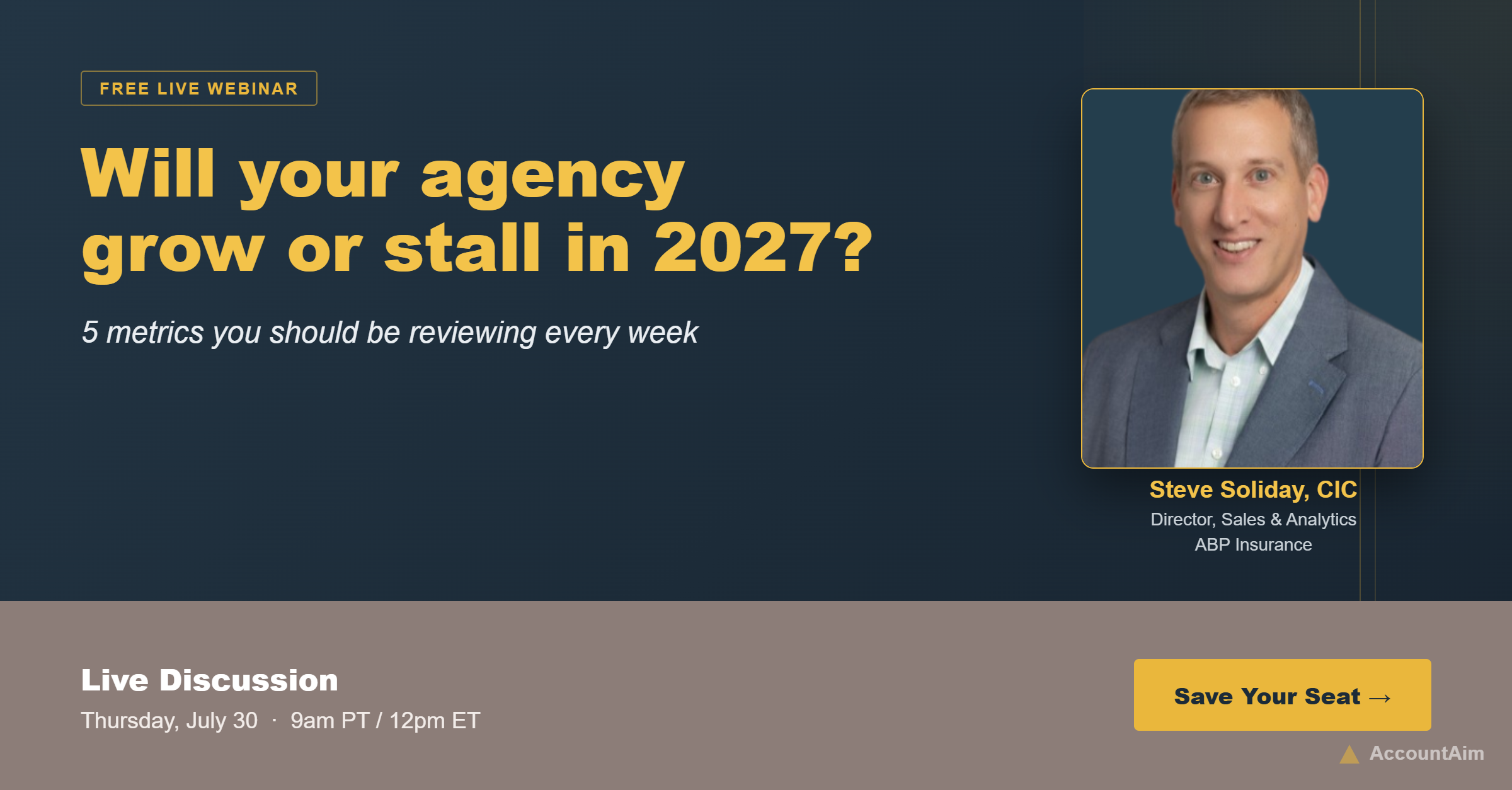
In this webinar, James Geter (co-founder of AccountAim) sits down with Steve Soliday from ABP Insurance Agency, a P&C shop in Fairfax, VA, to break down how agency leaders can diagnose and improve their growth well ahead of year-end.
Steve is a rare hybrid. He’s got 21 years in insurance with both a sales title and an analytics title, spanning agency and carrier sides. He shares the exact metrics his agency uses to drive the business to greater profitability.
The 5 metrics they cover:
- Revenue growth: why it’s your foundation for strategy
- Policy retention: the “house money” that makes or breaks an agency, especially heading into a softening market
- Weighted premium opportunity: the best lever for forecasting whether you’ll hit your number this year
- Policies per new business customer vs. policies per customer: the leading indicator diagnosing your retention rate
- Policy mix over time: how to have better conversations with producers about what they’re actually writing
Also in this episode:
- Why a “number two producer” in premium can be a “number six” in revenue, and how that changes comp conversations
- The double whammy that hits agencies who ignore retention when the market turns
- Building a data lake: APIs vs. report-pulling, and why it opens up vendor options you’d otherwise have shut the door on
- Redeploying your commissions person toward claims tracking and contingency planning
- Coaching producers to round accounts (the realtor with a home-heavy book problem)
If growth is top of mind, you’ll want to listen to this.
Guest: Steve Soliday, Director of Sales and Analytics at ABP Insurance
all right, we got some folks trickled in, so maybe we get started here. I’m sure some more will join us. Um, great to have you guys. I’m excited to have you here, Steve. So funny thing about insurance agencies, uh, I think a lot of people will describe them as kind of data rich but actually insight poor.
Um, you know, the data models from existing systems are challenging, the data model of the policy is challenging, and you have to deal with manual carrier statements which are never nice and clean. Uh, trouble getting things in and out of siloed systems. All of this stuff leaves agency leaders and owners to often run on gut feel.
, But you know, I think most people would agree they should be using metrics to understand and drive your growth. And so today we’re going to chat with a forward-thinking agency leader in Steve on how to do this. So real quick intros. I’m James Geier. I’m the co-founder of AccountAim. We do commission intelligence and revenue visibility for agencies and MGAs.
So take the manual process of commissions, automate it, provide a whole lot of revenue visibility in the meantime, so leaders can kind of drive their agency strategically. Um, so that’s us in a nutshell, but I’m the less important one here. Steve, it’s great to have you. Do you want to share your kind of quick background for folks?
Yeah, sure. So I’m twenty one years, I think, in the, uh, industry now. Uh, about half of it on the agency side, the other half on the carrier side with different roles in underwriting and, um, as a field rep, managing field reps and as a project manager working with, uh, analysts and, uh, sales force people. So yeah, pretty, pretty well-rounded, kind of seen a lot of different things.
Uh, we’re, we’re ABP Insurance Agency. We’re primarily a property casualty agency. We’re located in Fairfax, Virginia, and collectively we speak nine languages to serve the, the folks in the area. That’s awesome. I love that. Uh, the team over at ABP is great too. It’s been really fun working with you guys. Um, Steve, you’re a little bit of a unicorn or a purple squirrel, as they say in kind of like recruiting.
You’ve got sales in your title and you also have analytics in your title at ABP. Like how did you get here? How do you balance these two responsibilities? Yeah. So how did I get here? So I was, uh, I majored in information systems in college, right? So I’ve got that background back in the late nineties working in, uh, Microsoft Access and learning all the da-database management and stuff like that.
Then kind of just getting away from it, right? Of course, like before I got insurance, I was coaching college tennis, right, which is completely unrelated, but that’s how everybody lands in insurance is through some conversation somewhere. Um, so j- to say that, just to say that I’ve never actually had this in my title before, but at each stop along the journey that I’ve had, I’ve always had some sort of like data thing because I’ve had the skill set.
So I’ve always done something at each different role to help things out. And actually, um, when working for one of the big national carriers and working with the analysts, when they didn’t have time to do stuff, I would kind of just pick it up and do it and be like, “Here, is it– Does this work?” And they would take it and clean it up a little bit and, and publish the work and do things like that.
But also, um, jumped into the industry as a completely green commercial producer and having to learn the business. So produced for ten years and ended up, um, moving with my, my wife To a different area. And instead of starting over from scratch, we j- I jumped over to the carrier side. I did underwriting. I did all kinds of different stuff.
So yeah, I mean, it, that’s how I ended up here with the data background and the sales background. I can kind of do either. And at this point now, how do I balance them? Well, I’m not really expected to make… You know, to do production. I kind of, I mentor the staff. I help them with commercial placements, um, how to write things and make sure they’re done properly.
And then when there’s spare time, I jump in and I do analytics, right? That’s kind of how I fill the gaps in. So if, if I get a referral from one of my networking partners and says, “Hey, they really want y- you to work on this,” I’m like, “Okay, I’ll work on it. I’ll do it myself.” And then as time allows, I jump in and I do the analytics, which a lot of times is at night when the kids are doing activities and stuff.
So that’s the balance. Yeah. Makes sense. Uh, that’s awesome. Um, well, let’s, let’s get into it. I’d love to actually get your perspective on kind of the state of play for data analytics at agencies. I kind of gave my spiel around, you know, data rich, insight poor. A lot of agencies, particularly in kind of like the mid-market, smaller end, not having good data hygiene and cleanliness.
Like, what’s your view on this? Like, uh, why is it so important to be data-driven in an insurance agency? Why, why do folks challenge this? Like, what have you seen out there? Yeah, I mean, there’s all kinds of challenges that we have, right? ‘Cause you’re, you’re kind of a lot of, like you said, small and mid-sized agencies.
We’re kind of stuck with what we have in our agency management systems. And you mentioned silos earlier, right? And that’s a big silo. And if you want to integrate any kind of technology into what you’re doing, um, y- you’re, you’re stuck working directly with the vendor and trying to get the two vendors to work with each other to get information either in or out or whatever you’re trying to do.
Um, and, and it’s, and it’s a big challenge for agencies to do that Yeah, definitely. And then what do you think, like, an agency loses when they don’t have this kind of all, like, stood up? Like, they don’t, they don’t have a lot of these metrics. Yeah. You’re guessing, right? Uh, so let’s say you’re having a meeting with one of your producers, and the producer comes in and says, “Hey, you know, I, I, it, it really helped me feel a little bit more comfortable.
Like, I have a little bump in my base salary.” And you’re sitting there, and you’re … In your head you’re like, “Okay, this is my second … number two producer in the agency,” right? And you kinda know that they write a lot of non-standard auto, and they write some surplus lines. And if, if you don’t have the data in front of you to know what revenue they’re generating, guess what?
It turns out they’re, they’re number two in the agency in terms of production, but they’re number six in the agency in terms of revenue, and they’re not really bringing in … You know, they’re, they’re … You’re making money off of them, but you’re not making the kind of money you’re making off of the number one and the number three producer, right?
Mm-hmm. Mm-hmm. So without that, that revenue tied to the producer and their book of business and their mix of business, you’re, you’re, you’re guessing. Yeah, and I think that leads to, like, performance management too. Like, if this is actually a really capable producer, like, maybe they don’t know or they haven’t been told what to kind of focus on, and maybe you can use this data to actually get them to be number one, and then you can bump their base salary and everyone wins, right?
Yeah. Absolutely. They could be just, you know, taking orders, and, and the orders that they’re taking are for, you know, the non-standard stuff, ’cause that’s just like if people keep referring them to that, and they’re like, “Hey, we, we need to … L- let’s try to, let’s try to turn the story here a little bit, and let’s try to get you to, to
into different things that are paying more and making you money and, and helping everybody,” like you said. Yeah. That’s great. Well, I think one of the challenges, um, and when I chat with folks in the market, is around, like, where do I start? So some agency owners will be like, “Yeah, you know, I know I need to be a bit more data-driven, um, but I don’t know how to do it.
I don’t even know which metrics to look at. It feels really overwhelming, so I just don’t change.” And so Steve, I asked you for today to think about, like, if we were just starting with, like, the five most important metrics in your experience for folks to look at, um, what would they be? And you kindly, you know, came up with these five here, which I think I, I wanna just dive right into.
And so I’ll just kind of say them real quick. Um, it kind of goes from top to bottom. So we have revenue growth, policy retention, weighted premium opportunity, uh, policies per new business customer versus policies per customer, and policy mix over time. So all these together are a mouthful, and we’ll kind of take them one by one.
Um, maybe let’s just start with what’s probably the most obvious one, but just, like, revenue growth. Would love to get your perspective, Steve, on kind of like why this is so important to, to look at. Yeah. So, um- revenue, right? Everybody’s got revenue somehow because you have to pay your staff. You have to, you have to pay the producers.
So at some level you’ve, you’ve calculated the revenue to the agency. You’ve got the statements that came in, and yeah, I guess you probably put them in a spreadsheet or however you’re tracking them. You’ve got the revenue number. I think a lot of times the, the, the thing is when you look at it you’re like, “How are we, how are we doing versus last year?”
Like, “Oh, let me go grab last year’s spreadsheet. Let me, let me pull that out and see how we’re doing.” And it’s not… It, it’s, at least for us, it was super segmented where if, if I wanna know how we’re doing year over year I gotta find that spreadsheet, and maybe we changed the spreadsheet a little bit from last year to this year and now it doesn’t really make sense the same way.
Having… So we, we’ve gotten a little bit, full disclosure, we’ve gotten a little bit of, uh, of our revenue data standardized from AccountAim, and I started playing around with it and it’s fantastic to be able to be able to go back, and I can sort it by month and look at different things. I can attach it to the producers.
I can look at, you know, how much revenue they’re generating. The, the, the difference, and we’re just at the very starting point of this, is gonna be dramatic ’cause it’s gonna give us a lot of, um, insight into what each person’s doing, what it’s doing by line of business, what it’s doing standard versus non-standard auto, things like that.
So it’s, I mean, it’s, it’s really gonna be a game changer for us. Yeah. I think some people think of revenue as, like, the output, and it is. Like, it’s a lagging indicator, right? But it’s also the foundation for how do I make strategic decisions in my business, or where do I point resources in a certain direction or understand kind of, like, how we’re tracking.
I think you put that, that really well. Um, tell, tell me a little bit, Steve, how do you think about contingent commission, supplemental commissions as it relates to kind of like revenue reporting? Is there anything important to, to think about there? Yeah. Well, we don’t include it . So it, it, you don’t know if you’re gonna get it, right?
You don’t know in e- November, December if you’re gonna get it for sure maybe, ’cause it depends on when the books close for each carrier. But if you’re, if you’re counting on that- That’s a dangerous spot to be in, right? You need to … Your agency needs to be profitable on the revenue that’s generated by the commissions alone, and then anything else that comes in, well, you either take that out of the business or you reinvest it in the business, and that’s your decision.
But you’ve, uh, hopefully nobody’s looking at the contingencies and, and they have to have them in order to continue operating. Yeah, it’s a little scary. Yeah. Um, the last thing I’ll say on revenue growth too, and it actually is a, is a comment that fits all of these metrics, but, like, you know, a lot of agency owners are looking for their business to be acquired or they’re getting older and they wanna think through, like, perpetuation.
I think, like, being able to show this great historical information that’s, uh, segmentable by, you know, carrier, by producer, goes a long way in building trust with your acquirer or even just your valuation in terms of how folks- Mm-hmm … can actually kind of underwrite the business. So I think that’s really important there too.
Yeah, absolutely. Um, let’s move on. So that’s revenue growth. Uh, policy retention. There’s kind of a few flavors of this. So talk, talk to me here how you think about policy retention. Yeah. So that’s how a, an agency makes money off of the retention, right? ‘Cause most agencies are paying more for the new business than they are for the renewals, and the renewals are the house money, right?
So if, if you’re not … I- I- if, if the retention is bad, then the money’s going out the door, right? You’re bringing it in and you’re paying the producer, and then you’re losing it in year two or three. It’s not, it’s not a great way to build a, um, to build the agency revenue. But also we gotta look at, you know, i- if you’re just looking at the premium dollars and somebody comes into your door and says, “Hey, how’s, how’s your agency doing?”
Like, “Oh, we’re doing great. We’re growing. Like, premium’s up, revenue’s up, everything’s great.” But then on the back end, say you’re coming out of a hard market and your premium’s been going up and your revenue’s been going up, but then on the back end you weren’t watching that policy retention, and the policy- Mm
retention is slipping. And then all of a sudden the market turns and now s- soft market- Your, your retention continues to drop, right? And you’re getting the double whammy because now you’re, you’re remarketing accounts, you’re renewing them for less, and now that’s hitting you twice. And now you went from growing to shrinking at a very rapid rate because you weren’t keeping your eye on the policy retention.
‘Cause you could have, if you were watching that, make some strategic changes to try to level that off a little bit. That’s great. How do you think about, like, the definition of policy retention? And maybe not in, you know, a granular Excel formula detail, but, like- … how, how do you think about it conceptually?
Yeah. So you’re looking at what you, what you have on the books today minus the new business divided by the prior year, right? So you’re just … You’re, you’re comparing it to the last year but, like, getting rid of the new business. Yeah. Got it. Okay, cool. So it’s, yeah, when, uh, the, the percentage of policies up for renewal that, that do renew is kind of how I think about it at
a high level. Yeah. Mm-hmm. Yep. That’s, that’s great. Um, tell me more. You ment- you mentioned, like, being able to make some, some changes. Like, what are those changes if you do see it dipping? Is it, is it mix of type of business like we kind of just talked about, or is it something else? Yeah. No, so it totally could be.
If we’re talking specifically about policy retention, maybe it’s account round. But again, that’s gonna hit new business. But it’s al- what el- what else we’ve done in our agency is take a, um … We have a team that is keeping an eye on a report, that it’s actually in our management system, that shows when the renewals come in and the increase in premium, and we’re pulling those things out early, and we’re remarketing them proactively to- Mm
try to retain that business. So yeah, maybe, maybe you do renew it for a little bit less, but you renewed it and you kept it. And a lot of times these could be house accounts, and if they’re house accounts, you’re, you’re keeping 100% of the money in the agency, and you’re able to level that off a little bit.
But if you’re not, if you’re not watching it and you’re not being proactive, then it just keeps getting worse. 100%, love that. Okay, cool. So I think of revenue growth as kind of a, an output, almost like a trailing indicator. Policy retention technically also is, but I also view it as, like, a leading indicator, as you, like, put really well, as, like, you can kind of start to, uh, forecast the future a bit more from a profit perspective for the business.
Another kind of forward-looking metric we have here is weighted premium opportunity, and I think, uh, the first two people probably recognize. Not everyone will maybe understand this phrase, so kinda walk me through what this is. Yeah. So this is the premium dollars that you have, so in the, in the pipeline, right?
So it depends. Each agency works a little bit differently. Uh, I, I think the best way to work is when an opportunity comes in, you have them key it into a CRM or your agency management system. I agree. And at that point they’re putting in, like, a likelihood of being able to close this account and a rough estimate of the premium, right?
So you take that … You, you have that premium that’s in there, and you can forecast it out and see what’s, what’s hanging out there, and you can multiply it times the probability of close, either that the producer estimated or you can use historicals. Or if you don’t have historicals, just Google it and, and p- pick a close ratio.
Get, get, get something- Mm-hmm … so that you have some sort of weighted premium that is out there in the future. And if you’re watching this over time and that starts to slip, and you’re looking at it and it’s the middle of the summer, maybe you can explain it away and say, “Well, so-and-so’s on vacation,” or, like, a lot of the customers are on vacation, or, or whatever’s going on.
But then you can compare that to the, the year before and go, “Wait a minute. No, actually, actually, we are down year over year. What’s going on?” And trying to find out what it is and, and, and steer the ship a different way. Yeah. This is kind of like … I think you … It’s actually a great metaphor, steering the ship.
Like, this is, like, the best lever for are we gonna hit our number in this calendar year, right? ‘Cause we can actually see what’s, like, in the pipeline versus historically and how it converts and kind of, like, you can actually calculate the delta. So if we have, uh, our current revenue base, we have what we believe to be our retention rate for existing policies that are kind of up for renewal this year, and then we also have our weighted new business premium opportunity with, you know, historical close rates, that pretty much builds you your number for the year.
I think it’s a really powerful tool. It sure does, but you’ve also gotta keep an eye on, like, hey, is there a whale in there? And somebody’s got a- Mm … somebody’s working on a half a million dollar account, and they put in there that they’re 90% confident they’re gonna close this thing ’cause it’s a personal friend of theirs and blah blah blah.
Uh, you gotta, you gotta be careful with that because if you’re, uh, that’s a lot of eggs in one basket, right? And if that one doesn’t come through, then you’ve gotta see what else is in there, and you throw out the outliers or whatever you’re gonna do to, to see, to see where you’re gonna land. Totally, but it’s great for resource management too, ’cause if you do have a whale, I’m putting the, the CEO of the agency, like, in those meetings too, right, to try and reduce all risk.
Yeah. Okay, awesome. Th- that’s a really great kind of like formula to, to understand if you’re going to grow or shrink in 2027, which is kind of the whole, the whole name of this webinar. Um, let’s move into, like, these next couple. I, I would call these, I would bucket these under, like, account health broadly.
Yeah. So talk to me about policies. It’s kind of two metrics as a comparison. Policies per new business customer versus policies per customer. Yeah, so policies per customer, you know, it, it, you want your accounts to be rounded, right? Everybody knows that if you write two, three, four lines of business for, uh, for an account, they’re stickier, right?
You don’t have, you don’t have an agent who’s not in your office writing the home, and you’re writing the auto, and they’re calling and the customer walks away, right? It’s a, it’s an uninteresting, I don’t think that’s a word, number to look at on a report because it doesn’t change that much, especially if you have thousands of policies on the book.
I, I could tell you, it’s like, it, it’ll say the same number every single day when you bring it up. So by itself it’s not that interesting. But let’s say you have a, a, um, a goal of increasing that and you’re telling all the producers, like, “Hey, look, I want you writing rounded accounts.” And sure, somebody’s gonna call in and say, “Hey, I need a GL policy for my contracting business so I can get paid at the end of the week,” right?
And that’s all they’re gonna buy no matter what you do. You might as well write it, and you got one line of business on the books. But if you’re, if you’re trying to track, especially like personal lines, right, are we, are we writing rounded accounts, which I guess in a, in a personal lines is gonna be two, right?
Maybe it’s three with the umbrella, but you want it to be around two. And then on commercial lines, you wanna write two to three lines of business. Um, four is fully rounded, right? And so if you’re looking at the policies that you’ve written on new customers, you can see if you’re trending in the right way, right?
Mm-hmm. ‘Cause that, again, that cus- policy per customer is not gonna change, but if you’re looking at your new business, you want that number to be higher if that is what you’ve set out as your mission is to increase the, the, the number that you’re writing on the front end. Yeah. This is so good. It’s like a, it’s a chain here.
Now I’m thinking how I want to rearchitect this slide on the screen. It’s like, okay, policy retention numbers are kind of forward-looking for how we’re going to build profit in the future, but this policy per new business customer is actually a leading indicator for policy retention because the more rounded the account is, uh, the more likely it is to renew, right?
And so this to me is like the operational cadence of how do I view this and make sure that I’m actually moving this number in the right direction to ultimately move this number in profit. So it’s pretty, pretty cool how it all kind of fits together. Yeah. S- uh, last one here, and I think it’s kind of similar in flavor to think about profit, but policy mix over time.
Yeah. So again, you’ve got, you’ve got personal versus commercial. You’ve got standard versus non-standard personal auto. You’ve got admitted versus non-admitted. You’ve got line of- lines of business for commercial. You’ve got premium and revenue by industry. So there’s so many different ways to look at this policy mix over time.
But you attach that to revenue, right? And you look at it by personal versus commercial. Like how much, you know, excuse me, percent of revenue or however you want to look at it, personal versus commercial. And sitting with that producer that you were talk- we were talking about earlier, where they’re writing a lot of non-standard auto and showing them like, “Look, your book is 67%, your personal lines book, non-standard auto, and here’s the rate you’re writing, and here’s what the agency average is, here’s what the industry average is.”
And y- you can have more intelligent conversations about it, but being able to see the revenue that’s, that’s coming into the business based on that mix is, is a very powerful number I love it. Um, this is great. I wanna move on to kind of like, uh, getting to these numbers, like tactically. But anything else to add, Steve?
I feel like we covered it pretty well, but anything else to add here on like the metrics that are kind of important here, or do you think we covered it pretty well? Yeah, I think those five’s pretty well. I mean, there’s other things that we track in the agency. We have a report that we call the 12 box, and we’ve got 12 metrics on it that we kinda watch every day, and, you know, the- there’s, there’s different things.
We ca- we, we… So along with, um, I guess policy retention, we also look at customers and customer retention. Mm-hmm. So, the, uh, again, they’re kinda, they’re kinda tied together, but they can, they can wiggle a little bit. You could lose a policy but not lose the customer, but a lot of times they kinda go together.
Yeah. Awesome. Well, appreciate the, the roundup. So, um, Steve, you lead analytics and AVP. Um, talk to me. If I’m a leader that doesn’t have this visibility right now, uh, what’s the process here? Can I pull this out of my AMS? What are the challenges there? Is it doable? How do you think about those? Yeah, I mean, it, it depends, I guess.
D- do you have somebody in your agency that’s pretty good with Excel, right? Or, or, or at least at a, at a very basic level. Could you go in and pull some reports out? And I can tell you, like, we’re on, we’re on EZLynx, not to plug any particular agency management system, and we have advanced reporting, so I can, I can kind of pull any fields I want.
But if you’re stuck with the standard fields that, that come out, you could pull a book of business report, right, that would show everything that’s active in your agency. You could even, at least in, in EZLynx, you can tell it to, like, filter off of active, and you can see everything, right? And you can see the, the most recent state of every policy that you had on the book.
So maybe you could look at canceled loss policies and pull some information that way. And then, uh, I think most systems allow you to pull a transaction report, uh, which would show you every single transaction that’s happened on, on each policy, right? So with those two, you could do some … You could find some metrics, right?
If you’ve got somebody at your agency that’s pretty comfortable with doing that stuff. But I would say the best way to go about this would be to build yourself a data lake, and that’s something that I, I didn’t do myself, right? We engaged a third party to do that. And you could build that da- data lake either via APIs, where you’re going out and you’re interacting directly with the agency management system and pulling things in and building tables, your vendor-built tables, or you could do it by pulling reports, and if your reports are thorough enough, you can, you can pull that data in and, um, and build your lake that way.
So there, there’s two ways to do it. But I would say having that data in the lake is very powerful because now- You don’t have to call up your agency management system vendor every single time you want to integrate a new thing. The data is in a lake, and anybody can interact with that data, right? They could go in and, like, you give them permissions to read, and they can pull things.
And say you want to do like a, I don’t know, a, a, a receptionist, a virtual receptionist, right? And you let it go in there and grab it, and they, they see the phone number that’s incoming and they know who the producer is based on the information that’s in there, and they route the calls. I mean, there’s all kinds of things you could do without having to get that integration going directly with the vendor.
Yeah. And I know, um, integrating with some AMSs is, is surprisingly challenging, sometimes expensive. But yeah, I know from talking with you guys, like, w- getting your data lake up was kind of like a game changer for you. It kind of unlocked… It was like the foundation for so much, uh, strategic initiative that you guys can move into.
And there’s all this talk of like AI, but, um, if you really want to take advantage of AI, you need to have your data in one place. You need to have it clean and trustworthy too, and kind of have like that context layer for AI to work from. And I think getting it into a lake is, uh, is, is step one, something that we help a lot of, uh, insurance companies with too.
And so, um, for, for any folks listening, always happy to chat about that as well. But there are plenty of great providers and agencies out there that, that do that for folks as well. Any surprises in that process, Steve, that folks should be aware of? Um, I know you said you engaged a third party, but you’re obviously still, um, on the hook for some of the business requirements and definitions and things like that.
Was there anything surprising there or was it pretty straightforward? Um, I think it was pretty straightforward. I mean, there were… We’re working with a company that had done this before. I know like AccountAim, you’ve worked with all the different vendors that are, that are the AMS vendors, so you’ve kind of seen everything and you’ve got experience with it.
I think you… I- if you’re working with a company that hasn’t done that before, there’ll be a few bumps in the road . Um, just, just being able to map the fields and everything, they’re gonna ask a lot of questions where like AccountAim and, and other vendors that have done this in the insurance, um, ecosystem for a while already kind of know what’s going on, at least with three big, big dogs out there in the AMS world, and can set that thing up pretty easily Yep, that’s, that’s great.
Um, well, cool. Um, anything else to say on… I’m just looking at my notes here. Um, what’s different now that you guys have the, like, you talked about it a little bit in terms of the example of, like, the virtual, uh, receptionist and things like that. But, you know, now you guys have your data in the lake, uh, you know, we’re providing you some of that revenue data and, and we’re still kind of operationalizing that.
But did this unlock anything we haven’t already covered, like, for the agency? Uh, I’m just thinking again to the, the benefits versus cost for any kind of owners listening to this on the, the decision. Yeah. So it definitely unlocks a lot of things. W- vendor conversations that we had had before because, like, so EZLynx, right, it- it’s not, it’s not Epic and it’s not AMS360, and those are the two, the two big ones, right?
So when, when vendors are going out and they’re targeting the AMSs to go after, those are the two, and EZLynx is, is they do that later, right? Um, and there’s others out there. So they’re gonna kind of go down the list, and they’re gonna try to do the ones that have the most users first. So we, we had shut the door on a bunch of vendors before because they didn’t integrate with EZLynx, and now if it’s in the lake, we can revisit some of that stuff, and we can do- Mm
some different things that we weren’t able to do before and consider other technologies that we couldn’t do before with this data in the lake. ‘Cause you, now you can just call them up and say, “No, no, no,” you don’t have to integrate with them anymore. You can just pull it straight from our lake and, and get the information that you need to, to do this integration.
That’s great. Um- Yeah … cool. I, I wanted to say, we have about five minutes left, and I always like to save that time for audience Q&A, Steve. And so I ha- I saw one or two, uh, come into the chat while we were speaking. Um, and you know, anyone listening, feel free to put some more in here. So I’ll just kind of run through these quickly.
Sure. Um, the first question was, you mentioned maybe pulling out contingent commissions, um, from your revenue numbers ’cause you don’t want to bank on that. But, uh, the question, they’re, they’re curious if you use data or metrics to help hit c- contingent commissions. Uh- Do you see much about driving the business there?
Yeah. All right. So we didn’t get into this, but we’ve got a human right now that does our commissions, right? And they spend five to eight days a month just doing the commissions, right? So now that we’re working with AccountAim and we’re getting closer to the point where they’re gonna be able to kick reports out for us, and, and what we’re gonna do with that person is redeploy them.
And one of the places where we’re, we’re gonna deploy them is in pulling claims information from all of our different carriers so that- Mm … if we have this claim information, now we can sit down and we can more accurately predict what’s going to… You know, which ones are we on track for. W- maybe there’s some claims in there with high reserves, and we can pick the phone up and call adjusters and have conversations to see, like, “Hey, what’s going on with this?
Why is this reserve still sitting out there? It’s September, and I’d really like to see that reserve come down.” Um, so yeah, you… We’re, we’re definitely… There, uh, there are other things that are happening because of the work that AccountAim’s gonna do for us. That’s awesome. Um, I look forward to, to seeing that.
All right, I don’t wanna di- divert the conversation. Um, someone here, the next question, wanted to clarify on AMS data access. So they were basically are saying in the question, if I, if I summarize it, uh, they didn’t wanna pay the cost for direct API integration. Yeah. They were kind of curious for you to elaborate on the pulling existing reports.
Like how, how does that process work in regards to a data lake? Yeah. So speaking specifically about EZLynx, and, and we’d had this conversation in the agency yesterday, uh, surprise to you, James. We’re, we’re, we’re actually … W- ‘Cause we’re, we have got to pull some data via report anyway because the EZLynx APIs don’t give us everything that we need.
Um, surprisingly they don’t give you the named insured on the policy. So we have to pull that by report and attach it to the, uh, the data lake every day with the refresh. And we’re having a conversation going like w- well, now with advanced reporting I can get anything I want, why don’t we just pull the reports?
And so what I do, here’s the secret sauce, right? So we have a, a, a reports at ABP Insurance email address. I have the reports, I schedule them to go into the reports inbox, and I use Power Automate to go in and grab the Excel that it generates, and I push that into our data lake. And then our vendor picks it up, does what he does, and it shows up as a table, right?
So y- it- it’s totally possible, and we’re actually thinking about reverting back from the APIs, ’cause we are paying a monthly fee for that. And yeah, we- Mm … we, we paid upfront costs, and we, we paid, you know, to, to get all this stuff set up. Um, but it might make more sense going forward just to run the reports now that we have advanced reporting and we can pull everything we want in the format that we want and just put it in there.
So it’s totally possible as long as you have some sort of elevated, um, reporting access where you can choose your fields and put them in there, ’cause they don’t necessarily give you everything that you need. Yeah. Really, really fascinating. And a good little hack there too. I, I like that. Um, all right, last question here ’cause we’re running out of time.
Um, this person wants to, uh, or they said they really like the policies per new business customer as, as a metric. Um, they’re curious if you have any advice operationally on kind of once you’re viewing that, initiatives to actually move that number in terms of how you’re actually coaching producers to, to round accounts better, basically.
Yeah. So we’re jumping into the other side of my role, right? So yeah, so, so the coaching. So we hold periodic trainings, and the trainings can be anything from like, “This is how you rate a contractor,” or like, you know, it, it can be really anything. And we’ve, we’ve hit this topic before, and we’ve talked about account round.
We actually have a few sales, um, sales classes coming up. I have a counterpart that’s a director of commercial, and she’s gonna do some, some sales classes coming up, and that’s one of the focuses, is talking about rounding your accounts right off the bat. ‘Cause we, we do have a couple of agents that are realtors, and- Mm
their books are super home heavy. But like- Coming up with sales techniques to be able to, to write that and, you know, like, “Hey,” like, “we could, you know, bundle.” That’s the big word, right? But if we bundle this thing, why don’t we look at the auto at the same time we’re looking at your house for your purchase, and let’s get this whole thing together and save you some money.
So m- trying to bring those whole accounts on in the first place and coaching them up to do that, yeah. Mm-hmm. That’s awesome. Yeah, the c- the training and the, the sales expertise combined with the data seems actually working. It’s kind of like an iterative loop, right? Yeah. That’s awesome. Well, Steve, we are right at time.
Um, I thought this was awesome, so, uh, thank you so much for, um, for coming on and chatting with us. That’s kind of a goldmine of information. Uh, anything else I should’ve asked you that I didn’t, or any closing thoughts here before I let you go? I don’t think so. I mean, 30 minutes went fast, I tell you. It’s, uh, it’s fun.
Maybe next one we’ll have to do, uh, your, your 12 metrics that you’re looking at daily- Let’s, yeah … and then we’ll, we’ll turn it to 45 minutes. Right. All right. Thanks so much, James. All right. Thank you, Steve. This was great. All right. Thanks everybody for joining. Cheers.