

Ask an agency owner how their placement or lead-gen processes work and you’ll get a detailed explanation. Ask how they’ll hit their contingent commissions this year and you’re more likely to get silence.
That’s a strange way to run your most important profit driver. Contingent commissions can be 50%, 80%, sometimes 100% of an agency’s actual profit. Yet most agencies steer toward them blindfolded, with production data in one place, carrier statements in another, and loss ratio locked inside each carrier’s portal, visible only occasionally.
ContingencyIQ drives profit sharing for you. It brings your AMS, carrier statements, and claims data into one place so you always know exactly where you stand against every contingent commission goal, and, more importantly, what to do to hit it.
Why hitting contingencies is so hard today
Owners obviously care about profit sharing, but for too long the deck has been stacked against visibility into how to hit these thresholds for three reasons.
The data lives in three silos: Production and policy data sit in your AMS. Earned commissions come in on inconsistent carrier statements. Loss data lives in carrier portals, if you can get it at all, usually at the book level with no per-policy or per-producer detail.
Contingency programs are complex: Every carrier structures its program differently, with detailed qualifiers around geography, line of business, volume tiers, and loss ratio. The rules are knowable, but they’re spread across programs and easy to lose track of. One agency put a $5,000 quarterly carrier bonus on their tracker, rallied the team, and hit the target, only for the payout to come in at $25 because a couple of counties fell outside the program’s eligibility. Without a clear line of sight into each program’s terms, details like that are easy to miss.
So decisions become reactive: You can’t manage what you can’t see. Growth gets celebrated on volume alone, even when a chunk of it is wrecking a loss ratio and torching the profit-sharing check nobody’s watching.
Introducing ContingencyIQ
ContingencyIQ turns contingent commissions from a year-end surprise into a number you manage all year. It works alongside sound placement practice, not against it: the right coverage, price, and carrier strength for the client come first, and contingency economics inform the decision when more than one suitable carrier fits.
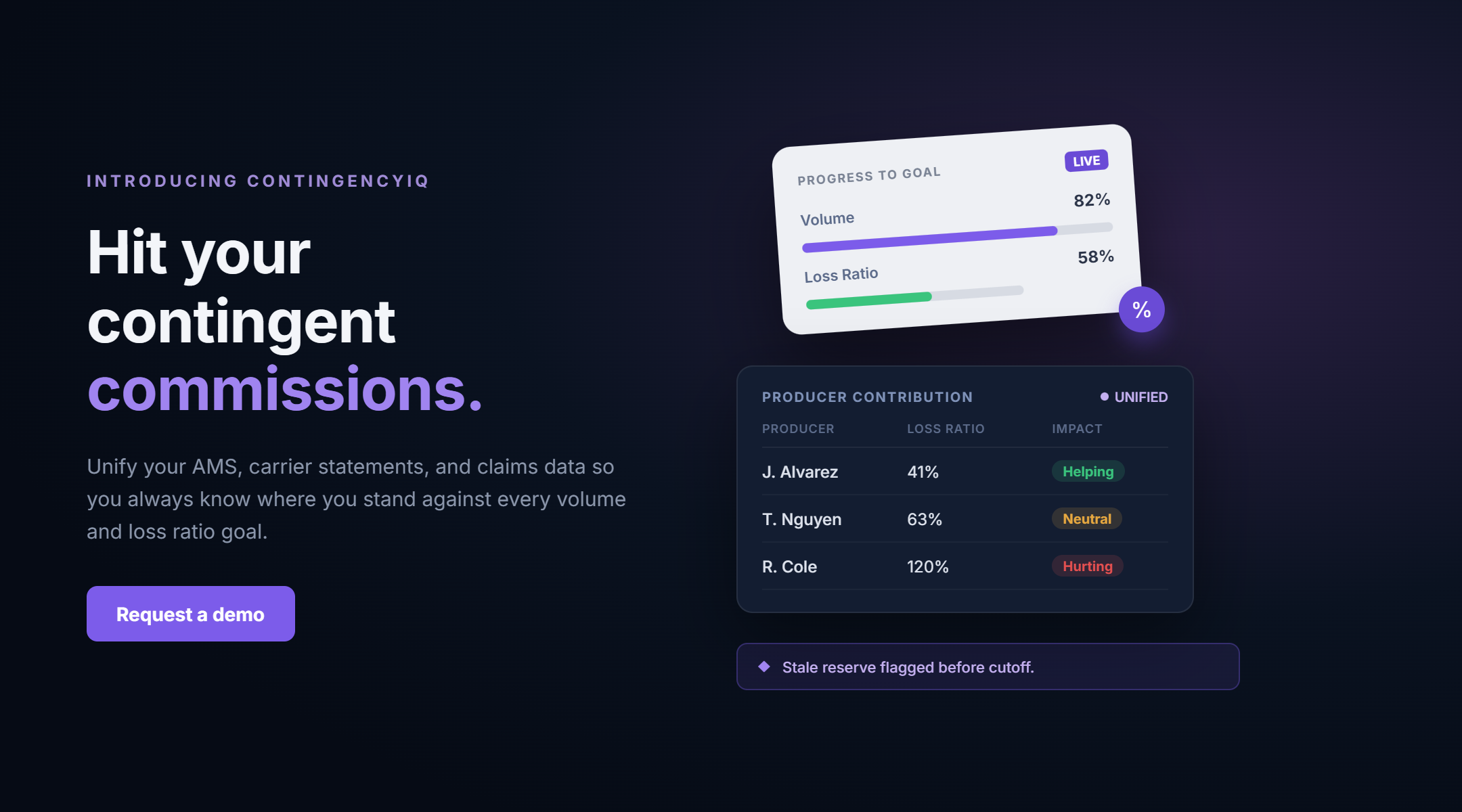
1. Track progress toward every goal in real time: volume and loss ratio. Every contingency has two dials: are you writing enough, and is the book profitable enough? ContingencyIQ shows both against each carrier’s target, continuously, so you always know where you stand and how much room you have left to hit the check.
2. See which producers are actually helping and which are hurting: By joining claims data to your production, ContingencyIQ rolls loss ratio and volume up to the producer level. Now you can see the producer whose numbers aren’t setting the world on fire but whose book runs a low loss ratio and quietly drives your profit sharing, alongside the high-volume producer whose 120% loss ratio is eating the contingency everyone else is earning. That’s the difference between coaching the right people and rewarding the wrong ones.
3. Match the right risks to the right carrier appetite: Contingencies reward the profitable business your best carriers actually want to write. ContingencyIQ shows whether your team is placing suitable risks with the carriers whose appetite fits them, so placement becomes a deliberate strategy that serves the client and the agency at the same time, rather than whatever happens to walk in the door.
4. Surface stale or inaccurate reserves in claims data: Some claims data is stale or inaccurate due to carrier administrative error, which distorts a loss ratio that should be lower. ContingencyIQ flags these likely culprits so you can raise them with the adjuster, get genuinely erroneous reserves corrected, and reflect your book’s true performance ahead of the cutoff period.
It does all of this by unifying AMS, carrier statements, and claims data, the three sources that have never lived together, so instead of flying blind you can spend your time on the business strategy that actually moves the check.
Check it out here.
Case Study: How an AccountAim Customer Tripled Its Profit Sharing
This customer is a growing multi-line agency that relies on contingent commissions to drive profit.
Before: no contingency focus and no placement discipline
When the COO joined the agency three years ago, contingent commissions were left to chance. In his words: “We had no risk placement strategy. The producer just wrote whatever. There was no sort of plan about how or why.”
Production data, commissions, and loss ratio all lived apart. Nobody could see, mid-year, whether the agency was tracking toward its carriers’ profit-sharing targets. Growth was measured in premium, with no view into whether it was the profitable growth that earns a contingency or the kind that silently destroys one.
After: manage the contingency all year instead of hoping for it in spring
With visibility across the whole book, the agency turned contingent commissions from a year-end guess into something they actively managed. Three things changed.
They monitored progress to goal continuously. Instead of waiting for the spring check to find out whether they’d hit a carrier’s target, the COO could see where they stood on both dials, volume and loss ratio, against every program throughout the year. That let them adjust placement and remarketing while there was still time to affect the outcome.
They measured each producer’s contribution to the goal and coached on it. By rolling loss ratio up to the producer level, our customer could see who was actually helping the contingency and who was dragging it down. Where a producer was writing suboptimal accounts, higher-loss business that looked like growth but quietly eroded profit sharing, leadership could have a specific, data-backed conversation and coach them toward the profitable accounts their best carriers wanted to write, while still serving the client.
They built a process to catch reserve errors before the cutoff. Stale or inaccurate reserves quietly inflate a loss ratio and shrink a contingency. The COO put a routine in place to flag likely errors and raise them with adjusters, so genuinely erroneous reserves got corrected and the book’s true performance was reflected before each program’s cutoff.
Combined with sound operational discipline, the payoff was real. In the COO’s words: “We’ve tripled our profit sharing over the last couple of years.”
ContingencyIQ makes that repeatable. It takes the strategy that tripled their profit sharing, monitoring progress to goal, measuring producer contribution, and catching reserve errors, and makes it visible and continuous, instead of something an owner has to hold together in their head.
The bottom line: contingencies are your biggest EBITDA lever. Start managing them like it.
You wouldn’t run new-business production without a pipeline. Yet most agencies run the single largest driver of their profit, contingent commissions, with no real-time view at all.
ContingencyIQ gives you that view: progress toward every volume and loss-ratio goal, the producers helping and hurting it, and whether suitable accounts are landing with the carriers whose appetite fits them. So you can stop finding out in the spring, and start steering toward the check all year.
Request a demo and see exactly where you stand on every contingency in real time.