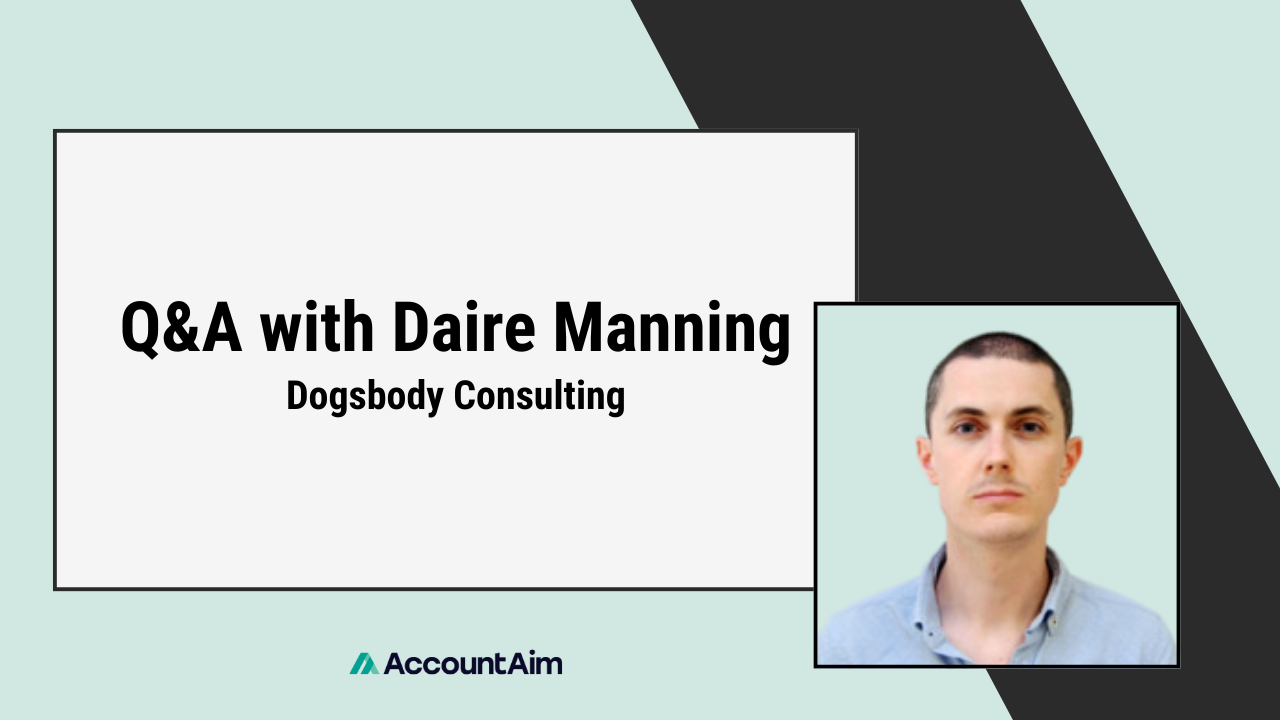

Daire Manning shares what it really takes to lead in Revenue Operations
RevOps is often seen as a messy, ambiguous function, and for those looking to grow into leadership, that ambiguity can either be a blocker or an opportunity. Daire Manning chose the latter path. Starting in sales operations at HubSpot, Daire rose to lead international strategy and ops, and later ran a 20-person RevOps team as VP of Commercial Operations at Tebra. Today, he advises companies like FinQore on how to scale their revenue engine with operational clarity. In this conversation, he shares his approach to leadership, analytics, team building, and how to earn influence as a strategic partner, not just a data provider.
What’s your mental model for becoming a strong RevOps leader?
Most RevOps leaders don’t manage huge teams. Even at scale, you’re usually close to the work. That’s why you need to be a generalist. You don’t have to be the best in any one area, but you do need to be strong across the board: analytics, planning, systems, and execution.
“You’re probably going to have to be 80th percentile or better at a variety of different things… budgeting and planning, analytics, systems and process. You don’t need to be the best at any one, but you do need to understand them well enough to guide teams and get stuck in when you have to.”
How do you determine when precision is critical versus when “good enough” is enough?
It depends on the outcome. If there’s money involved (commissions, invoices, compensation) that’s a high precision task. But if someone asks how many opportunities were created last week, and you’re off by one or two, it won’t change the decision. Applying the same level of rigor to everything will either slow you down or expose you to risk in the wrong areas.
“If an invoice or a paycheck depends on the piece of work you’re doing, then it’s generally gonna be high precision.”
What are the essential skill sets RevOps professionals need to reach the VP level?
You need range. That includes analytical and planning capabilities, systems thinking, and the ability to lead a team. But more importantly, you need to be comfortable with ambiguity. RevOps is never fully defined. If you’re curious and want to learn different domains well enough to lead, that will set you up to grow into senior roles.
How can RevOps professionals transition from being task executors to strategic business partners?
If you treat every request like a ticket, that’s how people will see you. The shift happens when you start asking why someone needs a piece of information. What are they trying to decide? What’s the real problem? That’s how you stop reacting and start contributing.
“If you position yourself as an order taker, then that’s the way you’ll be treated… A lot of the value of being a really solid RevOps business partner is in understanding the motivations of the person you’re working with and solving the problems on their behalf.”
What role does analytics play in RevOps, and how do you approach building meaningful data products?
You can think of it like a production line. Data is created in your systems, then transformed, and then consumed. The mistake a lot of teams make is skipping the modeling layer. You need curated data products that reflect how the business actually works. Building dashboards directly from raw CRM data rarely leads to alignment or clarity. You need structure, definitions, and context behind the numbers.
How did your career at HubSpot prepare you for leading large teams at Tebra?
When I joined HubSpot, we were still working in Excel. Over time, we implemented a proper data stack with Redshift and Looker. I helped stand up that reporting layer, hired analytics engineers, and learned how to scale both the data and the thinking. That experience gave me the foundation to lead broader teams, including CS ops, GTM programs, and analytics.
What’s your approach to building and scaling high-performing RevOps teams?
You need a clear picture of what skills the role requires and how strong someone needs to be in each area. Not every role needs an A in analytics, but you might need a B. Then you design your hiring process to test for that. Always ask for work samples or case studies. The behavioral interview isn’t enough. If you get hiring right, most other things fall into place.
Go Deeper
If you enjoyed this Q&A, check out the full conversation with Daire Manning at YouTube or Spotify.
About AccountAim
AccountAim is the planning and analytics platform built for Strategic RevOps teams. With AccountAim, RevOps teams connect all of their fragmented GTM data, automatically snapshot and see trended changes over time, and build full-funnel reporting — all without SQL or data team support. Learn how Strategic RevOps teams use AccountAim to streamline forecasting, territories, cross-sells and more here.
James Geyer: Hello again. We’re back for our latest episode of boardroom RevOps, where we’re bringing you valuable tips from RevOps experts so you can make to the C-Suite.
I’m James, co-founder of AccountAim. I’m the RevOps BI platform. Gonna be a great episode today. I have Daire Manning, uh, joining me today. Daire worked his way up, uh, from sales ops analyst to head of international strategy and ops at HubSpot, a company that you have probably heard about and then went on to become VP of commercial Ops at Tebra, leading a team of I think over 30.
Um, Daire welcome. Thanks for joining me.
Daire Manning: Yeah, great to be here. Thanks for having me, James.
James Geyer: We’re gonna chat about one of my favorite topics today. I always think it’s super interesting to give folks perspective, and it’s how to make it to VP in the world of RevOps. I think it’s like kind of a, a vague career path for many.
I’m so excited to hear kind of how this worked for you. But real quick, anything I missed on your background? What, what else should folks know?
Daire Manning: No, I think you nailed it. I mean, kind currently I’m, I’m working with, with a couple different companies. Most prominent a company called FinQore. I lead their customer team.
It’s a kind of a revenue analytics platform. But yeah, no, I think you, you nailed the background and I’m loath to talk about myself more than you already have, so I’ll stop at the.
James Geyer: All right, well, we’ll dive right in, but feel free to do all the self promo you want. Um, so, so let’s dive in making VP of RevOps like Daire.
Do you have like a mental model for kind of becoming a good like RevOps professional leader kind of working up the ladder?
Daire Manning: Yeah, so I think this is my mental model. I don’t think, I dunno how generalizable this is. I would love your thoughts on it as well. But you know, my mental model is as a RevOps leader, you’re not.
Gonna be leading a team that is massive. Generally speaking, you know, the team I led at Tebra was probably on the upper end of what you would expect to be leading, unless you’re like leading RevOps at a very large public company or something like that. And so I think what that means is that you’re one, always gonna have to be somewhat in the details.
It’s very rare that you’re gonna have a set of leaders, functional specialist leaders under you that are handling every single aspect of every single detail. And you, you’re freed up to just do the higher level stuff. So you gotta stay close to the craft. And the other piece that I think it means is that you have to be a.
Generalist. You can have places that you, that you have preferences for or specialize in, but you’re probably gonna have to be, you know, 80th percentile or better at a variety of different things. You know, budgeting and planning is, would be kind of one discipline. Analytics is maybe another discipline kind of systems and process and systems admin is, is a third.
You know, you can kind of list out disciplines. You don’t need to be the best person at any given one of those, but you do need to understand them well enough to guide teams and get stuck in when you have to. So that’s kind of my rough mental model is, you know, try not to be a hyper specialist if you’re looking to make VP at a rate reasonably sized org at any point in time.
And, and, uh, and, you know, being good enough is good enough sometimes.
James Geyer: Yeah, I think that, uh, covers it really well. My perspective is, is pretty similar, made me frame framed slightly differently. Um, I think of it as like. Execution and strategy and across the whole business as well. And so I, I think it’s kind of just kind of parroting what you said, but having to understand the data, be in the weeds, but also translate it to what executives actually want to talk about.
And that’s where I think a lot of RevOps folks actually get hung up. They can be really good at the system’s, really good at the data side. Actually translating to that to what it means for the business, um, is a challenge.
Daire Manning: 100%. And I think one. Related thing that I think tripped me up and I think can trip people up and continues to trip me up is I think probably the most important thing if you’re a RevOps professional, is having a good understanding of how good.
Good enough is in a given situation, you know? ’cause if you’re very detail orientated and you’re sweating every detail all the time, you’re gonna get bogged down and you’re not gonna get enough done. And for better or for worse, at any org that I’ve ever worked in or with, it’s a high velocity role where the expectation is that you’re getting a lot done right?
And some things don’t need to be perfect. So like a sales leader asks you, how many opportunities did we create last week? If that answer is an opportunity or two off. It literally does not matter. It’s not gonna change the conclusion and it’s not gonna change the action and it doesn’t matter. So you should just get an answer that’s good enough and get it over and move on with your life.
Right. But if you’re doing something like, um, building a commission plan, right, and your sizing rates or something like that, that is a high precision task. And you do need to set aside the time and have the discipline to make sure that all of the details are right. And I think when I’ve gotten myself into trouble in my career, it’s when I approached one of those problems.
with a level of rigor that wasn’t appropriate in either direction, like putting way too much time into something that didn’t warrant it right, or not putting sufficient time into something where the details really mattered. You know, that’s where I’ve kind of made a lot of my mistake.
James Geyer: I know it’s really a judgment call, but how do you kind of assess what is a high precision task versus a lower precision task?
Daire Manning: I think my general rule of thumb is if the decision impacts money changing hands, then it’s a high precision task. Commissions is a high precision task if it impacts if you’re doing some sort of deal desk activity. Right, and you’re, and you’re thinking about contractual terms, that’s a high precision task.
Budgeting, you know, that’s a high precision task. If it’s more of the, if the output of, of whatever analysis or piece of work you’re doing is more operational, right? It’s like someone’s going to have a conversation off the back of it or something like that, that can be a little bit lower and, and, you know, you can, you can blow some judgment as to like.
Just obviously a continuum there as to how much rigor is appropriate. But my general rubric is like if someone, if an invoice or a paycheck depends on the, the piece of work that you’re doing, then it’s generally gonna be high precision.
James Geyer: Yeah, that’s a good one. I think, uh, anger or level of upset is probably higher when there’s money involved, so it’s probably a good way to kind of cut through the noise.
Daire Manning: Yeah, for sure. Exactly. That’s a pretty good rubric.
James Geyer: So you, you summarized a few categories of things to be thinking about to be good at, to kind of, uh, climb the RevOps ladder, I think you said analytics, budgeting, and planning systems. I’m also gonna throw in just like hiring and running a team as you, as you scale, where do you think most RevOps folks kind of fall over amongst these four things?
Daire Manning: I think, I don’t know if it’s any individual specific discipline per se. I think it’s, it’s, it’s a little bit more about. You know, kind of attributes that, that folks have. So, like, I think if you’re gonna be a RevOps person, you need to have a high degree of comfort with ambiguity. You know, it’s not a role that’s well defined almost anywhere, you know, and, and you gotta be comfortable with that.
Um, if you’re looking for a highly defined role, then, you know, RevOps probably isn’t the place for you, you know, or you’re gonna like carve out a niche for yourself in one of those specific disciplines that I mentioned, right? Like, you might decide like, I’m just gonna be. Really good at analytics and spend all of your time, you know, working in a data warehouse and writing SQL and DBT building DBT models and building dashboards and all that sorts of, and you might be great at that, but if that’s what you want to spend 100% of your time on, you’re probably not going to be a VP of RevOps, right?
Like, you’ll probably be a functional specialist within a RevOps team, and that’s okay, but you need to make sure you’re comfortable with that trade off. So for me it’s, it’s, it’s, it’s more about do you have a curiosity to like learn different things. And get good at different things over time, up to kind of like a, again, you’d only be the best, but like an 80th percentile type level competence, like I think you need to have a love of learning and a curiosity there.
And then a comfort with ambiguity as well. I think it’s more like those things that are important and I think, I wouldn’t even say people get. Tripped up. But like I think if you decide to be a specialist, I think you need to understand that you should probably be, and you wanna grow your career and, and have a big title, you should probably do so with the understanding that the only real place for you to do that is at a large org that is gonna have a very big like RevOps analytics team or something like that.
That’s probably not gonna happen for you at a small org that needs a generalist.
James Geyer: Yeah, that’s a really good point. Um, so if we kind of break these down then I’m curious, like on the analytics side of things like. Tell me more about what it means to be good at the analytical components. And I’m thinking through a, a few kind of lenses here.
I’m trying to lead the witness, but you mentioned like the level of precision I think is a really great comment. I’m also thinking through like, where do analytics start and stop, right? There’s the analysis, there’s what you do with the analysis. I feel like this is all kind of like tied together. So yeah, tell me more from your experience, like what did it mean to to do that?
Well.
Daire Manning: Just ask clarifying. When you say analytical skills, do you mean in the sense of like, um, an ability to take an ambiguous problem and break it down, or do you mean like get a little bit more technically right, like an ability to like build analytical products, like analytics products?
James Geyer: I think more technically, yeah, whether it’s, you know, bi and dashboarding, it’s Salesforce reports.
It’s even maybe some of the supporting analytics that go with like budgeting, planning.
Daire Manning: Yeah, so I guess the way I would think about that is there’s kinda like a data production line of sorts, right? So you’ve got a number of source systems in any given business where people are actually executing on the work.
So like A CRM or an ERP or whatever, that’s where the data is created. Then, you know, you can, you can do a couple of things from there, but you gotta get it out into, generally speaking, into another tool in order to really make it come to life. Because any given system is not gonna have the data from all of the systems.
So that can be a data warehouse or a data lake. Or it can be another type of tool, you know, around which I think you are probably very familiar, right? Um, and so I think from there it comes back to, I think you need to have a deep understanding of the business such that you know which data products that you need to create.
And when I say data products, I guess to think about in terms of like layers of extraction, you’ve got raw source data, right? And then you’ve got dashboards like outputs where someone is actually taking an action. But. In between. And this is a, a concept that’s very familiar to you and, and I think probably any sort of an analyst, analyst, professional, you should have some data products that’s in between that, where you’re taking raw data, transforming it, or modeling it in a way that’s consistent and getting to more like summary measures or clean measures.
And then those are what you’re building all of your kind of like front facing, user facing products off of. And I think the trick is like in order to do a good job at knowing what those kind of like source of TR truth tables should be. And what the lines between them should be. You need to have very good business context and understanding of how the business actually works.
Right? And so you obviously need a set of technical skills to do the technical work of, of doing the data transformation and whatever tool you’re doing it in, right? Like that’s a, that’s a given, right? But I think the, the more important part is, um, is having your own mental model of how the business works.
Because your mental model of how the business works is what gets represented as those kind of like data products that sit under all of your analytics.
James Geyer: Yeah, I think that’s spot on and it, I think it kind of comes into play of like taking a step back and asking yourself for the business, like what are we actually building for?
I think a, a gap I see is some folks will say, oh, you know, a VP of sales just asked for this report and they go straight into building, but it’s like, what actions is the VP of sales actually trying to take? What are we trying to do with that information and getting folks what they need and not necessarily what they ask for.
I think that’s where some, like the business logic and judgment and even almost sales level discovery of your stakeholders kind of comes into play.
Daire Manning: Yeah, 100%. And I think, you know, again, this is a problem I’m sure you’re really familiar with, but I think one of the most basic things that you need to ask when anyone asks you for any sort of a kind of a data output or report or whatever is like, what are you looking to use it for?
You know, I think if you, if you position yourself as an, as an order taker, then that’s the way you’ll be treated. Right? And, and, and oftentimes people will, will ask for something that doesn’t actually meet their needs. Right. And, and, uh, I think a lot of the value of a. Of being a really solid RevOps business partner is in understanding the motivations of the person that you’re working with and solving the problems on their behalf, right?
Rather than just kind of being a recipient of requests.
James Geyer: Yeah, definitely. I think that’s, well put. The, the last thing I would add here as well, just on the analytics side is as you, as you said, is kind of near and dear to me, is like the semantic layer, even like laying out the true definitions of all the metrics that the business cares about.
I’ve seen time and time again, you know, sales and marketing becomes misaligned simply ’cause of like a metric, uh. Definition issue as well. So I don’t know if that’s something you’ve come across, uh, but that’s something we see as well on the analytics side.
Daire Manning: Yeah, totally. And I think that’s why it’s important to have these like.
Data products, right? Like, like you have a, a column and a table somewhere that codifies like, okay, when we say a dollar of ARR, this is what a dollar of ARR is. Right? And there’s obviously a data dictionary version of that that you should have sitting out somewhere. But like the more important places to have somewhere that people can go to pull it in an easy way, right?
Rather than having to piece it together from from raw source system data.
James Geyer: Yeah, definitely. I wanna take like a pit stop here into some of your career experience because I think it’s really interesting, grew pretty quickly at HubSpot and I’m even just, you know, looking at your, your resume here, uh, to ultimately lead like international strategy and, and ops.
I guess as I think about that, was that primarily like an analytical exercise or like, what was the scope of that role? As you think about even, you kind of started as a analyst manager moving up and, and maybe the answer is it wasn’t a very analytical role, but I’m kind of just curious to hear like, uh, the context of your, your career growth there.
Daire Manning: Yeah, it was a bit, I mean, I think, so the journey HubSpot, so when I joined HubSpot, I joined in 2014 and at the time, you know, the reporting stack was a CRM that you would dump CSVs out of into Excel and, and do analysis there, which is probably, you know, the way a lot of work still work today. You know, uh, and it can work fine over time.
We did put in place like a real. Kinda like data stack, right? So we put in place, initially it was a, it was a Redshift data warehouse and then Looker set on top of that. And then we began building a lot of the kinda analytical resources that we needed on top of, on top of that. And so I did have some involvement with that effort.
Um, I’m not a data engineer, so like the. The ETL piece of like getting data outta source systems into the data warehouse was not something that I did, but the building of reporting on top of it, um, is something that I contributed to, and, and over time kind of built out, uh, a small team of technical folks under me that, of what’s now called like analytics engineers to, to kind of manage that on, on and on.
James Geyer: Got it. Makes sense. Anything else as we think about and kinda take, we step back from analytics now and think about like the rise to, to vp. Like obviously to me it looks like, like HubSpot was a foundational kind of stepping stone to then kind of getting the role at Tebra. Like anything in addition or tangential to what we kind of already discussed around like why you were able to succeed at HubSpot.
Any, any reflections that could be construed as like advice for folks that might be, you know, in earlier middle parts of their career?
Daire Manning: Well, I mean, look, I think there’s a lot of luck and timing in this stuff, and I think it’s good to not get too hung up on your, your, your success or your measures of success in any given kind of quarter or a year or whatever.
Like I was definitely in the right place at the right time when I joined HubSpot and, and, and also when, when I joined Patient Pop, which became Tebra too. So I’ve been very lucky, I think, to the extent that I had anything to do with that. I think a lot of it is. I’ve, I’ve always had very much kind of like an outcomes orientation.
So like I’m okay with the, with the sausage being made in some sort of imperfect way or non elegant way so long as the result, um, is good. And one of the ways that that’s manifested in my various roles is, is, is I’ve always tried really hard to be an effective business partner to whatever revenue leader I was supporting, right?
So helping them come up with what the strategic priorities should be, you know, so kind of doing strategic work to define. The problem and, and, and a sketch of the solution, but also very much like leading the execution, kind of that strategy execution paradigm you were talking about. Mm-hmm. But like very tightly aligned with, with whatever leader you are supporting and weren’t being really hand in glove with that person.
Like I think that’s extremely, extremely important. And so I think to the extent that I got anything right, I do think I got that piece right, you know, with the various leaders that I worked with. All the way up at, at HubSpot and then similarly at at Tebra. I think having a really strong partnership there is the most important thing that you can do.
James Geyer: Yeah. What it like in your experience, and then we’ll dive kind of back into some of the more, uh, tactical stuff within the categories. I think the biggest challenge is kind of alluding to this earlier for some folks, is pulling back and having those strategic conversations with their leaders. Like, what do you think?
Your leaders were kind of looking from looking for, from you and their other, like RevOps leaders from that strategy building perspective, right? Because I think some folks will be like, oh, you know, I don’t wanna step on their toes. Or, oh, you know, I’m, you know, just a RevOps analyst and kind of in the weeds, like where do you think RevOps can add the most value, like in those strategic conversations?
Daire Manning: I mean, I think the fact that RevOps people are generally gonna think about the business in a very analytical fashion. Helps bring some objectivity to discussions that are in reality, like quite messy, you know? And, and often I think what, what’s hard is like, you know, you do need to have a really strong grasp with the details for sure in the role, don’t get me wrong, but like a lot of the, the job is distilling that detail into simple takeaways.
And the way I’ve always done that is like, you need to have a very simple mental model of how the business works and makes money, right? Like. Not many people in organizations think about things in like very concrete equation like terms, right? But I think as a RevOps person, part of what you can do is bring discipline to discussion by, by forcing the, the conversation in those terms.
And like someone like yourself who’s got a banking background would be very good at this. But like to give an example, if you’re working in a transactional business and with a very short sales cycle, your mental model of the business might just be like we generate a certain number of leads. They convert into opportunities at a certain rate.
They close into deals at a certain rate and at a certain deal size. And then we have an ongoing retention rate that we monitor. So you’ve got like five metrics that matter in the business. Like it’s a pretty simple mental model, right? And inevitably when you’re in any discussion in real life where there’s many people in the room arguing over what matters and what doesn’t matter.
The conversation will be about everything. That’s not those five metrics, right? And your job is to try and get back to the one or two things that matter at, at a given point in time and try and focus the conversation. And so for me, like that’s, that’s one of the key jobs of a business partner is like you need to have a simple mental model of the business.
Number one, you need to know what those numbers are at any given point in time and how they’re trending and why they’re moving around. Number two, right? But then you also need to have the kinda. The reputation and the discipline and the courage to bring that up in conversations with people that are generally going to be more senior than you to try and get them to focus on the things that matter rather than wherever the noise is in the business at a given point in time, which might be correlated to impact, but isn’t the same thing as impact.
James Geyer: I couldn’t agree more. And I think like very tactically, we’ll often recommend to customers and, and prospects that they build that go-to-market model, live, right? And you have those kind of like the top to bottom. Funnel metrics basically that you can always kind of point back to and see how they’re trending and to your point, relate every kind of conversation to them.
That’s actually like a good segue too. You mentioned like budgeting and planning was, you know, one of the four categories. If, if you allow me to throw in the building a team as a category that RevOps should be good at, it feels like that’s very related. Is that where you think RevOps can kind of provide the most value from the budgeting and planning process, or is there a different set of like competencies on that front?
Daire Manning: I think so. I mean, the budgeting and planning gets done in different ways at every org. Right? And your fp and a team should be the ones primarily driving the budgeting process, typically speaking. But I think where, where RevOps teams can add a lot of value is, you know, inevitably in any budgeting process at an at a, at an exist, at a, at an ambitious org, you’re not just dragging the spreadsheet forward.
You’re trying to find intelligent bets that you can place to accelerate growth. Right. And bringing some. Bringing a disciplined analytical per perspective to like what the best risk weighted bets are, I think is an important job of the RevOps team because an fp and a team, again, I’m painting up with a bit of a broad brush here, but an FP and a analyst or lead is generally gonna be managing a pretty wide swath of the business.
It’s hard for them to be really close to the people that are working in that business so that they understand the context beyond the high level p and l numbers that go into like what a good risk weighted bet is. And so like bringing a disciplined analytical perspective to complement whatever kind of more anecdotal perspective like the, the leader of that function will have, I think is a really important.
Discipline is part of the budgeting process. And then in addition to that, there’s a, there’s a bunch more kinda like meat and potatoes type things that, that I’ve generally owned during the planning process. So forecasting what quota coverage is going to be, would be a really typical one or what the expense and commissions impact of various compensation plan changes is going to be, is something that, you know, my teams have managed in the past or whatever.
And so you need very much, I think, to do that well, an fp and a skillset, which is part of what makes RevOps hard, right? Like you need to be able to do that job almost as well. Not quite as well, but almost as well as, as your equivalent peer in an fp and a department while also doing the systems and process and while also doing some element to the analytics.
I think that’s what, what makes the job tricky.
James Geyer: Yeah, that’s really helpful. I wish we had more time to dig in there. Uh, but we have five minutes left on the clock, so I wanna kind of fill the bulk of the time on kind of hiring and running a team, because I think you had a really good run at this, at Tebra.
So I think the team was kind of quite large there. I think one challenge I see in RevOps is, is for some, it’s hard to get resources to grow the team. It’s quote unquote not a revenue driver, which I ultimately disagree with, but I, I see why people say this. Um, and you know, it always feels. Easier for leadership to say, oh, we’ll just hire another seller rather than RevOps.
So like, tell me just the context of like, how did your team progress? Like how did you guys get the resources, make the case to kind of grow here?
Daire Manning: Yeah. Well I think, I guess the first thing to say is like, my team at Tebra, I don’t think it was quite as large as you said. I think it was somewhere in the mid twenties at its peak, but, um Okay.
It was really a collection of things, of some things that you would not ordinarily deem to be RevOps. So there was, it was, it was kind of. Sales operations and CS operations. And there was an analytics team, and then there was also some kind of like related support functions around project and program management.
There was like a workforce planning analyst for the support team, stuff like that. So, so it was, it was really kind of like fairly broad. I, I don’t think it would be typical to have like a, uh, a more narrowly defined RevOps team that was that large, unless you’re at a very big company. I think for me, the way it kind of developed was more around, I think we, we kind of.
Built a bit of an internal reputation as being really good business partners, you know, and I think if you’re a really good business partner, sales A CRO, or a sales VP or, or a CEO, like, they’re not gonna mind investing when the value is obvious, right? Even if it’s a little fuzzy, right? Like if you’re, if you’re able to deliver value that’s perceived as five or 10 x.
You know, the resourcing will kind of just come along with that. And so I think, um, I think staying close to your business partners, understanding what’s important to them, like really being almost like a chief of staff for whoever it is that you’re supporting is probably the most important thing. If they perceive you to be valuable, then the resourcing to some extent figures itself out.
You know, you still need to have conversations around that sometimes, but I think, again, I’m, I’m, I’m. Painting with a bit of a broad brush here, but I think to the extent that folks are struggling to get resources, it’s maybe that they’re delivering value in a way that they perceive to be important. And it might even objectively be important, but it might not be the way whoever approves the resources perceives value to be delivered.
Um, and, and there’s a mismatch there. Perception. I think that’s probably where, where things get tricky.
James Geyer: That’s a really good point. How do you, in your experience, so we talked about, um, being a good business partner briefly earlier, and you mentioned some of like the high level strategic planning, so that makes sense.
I think one trap a lot of RevOps folks fall into is that it’s like a, a fire hose. Like I am, you know, I’m trying to support the CRO, he or she is just sending so many things my way. I imagine you felt some overload at times too, like how do you balance. Prioritization or pushing back on some of those things so you can actually get the most important things done.
Daire Manning: So I think you should have a formal prioritization process if your team is at any level of scale and your org has some level of stability in it, like you’re not at a five person org. So the way I’ve generally done that is to set priorities quarterly, get a lot of feedback on what the priorities should be, um, ahead of that from a variety of leaders in the business, set them and then try and stick to them as much as you can.
And if you need to change the priorities, that’s it. Need to be a huge conversation, but it should be a conversation, right? Mm-hmm. Like we are deprioritizing this in favor of taking this new thing on and we’re all making that decision together and okay with it. But I think, um, you know, again, and I’m not trying to like demean or belittle anyone who’s experiencing the fire hose right now.
It is real and I’ve experienced it myself, but I think the main levers that you have to counteract that are, you know, again, I know I’m being a bit of a broken record here, but if like being a really good business partner, like if you’re just getting like shot a bunch of different requests all the time.
Right. It might be that, um, the work, you’re, you’re doing a great job delivering, but the thing that’s getting delivered isn’t actually solving the problem. Right. And you need to take a bit of time to do a bit of extra discovery to, to try and learn what the true problem is, right? I think the other thing that might get in the way is like you don’t have a perspective yourself on what the right solutions are.
Right, and, and you should, you should develop that and have a dialogue with your leader about what they should be. Right. And, and it might be that like this is a problem,
James Geyer: yeah, there’s really a theme in, in your responses around just like ownership too. It’s like you are in control or you should at least strive to be in control and take some ownership on solutions and prioritization and pushing back where needed.
I think some people are kind of nervous to do that, but I think people will ultimately kind of appreciate if you can bring kind of order to the madness.
Daire Manning: Totally. And I think, I guess what I would say to anyone is like, I think there’s, there are very few jobs. The ambiguity is a gift. There are very few jobs where you get to kind of like pick and choose what to work on, right?
And that means that this is a very high leverage role and you should, you should feel that way and you should be confident about your ability to deliver value in the role. You know? And I think if you, if you lose that confidence, I think you’ll start slinking back into more order taker mode. And I think that’s a little bit of a negative spiral because for all the reasons that we already discussed, right?
So you definitely do need to have a. A sense of self in the job, you know?
James Geyer: For sure. Daire, I know we’re almost at time here. The last thing, kind of a catchall, I wanted to ask you, there was so many questions. I wanted to go deeper on building a team, but any learnings or things that surprised you about building, growing, managing a big team that you would highlight here?
Daire Manning: I think, I guess I maybe share one thing on hiring, so, you know, standard generic hiring advice, but you need to have a, again, a mental model of what the scale area is you need. To have, in order to be good at the job are you need to know how good someone needs to be at any one of those things. So you might not need like an A grade on analytical competence, but you might need a B grade.
Right? And then you should set up your interview process so that you’re testing on each of those at different phases and ideally testing such that people are showing you the work. So like that can be in the form of showing you a, a work product they produced previously. It can be a case study, it can be something else.
But in my experience, there’s no substitute for seeing the work. I’ve interviewed people where the. The behavioral interview went awesome, you know, and I was super impressed. And then we had them actually do the work, and it was night and day, and it was a definite no go. And I’ve had the flip as well, where someone was a little nervous and maybe not the best in a behavioral interview, but they, they really nailed the work, right?
And so I think that’s the key. Like if you, if you hire, well, you know, a lot of stuff looks after itself. That’s the key to kind of having a, a, a, a, a good high functioning. Large team and, and I think that mostly comes down to just having a good, clear picture for what you’re hiring for and structuring a process that actually tests for it.
James Geyer: That’s great. Yeah, I think it’s easy to not be thoughtful on the hiring front ’cause you’re so busy, but I think that’s a, a really great framework for, for doing so. Well, um, Daire, thank you so much. I thought this was awesome. Uh, some, some great learnings there from someone who made it up to vp, so I’m grateful that you came on and shared with it.
And you know, anyone listening, if you have any questions for Daire about this, uh, feel free to shoot it my way and I can kind of batch them up and, and get them to him for, uh, for responses. So thanks again for joining me. It’s great.
Daire Manning: Awesome. Thanks for having me James.