
The First 90 Days in Rev Ops: What to Do, What to Avoid & How to Win Early
Starting a new Rev Ops role? The first 90 days can make or break your credibility, and there’s no shortage of landmines.
In this session, Josh sits down with four seasoned Rev Ops leaders to break down exactly how to hit the ground running: from building trust with skeptical revenue leaders, to prioritizing a backlog when everything feels on fire, to avoiding the trap of becoming a “ticket jockey.”
In this episode:
- How to get the lay of the land in week one
- Building credibility with your CRO and GTM leaders fast
- Balancing quick wins vs. long-term strategic projects
- Managing competing priorities across Sales, Marketing & CS
- What a healthy Rev Ops / CRO relationship actually looks like
- How AI is changing the way new Rev Ops hires operate
- The biggest mistakes made in the first 90 days (and how to avoid them)
- What success actually looks like at day 90
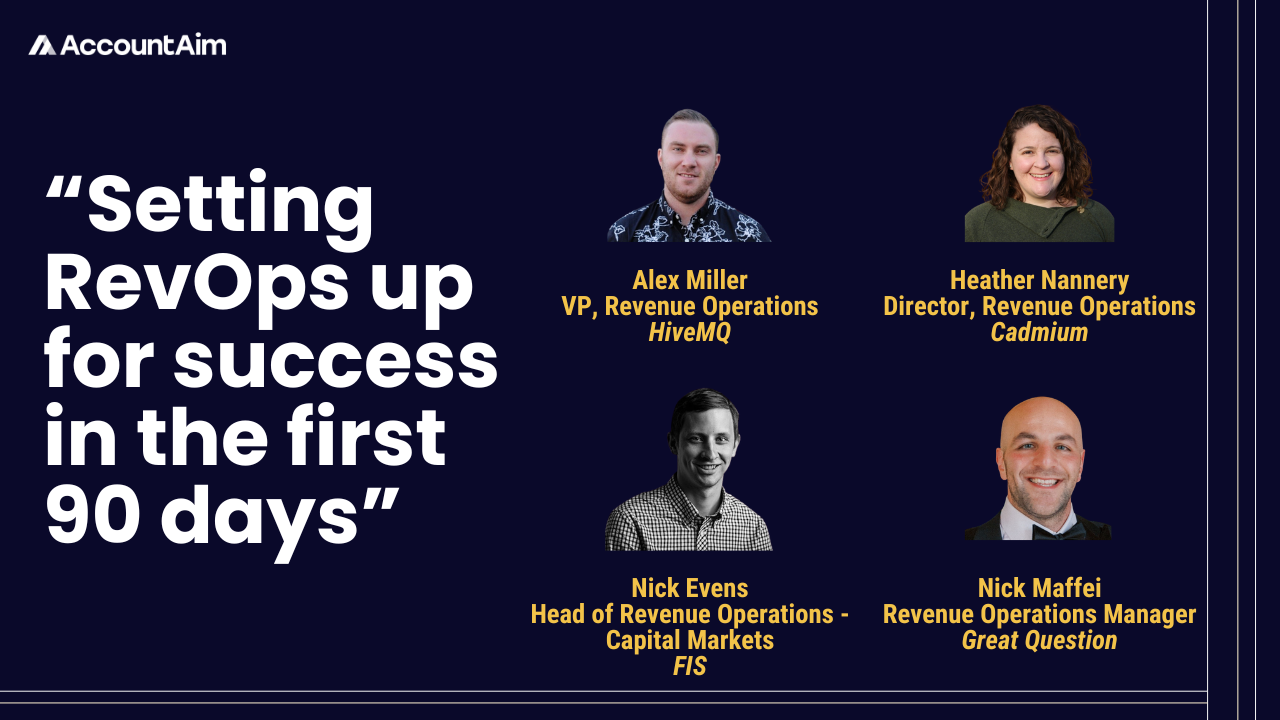
Guests: Heather Nannery (Cadmium), Alex Miller (HiveMQ), Nick Evans (FIS), Nick Maffei (Great Question)
Josh McClanahan: All right, we have officially started, we’ll give it about a minute or so for folks to start to trickle in, as we all know, or everyone’s back to backs right now. So we’ll just give it a, a couple of seconds here, but, I’ll start to discover some of the the groundwork and the admin pieces here.
A as always, with these. We are recording this and we’ll be sharing the recording. So don’t worry about trying to capture every single note here. We also have the q and a enabled. So, as you’re thinking and listening to our speakers here, if you have any questions, feel free to ask them in the q and a and we’ll try to cover them.
We only have 30 minutes. We’ve got four folks that are very experienced here that I’m super excited to chat about. , We’re gonna be covering a lot of ground here in a second, and so, , we’ll try to get to them, I promise you. But if we don’t, we will follow up with each and every one of you. So, , why don’t we go ahead and just kick things off here, , kinda officially.
So, I’m Josh, the co-founder and CEO of AccountAim. We started AccountAim three years ago to help RevOps and GTM teams tackle data and analytics challenges by building a RevOps data warehouse and PI platform. Along the way, we’ve had a chance to talk with hundreds of folks in RevOps and couldn’t be more excited to sit down with some of my favorites to talk about by far our most requested topic of the year.
First 90 days in RevOps. So this is gonna be the most, you’re probably gonna hear from me on this, and I’m gonna turn it over for some quick intros. Heather, do you wanna kick us off with, uh, your background here and then we will go around the horn. Really?
Heather Nannery: Great. Hi everyone. I’m Heather Nannery, the director of RevOps at Cadmium.
Uh, we’re an event technology and learning management system platform sort of spanning the United States. My background and career has been, um, sort of wearing all the hats and being an operator to fill all the holes, and that’s how I found myself in RevOps. I’m sure that’s resonant for many of you and it’s a place I love and love working in.
It’s, uh, I think there’s so many problems you can solve in the tech stack, so. I’ll pass it off to, uh, Nick.
Nick Evens: Um, yes, my name’s Nick. I lead revenue operations for the Capital Markets group at FIS, which is a large FinTech company. Um, my background’s originally in consulting and then have transferred over into RevOps over the last five years leading RevOps set.
Smaller private equity backed companies to now a large, like multi-billion dollar group and a public company. Um, so we made the transition, made a lot of mistakes in the first 90 days, and, uh, hoping that, uh, we can help what people avoid to make some of those going forward.
Josh McClanahan: Uh, Alex, you wanna go next?
Alex Miller: Sure. Hey everyone. Uh, my name’s Alex Miller. I’m the VP of Revenue Operations at mq. Imq is an industrial AI company. We power a lot of the data backbone for, lets, lets companies, uh, leverage their data with ai. So about 70 days into the role I started in December. And, uh, so lots to talk about in this conversation.
And I’ve been in the RevOps space, started my career out as a seller. Long time ago, and, uh, for probably about the last 14 years I’ve been leading RevOps teams in all sorts of different companies. So looking forward to the discussion today. With that, uh, Nick, I’ll hand it over to you to bring us home.
Nick Maffei: Thanks, Alex. Yeah, I’m Nick. The other Nick. I work as the first RevOps hire at, great question. We’re an all-in-one UX research platform. Uh, before that, spent some time doing RevOps at two other companies and a lot of time at one company, uh, rising through the ranks there. And before that was in.
Really low quality, uh, SCR and AE at a few different companies where I learned how to automate my way out of my job. So, yeah, excited for this. Just started my aggregate question in November.
Josh McClanahan: Amazing. Uh, I am, like I mentioned, I’m super excited to chat with all of you. We’ve got a ton of different experience here kinda across the board of different companies that, we’ll, we’ll be diving into some of the, the key differences between them.
But, um, maybe Heather, we’ll have you kick us off here. I would love to chat about and walk through the first week in a RevOps leadership role. What was the first thing you did when you sat down, um, in that new role?
Heather Nannery: That is a great question, and I’ve now done it twice in the last year. So I joined cadmium in September of 2025, and before that I had started a new role in September of 2024.
So, um, this is my, you know, couple go arounds of this, but that, that first week, I think. It’s really all about getting the lay of the land, um, aligning with the revenue leadership team that you’re going to be working with and supporting, aligning with the overall business needs and goal, trying to get situated in product, uh, especially if it’s a new company to you.
One that. You may need to ramp up on the specifics, the space and all of that. And I think the last thing is really starting to build out your framework and structure for how you’re going to onboard, how you’re going to run your RevOps org and what are the different like levers and parameters for, for what that’s gonna look like for you.
And I think depending on company size, um, whether they’ve had RevOps before, it’s, it’s going to greatly vary. So, and I entered a role where we. Have never had RevOps. So that means that I’m literally setting the foundation from from scratch in terms of what it’s going to look like and how I’m going to work with the people around me.
So that first week is, it’s all about like building out your plan for alignment and building out how you’re going to fill those knowledge gaps that, that you may have.
Josh McClanahan: I, I, I love that. One of the kind of questions that comes up a lot is how do you think about building credibility early with revenue leaders who maybe are skeptical of RevOps or have had a bad RevOps experience before?
Alex, I know that you and I have chatted about this quite a bit in the past, like kinda what, what’s your take on that? Yeah. And you know, the funny irony of these roles is like, they don’t exist if everything was being run so perfectly up to that point, right? So naturally there’s gonna be some firefighting in those first couple weeks, couple months even.
Alex Miller: And you know, a lot of building that early rapport with other leaders is, is critical. Like, you know, I started diving Q in December and we actually rebranded our team from RevOps to GTM operations, just hit the reset button and saying, Hey, just because it was done this way before. It doesn’t mean we’re doing it the same way going forward.
And while that may have been somewhat of a superficial, mostly optical change, I think it resonated a lot with their business just ’cause it’s like, Hey, okay, what we thought was the definition before, it’s different going forward, but laying that foundation and building trust is key. I think there’s a lot of folks that come in who are like, all right, we’re just gonna pick it up and keep doing it the same way.
And that’s obviously often is not well received by the business. So not to say it’s a prison yard, we have to come and fight someone and make a name for yourself on day one, but like. There’s some degree of like, are there quick wins you can put on the board and just say like, there’s, whether you want to say it’s a new sheriff in town or saying, Hey, this is a new function that maybe didn’t exist before.
Um, it all comes down to, again, this like laying the foundations for a building working relationship with the GTM leaders. I, I joke with our leaders, it’s like, Hey, you’re all my VIP so y’all might sell, like if something comes up, you’re gonna be at the front of the queue. And sometimes even just. People that are, you know, other leaders will look at RevOps and say, all right, they’re all on the same page.
Like their, their team members are not here to be a Salesforce police. They’re here to be a catalyst for helping me as a revenue leader put more money in my pocket and be successful in the goals that we’re trying to achieve. And I think if you can get that early, then it’s usually a pretty epic relationship that scales throughout the tenure at the company.
So a lot of different ways you can take that, but I think it ultimately comes down to just like, you gotta build trust.
Josh McClanahan: I’m glad you brought up the idea of like a queue. I think one of the challenges that we hear oftentimes from new RevOps hires is they have almost three different stakeholders between sales, marketing, and cs.
They all want something in those first 90 days from the RevOps team. Uh, Nick Odds, you joined as the first, you know, RevOps hire here recently. Uh, how do you think about managing and prioritizing between those three different teams and how are you communicating that with the, the rest of the organization?
Nick Maffei: Yeah, that’s a good one. I give a big shout out to my manager Harry, who’s, uh, the chief of staff at Great Question and a former professional UX researcher from Meta. So he has a really extremely strong project management background, which, um, I think a lot of first time RevOps hires or don’t, at least I don’t.
Uh, I’m used to operating, getting things done, not necessarily documenting and tracking. So we work together to prioritize like. You come into to this role, lots of things are broken. What are the most important things to fix at most companies? There are a few things that are on fire, especially when I joined in November end of the year like final year reporting next year, forecasting all that stuff, which is really important.
But making sure that you deliver the highest value to the company first. And for most of the people that’s typically like. Reporting and forecasting fixes and, and cleanups improving accuracy. Um, and then two other things, like I think about are what are like, uh, the RevOps roadmap, so to speak.
Like I look at the hyperscale one that I think I originally found actually from, from you guys, Josh. I use that and refer to that all the time and send that out to leadership people because oftentimes they think of RevOps as like a traditional sales ops function. So. Like, great, what are you doing in the CRM this week?
I’m like, lots of stuff, but there’s also other things we need to work on. Um, so delivering that roadmap is one piece. And the second part of that is like delivering quick wins and value to people. And I’ve done that at great question and at the previous roles at Velocity and more frequently at a longer stint, um, at Ong by interviewing end users, so like AEs and BDRs, CSMs semi-frequently to make sure that.
What it is that I’m working on as an ops person and being told by leadership to do actually resonates with like the on the ground people, sellers, CSMs, like they’re the people that are actually creating and generating revenue and working on it. We’re just clicking buttons and like making sure that what we’re doing actually delivers value to them is a key thing that I try to remind myself because it’s no point in making a spreadsheet for a spreadsheet’s sake or a report for report’s sake.
Um, if the sellers are like, Hey, this button doesn’t work. Our sales sequencer and, you know, I can’t find phone numbers and I can’t reach people, so,
Josh McClanahan: no, I, I love that you brought up the idea of quick wins. I’m gonna circle back to that in a second, but before we do Nick Evens. One of the, the, uh, things I think that’s a little bit different about your experience than most is just how big the RevOps team is, uh, over at FIS.
Can you share a little bit more about the experience of joining a a, a larger team that was kind of already established, you know, if we contrast this with Nick Odds who joined as a one, uh, you know, one man band here, you know, kinda what were like the key differences that you’ve seen joining and become like a part of a much, much larger organization.
Nick Evens: So I think a lot of, kind of what Alex talked about, uh, holds true here. As you join in as a part of a larger organization, there’s still a lot of people here who are used to how things were done in the past. Uh, and that is the way momentum goes. And unless you make a very concerted effort to change that.
You are gonna continue flowing that direction and you are just gonna kind of be the new head of the old motion. Uh, and very little is gonna change. And so one of the big things when you come in is really understanding what is working, what’s not working, and like why are you in this new role? Like is there a reason the last person who is here left or is there a reason we’re kind of bringing all this together and like what is the main priority that needs to be fixed?
And then I really like the kind of how you rebrand and everything there. You are coming into a large organization. I think some of that symbolic rebranding probably has a much larger impact when you’re at a larger organization of this is exactly how we are changing, this is not what it was before.
And so really big things are is finding out who those key stakeholders that you need to win over are. And so at FIS though, one of the key stakeholders is I needed to win over the head of sales more than really anyone else. I’m dealing with hundreds and hundreds of managers and reps, and so I need to get him so I can have him spouting the benefits and why this is different and why this is gonna change, and really appear tied at the hip there rather than, you know, dealing with kind of the individual, Hey, I’m gonna make this button work.
Hey, we’re gonna do this and do those small ones. The small ones are never gonna change the momentum at a large company. Uh, and so you really need to focus on that right from the start. I love that. I mean, kind of speaks a lot to like the, the quick wins and just like thinking longer term too there. I know this is something we’ve chatted about in the past.
Josh McClanahan: I’d be really curious, like how do you decide on like what do we actually fix immediately first? What should go on that six month roadmap, particularly when folks are just screaming like, I need this fixed yesterday. It’s, that’s a really good question. And it was, it was one I was thinking about as, um, Nick Odds was, was talking.
Heather Nannery: Um, and I think it, it does boil down to. Just really assessing in place and prioritizing in place. So one of the things that I like to focus on is really as I’m doing my tour of the business, understanding like where are reps? Or marketing syncing and or our customer implementation team, where are they syncing the most time?
That’s not valuable. So really unearthing the time and efficiencies of across your, your large swath of your end user, which is your, your rep, your marketer, your, your, um, accounts person that is spending like maybe two, three hours building a quote when you really want them. Spending that time with customers, with buyers.
Those kinds of things. So the, the first thing that you think about is like, how do I make my reps more efficient and how do I prioritize that? First and then second, what are the large projects that we need to undertake because they’re gonna be the underpinning of how we scale going forward. And an example of that that I really think about is like, is our deal structure?
Is our company structure? Is our data structure going to help us scale beyond where we’re at now? And sometimes the answer is no, and we need to think about like, how do we build it so that it can meet the needs of the organization? One year from now, we really wanna understand our total buyer journey.
And right now all of our data is disparate, not living in the same PA place, and also not serving us. Like that may be something that makes it onto the roadmap because it’s not gonna be a quick fix, but it is gonna be a foundational thing that just changes the way your entire teams operate. And so I like to think about like what are the time and efficiencies that I can cut immediately while I am building those bigger projects That requires.
Alignment across teams outside of the revenue org, product, implementation, et cetera, finance. So that we can create a base for how we wanna operate going forward. So it’s a, it’s a little bit of a juggling act. I think it’s really hard actually.
Josh McClanahan: Yeah, I think, uh, being hard is like the staple of RevOps.
Right? All of you have mentioned here, you know, the stakeholder alignment and building these relationships. Uh, Alex Miller, we’ve talked about this quite a bit actually. Like, what does a healthy versus unhealthy relationship look like, maybe between RevOps and the CRO? I think we’ll kind of take this question and go through a couple of different variations too, but yeah, like how, how do, like, you know, how do you think about kinda like what that should, should really be?
Um, how can you establish in the first 90 days.
Alex Miller: Yeah, and it’s, it’s, it’s an interesting question, actually, I’ll put some context. I actually followed my CRO from my previous job into this one. So really part of taking the role was actually more of a gravitational towards that partnership than it even was saying, Hey, you know, yeah, I’m a big fan of what we do at HIV mq, but like, the real reason I was joining was to say, Hey, there’s a team that I know I’ve already worked with before and want to bring that back.
So what a great relationship between A CRO and a head of RevOps is, is, you know. Mike, our CO, he calls me his consigliere. He’s like someone who goes out and follows their, you know, like I said, watches his blindside and or just saying, Hey, let me kind of run with chief of staff, almost type responsibilities to be able to take care of a lot of just stuff and get it off their plate within New York.
So a lot of the stuff that I own, you know, Mike’s like, Alex is my brain. Just go to him first if you have any questions on data, metrics, goal setting, comp, all those things is starting to find the partnership about like. Where’s the CRO strengths and then where’s everything else? You can kind of flank this lower priority to them.
So, but I do think that I’ve also joined roles where I wasn’t following a CRO and just like any job, getting a trust with your manager is really the first priority of your 90 days. Like, yeah, you want to join and be able to understand what the company does other people, but so much of that first 90 days is just figuring out how you work with your boss.
So really what understanding what their priorities are is where everything should start, is to say, you know, Hey, you know, manager, boss, your, whoever it might be, what are your priorities? And like, where can I help in support of those? I think, like Heather said, we’re always gonna go find other things to do.
There’s gonna be a million fires to put out and I think you just have to fight like the, let me go find a bunch of quick wins versus aligning to the strategic initiatives in the business because. I think that’s what separates like a great RevOps leader from a lot of folks who are just, you know, Salesforce type admins is like, Hey, you know, they brought you in to be a strategic partner, especially the more senior you might be, or the more senior you align to a leader within the org and really understanding their priorities.
The thing is the first start and like. Frankly, like I talked to my CO Mike a lot about like what keeps you up at night outside of your priorities and like where can we go tackle some of those things? And maybe some of those things aren’t even traditional RevOps projects, but it’s just like, how do we get alignment with another org better?
And it’s like great. You know, GT mops, RevOps is actually like, we joke where sometimes the nervous tissue of a lot of these orgs where, hey, let me help go be a conduit to finance. That’s not a task on an Asana board, but like. Let’s strategically say that I’m gonna help build this relationship with this other department, help the conduit that way.
So to summarize a long answer, it’s like you gotta build trust. You gotta understand how each other works and the faster you can align to their priorities, the faster you’re providing value to them, which is ultimately giving them a sigh of relief to saying, Hey, the reason I brought so-and-so in like this is what they’re delivering on, and they feel like they’ve got a partner versus just another report.
Nick Evens: Can I add Josh?
Josh McClanahan: Please.
Nick Evens: So I, I love everything about that. And I think the one thing I just want to add is like what their priorities are. The number one thing I have found coming in is sometimes they don’t know what their priorities are. If you ask what their priorities are, they’re gonna tell you, Hey, keep doing the same.
I need this dashboard, I need this, I need that. Where you really build the trust is when you come and. This is what I think you need and make your job easier. And they suddenly see that and go, you’re right. That is actually what I need. And that answers that question. So hear what their priorities are, but don’t take it at face value.
Take it to the next step of, okay, I understand what’s causing that and like what’s gonna go there. Like that’s how you build trust really quickly. A hundred percent.
Alex Miller: And I’d say too, like, you know, a lot of revenue leaders are the first two admit. They’re like, I’m not an ops person. They’re like, you tell me what I don’t know.
Sometimes it’s like. You’re the scientist, I’m the artist. Like, let’s, let’s, tell me what I don’t have that other people do. And I think that’s where we can again, be great partners is to say, Hey, like, it’s a fantastic point, Nick, but just to say, you know, yeah, great ops teams have this, that there’s revenue leaders have you don’t have that.
Let’s work on delivering that. And maybe they’re like, yeah, never thought of that. And that’s a huge win, especially the earlier on to do that is just, uh, like you’re, you’re a trusted partner from day one when you start having those dialogue. Great point.
Heather Nannery: I I wanna jump in too and say that I think something I’ve said to Josh before, and I’ve said in a lot of places that I think particularly in companies my size, Nick Evens, you can speak to companies your size, but when you have a CRO and VPs of sales without strong RevOps, you have folks that are trying to do a lot, build strategy, often do direct line management, and it is the hardest job.
I have a lot of respect for the, the folks that are in those roles. And it’s high burnout because when you don’t have a strategic partner, someone that’s gonna knock on your door and be like, you’re not paying attention to this thing, and I, I need you to go and do that thing, it becomes really, really challenging I think for CROs and VPs of sales to lead without the visibility that RevOps can give and sort of that backup that, that we can give as well.
I like the idea of being like a coner that’s like really funny. But I will throw out there like, I think this is a hot topic on LinkedIn and something that I see folks debating all the time. I wanna see more RevOps folks get more direct sales experience so that we can rise to the CRO seat. I think it’s ours for the taking because we have the strategic insights and why not us, um, in a lot of ways.
But you do need to get some on the ground chops, I think, of being in that direct customer facing role, which go get it. I, I think it’s ours for the taking.
Josh McClanahan: I love that you brought that up, Heather. I think that it’s a, one of the more common topics that we obviously talk about. We’ve got a boardroom, uh, RevOps podcast that’s dedicated to helping, uh, helping folks kinda rise through the ranks.
I’m curious if there’s anything for the group in the first 90 days, uh, as you think about, you know, setting yourself up for like that future path to CRO. Is that something that you’re conscious of early on? Are there things that you’re doing in those early days to kinda get you on that path or at least see it within the organization?
Um, or is that some, something that like we’ll tackle down the line a couple years in after, uh, we’ve got through, you know, the bulk of the RevOps issues here that we hope to solve.
Alex Miller: I’ll, I’ll add one piece of color to that. I think like. Tying all the initiatives we do back to some sort of revenue lift. I mean, admittedly like we are not people who are directly closing revenue, but we are the backbone for a lot of those teams that are.
So I think, you know, getting into a new org and saying we’re coming with the needle on Ultimate revenue, I think puts you at that table where you’re talking about actual outputs across the org, much less building infrastructure. And I think too, there’s a growing trend, needless to say, in the year 2026, where.
There’s a lot going on with ai and I think one of the things that we’re trying to at least become, at least the center of excellence in within our work is. What men you’re calling GTM Engineering and actually being able to build some systems that ultimately kind of do become customer facing, even if it’s not necessarily a traditional sales role.
So not to say that I would advocate for everyone going out and trying to build their own RevOps automated workflows to go interact with customers, but I think in a right work structure, there are new ways that didn’t exist even like a year ago, where RevOps can actually be part of that process versus being somewhat exists.
Largely in the shadows and think maybe the outreach is not in my name, but it may be a workflow that we’re automating and orchestrating behind the scenes that are ultimately leading to more bookings. And you know, even if it’s just at the top of the funnel, like there are new ways that I think we could be creative to again, be more in the revenue conversation as contributors versus just supporting members.
Josh McClanahan: I love that. And I think, I mean, obviously ai, you know, the hottest topic that is kind of out there. Um, I knew it was gonna come up at some point. I think we made it 21 minutes in before we heard ai. Sorry, for the first time. No, I’m, I’m glad this is, uh, perfect timing because I think there’s a lot on LinkedIn.
There’s a lot of conversations, a lot of webinars about, you know, kind of the use cases for ai. I’m actually curious, like has it changed how you think about onboarding in your first 90 days with what’s available now? Nick Smy maybe, uh, you know, kind of being in that role, you know kind of a little bit newer here.
Like has it changed at all from like what you’ve seen?
Nick Maffei: Yeah, so I’d say like a year ago if you asked me about AI in RevOps, I would kind of smirk and be like, yeah. I’m sure people are using it to write their emails and do whatever. About a month or so ago, or a month and a half ago, Victor Sers, who’s my old manager, who’s sort of been like the rev, this, you see him on LinkedIn, uh, onboarded me into what he is called this like knowledge os thing and cloud code.
It’s totally transformed my daily workflow as a sort of first RevOps person. I’m in there every day, all day, essentially using it as an analyst for my. For my job, right? So example use cases is I’ve of course connected all of our, our stuff in there and I went in and pasted a linear ticket and like two HubSpot workflows and gave it some context and said, can you figure out why this is stamping wrong and recommending what to do?
And like in five minutes it figured out something that would probably take a manually, like two or three hours of looking at workflows and, and expect inspecting things. All that is to say I think like. There’s a lot of hype around these tools, but at the end of the day, I think the biggest and strongest use case rep ops people can think about for cloud code.
If you’re on LinkedIn, that’s the only main one you’re probably seeing is to think about it as an extension and a way to do things that you already know how to do faster. And that’s been the biggest use case. And like what Alex was talking about, the G-T-M-G-T-M-E stuff. Also extremely valuable. Even at the basic, most basic sense, I get, I think back to like four or five years ago, spending time in Google Sheets, like transforming and vlo, like that’s a thing of the past.
You should be in there like making it do all that stuff. That’s my opinion, but I think like the hype is real, but you do have to be careful of like ascribing this, like super magical powers to it.
Josh McClanahan: Yeah, I think that, you know, we’re seeing more and more RevOps teams just being able to self-serve generally.
Um, I would say, you know, no longer having to rely on engineers or other parts of the org and just getting to those answers faster is something that we kinda see, you know, across the board. Uh, I wanna kind of pull us out for a second here because we only have five minutes left and there’s kinda two questions that I wanna end with here.
Um, and maybe we can kind of go around the who on each of these. I’m curious if there’s a, a mistake that you made in the first 90 days or something that you maybe would’ve done differently that you wanna warn others about on how to avoid if they think about entering a new RevOps role themselves.
Nick Evens: I can go first on that.
So I, um, I, I definitely kind of did it both ways. So I think kinda the first time I came into a RevOps role, one of the big things I did was, was say yes to everything. Like, how do I fix everything? How do I prove my value? And everything there and quickly that became you were just the problem solver of like, here, clear the ticket, clear the queue, clear everything there.
I took that lesson and kind of went into my second role and said, Hey, I’m gonna make sure I’m not the Salesforce guy. And I probably went a little too hard on the not being the Salesforce guy and you know, made it very clear, I’m not the Salesforce guy. I’m not gonna do that or not gonna that. And I think that’s really one of those big things that you just have to figure out the right way to be able to balance what are you doing and what is the team doing?
So setting those priorities straight and really finding the way to balance how can I be helpful without going to the point of. I am just the spot where every problem gets dumped and this is what I need to do. And that first 90 days is just so, so huge to make sure that you set the standard of what goes on there.
And so be very aware, be helpful, and be, you know, you know someone everybody likes, but you need to be able to have that firm boundary of, Hey, this is not what we’re doing, sort of thing.
Josh McClanahan: Hans, I see you going off mute. What, uh, what, what mistakes should we be avoiding in the first 90 days?
Nick Maffei: I totally agree with Nick Evens.
I feel like, um, one of those things you do have to do is avoid becoming, as I like to call the ticket jockey, like the person that just hammers out tickets. With that being said, I agree with that wholeheartedly, and I think like one of my, the biggest things I’ve been focusing on is a strategy.
Sometimes there is like some things that have to be cleared, especially as a fresh new hire and especially as the first RevOps hire, there is probably gonna be a true backlog of actual. Hardcore classic RevOps work. Like I was telling Josh the other day, like I had to completely rebuild our attribution because it was just non-functional in HubSpot.
And like that is something that is a traditional sales ops CRM job, but like you have to set the foundation before you can do all the cool stuff. But that’s very dependent on like where you’re working. Makes sense. Heather, you wanna weigh in? Yeah, I agree with everything both Nick said. Um, I think being reactive is like a really a hard thing to break out of once you’re in it.
Heather Nannery: But I like wanna throw out there something a little different, which is deeply understanding the buyer. I think that once you understand why buyers buy, um, and you know what they’re using your company for, I think it unlocks a lot of, a lot of better work for you across the entire like go to market stack.
So didn’t do it once and deeply regretted it because I got to month six and was like, I need to go back around now and watch a bunch of demos and maybe get on some customer calls. And so the earlier you can do that and ground yourself in that knowledge, I think the better.
Josh McClanahan: I love that. Alex, you wanna round us out here?
Alex Miller: Yeah. Just to kind of add to what everyone said. You know, one thing that I’ve been guilty of this myself, and I also challenge any new hire end on my team, I always kind of give them this stern warning is like, you can’t make it your way into your 90 days and then go back and, and start over again. So make sure during those first 90 days where there’s 36 of your 90, you’re spending time to like get to know other people within the org.
Like every part of the 30, 60 90 plan is like, here’s a bunch of people you gotta meet with. Do intros. My challenge is always take whatever is given to you and do two x of it. There’s a lot of people out in the org, they’re very curious about what, what happens in in RevOps or what’s happening in GTM and spend that time to build those relationships early on.
’cause what that provides you, kinda like what Heather said about customer facing stuff. The same thing happens with these internal conversations. It gives you context, so, so that then you can take what you’ve learned about the business. Both internally and externally, apply that to project backlog priorities, et cetera.
But if you jump into projects, like the Nick said, you lose that context. So you don’t spend the time to build that. And before you know it, you’re, you’re so far underwater in tickets. They’re like, I don’t even know what our business does. And unfortunately, you look like an idiot 90 days in, but you’re like, you’ve been here for 90 days.
What, what have you been doing if you haven’t been learning about our business? And you can’t go back and redo that period. So again, fight the urge to jump right in. Still, you can, there’s still quick wins you can take, don’t, don’t get me wrong, but like spend the time to build those relationships, do those intro calls, have people walk you through workflows.
Tell me what kind of regular meeting currencies you run. Like learn that stuff in the first 90 days such that you can become a part of it. And ultimately then the work you’re doing is aligned to these other things. And absent that, you can kind of tend to find yourself in just another silo, which is, uh, unfortunate, but it happens.
Josh McClanahan: So as we expected, we’re not gonna be able to get through every question here. Uh, we’re almost at time. I wanna do one last question, rapid fire in a single sentence from each of you. What does success look like at the end of the 90 days?
Alex Miller: I’ll go quick because I’m right off mute. People are like, Hey, you’ve been here for only 90 days.
Josh McClanahan: Well done.
Alex Miller: Easy one.
Josh McClanahan: Either the Knicks.
Nick Evens: I’m just gonna go, I, I think strong alignment with key stakeholders. If you have strong alignment and they trust you within 90 days, you, you’re, you’re doing it right.
Heather Nannery: I, I think you, you have a clear mission and you’re gonna go get after it.
Josh McClanahan: I love that. Nick. S you wanna round us out?
Nick Maffei: Yeah.
Last but not least, um, you’ve shown your value and people can’t live without you basically. Hopefully.
Josh McClanahan: I love that. Well, look, this has been incredibly insightful. Always a pleasure to chat with each and every one of you, so I’m glad to do it, uh, here together. Uh, as I mentioned at the beginning here, we’re gonna be sharing the recording of this, uh, with everybody here.
Thank you everyone for attending and joining. Couldn’t thank you enough. And, uh, we’ll let you get back to, uh, to the fun of the day. So take care everybody. Thanks again.