
In this episode, we break down what it really takes to build a scalable quote-to-cash engine in 2026. You’ll learn:
- Why quote-to-cash breaks when companies scale
- How to spot the early warning signs that your process is already failing
- The biggest mistakes teams make when sales, finance, and RevOps aren’t aligned
- How to move from messy, manual quoting to a predictable, auditable system
- What “good” quote-to-cash actually looks like in practice
- How to work effectively with finance as a RevOps leader
- Why exceptions quietly turn into rules, and how to regain control
- How AI is changing CPQ, pricing, approvals, and seller workflows
- What usage-based and outcome-based pricing mean for the future of quote-to-cash
- Real-world lessons from scaling SaaS revenue from $5M to $40M ARR
This conversation is a must-watch for:
- RevOps & Sales Ops leaders
- Finance & FP&A partners
- Founders scaling beyond early-stage SaaS
- Anyone owning (or inheriting) quote-to-cash for the first time
Guest: Amie Weizer, RevOps Leader & Quote-to-Cash Expert at Thriviti Topics: RevOps, CPQ, Quote-to-Cash, SaaS Finance, AI in Revenue Operations
Transcript
The Path to Predictable Quote-to-Cash
Josh McClanahan: All right, here we go.
All right. It looks like we’ve already got some folks, uh, popping in here, so we’ll give it a minute here. Um, but Amie, so excited to chat today. Uh, this is gonna be really fun. Uh, I’m excited to learn more about quote to cash, uh, as someone who’s never fully owned the process myself. So I thought I’m gonna, I’m gonna learn a lot in this one.
Amie Weizer: Very fun. Yeah, that’s typically how it is. People own pieces, parts, but the whole thing, having the whole view, that’s where the magic gets unlocked. So it’s a good conversation. Thanks for having me.
Josh McClanahan: Of course. Well why don’t we go ahead and get kicked off here. Um, so Amie, maybe you can give, uh, folks just a brief background on yourself and then let’s dive into the, the heart of the subject today, which is gonna be building quote to cash in 2026 and how we can make it, uh, actionable for folks.
Amie Weizer: Yeah, most definitely. My name’s Amie Wiser. I’m a RevOps leader. I’m a huge learner and I’m a mentor. I’ve lived in the chaos of quote to cash at scale, supporting a SaaS company going from five to 40 million. So I’ve been in the trenches and I now help companies at th be able to turn the intangible into tangible with a standardized quote to cash process.
Josh McClanahan: I love it. So RevOps obviously covers a ton of ground and some folks might not be that familiar with what you quote to cash even is. If you were to give like the, the 1 0 1, like first time that anybody’s ever heard of, like quote to cash, like how, how should they be thinking about it?
Amie Weizer: Yeah. Uh, simplest definition is that quote to cash is a end-to-end business process.
Understanding when the quote gets signed, how that moves through your organization, what do the handoffs look like, how does the revenue get recognized? All of those things get, uh, really defined and really measured in a quote to cash process. So it’s a lot of different teams, a lot of different stakeholders, and just like RevOps, you’re breaking down as many silos as you can so that it moves smoothly through the process.
Josh McClanahan: As you think about there a lot there to unpack that I’m sure we will here over the next, uh, 30 minutes or so. Um, as you think about like, when is the right time for somebody to start to think about quote to cash? You know, I think back to, you know, some of the earlier startups that I’ve worked in, there was no quote to cash process.
It was done like really manually. Like when should folks be thinking about whether they should, you know, is now the right time to start to think about Quotate cash or you know, are we okay with the maybe the messiness of, uh, the Wild West before.
Amie Weizer: Yeah, it is definitely a journey of when is the right time to bring it in and how mature does your quote to cash process need to be.
So, while I’m answering that question, I’m gonna introduce a framework that I’m starting to implement with some of the customers that I support, and really just in my experience of working through quote to Cash is kind of three stages of this. Path to predictable, quote to cash. You’ve got the intangible where chaos is happening, so you can immediately see signs at any stage of your organization, maybe your metrics are calculated inconsistently across the organization.
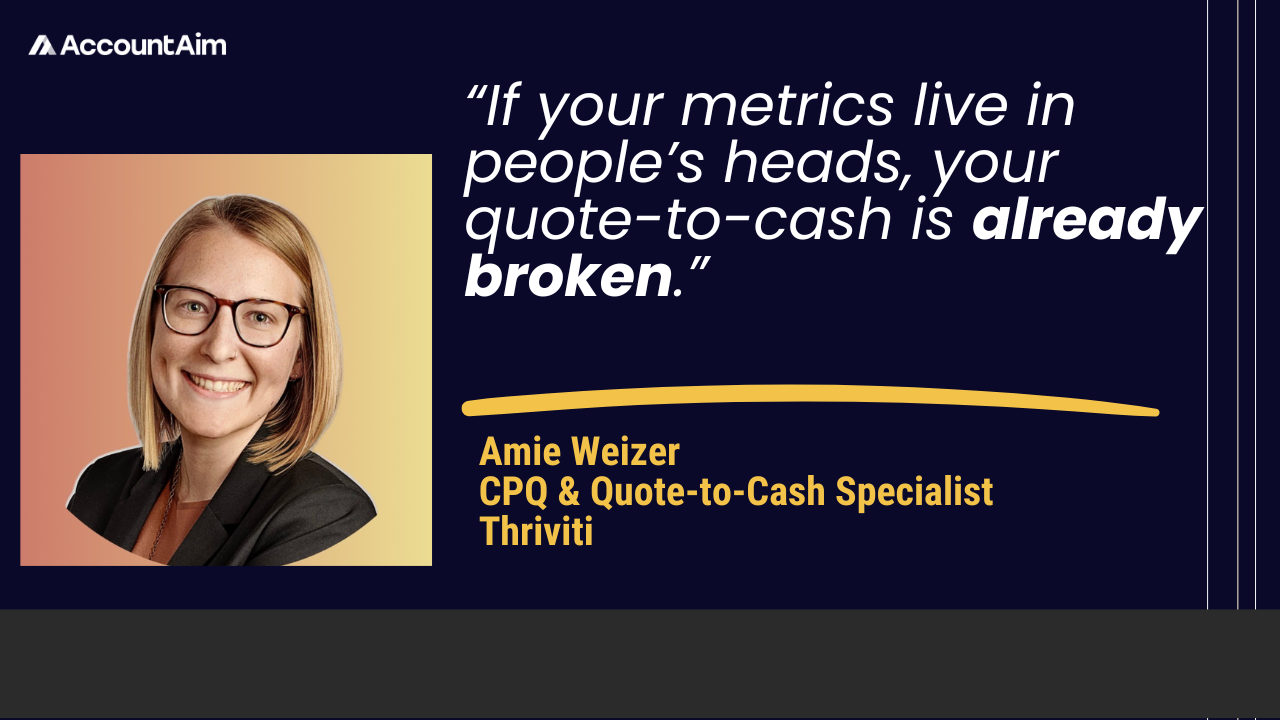
Maybe one region looks at churn and another comp another is going to look at churn differently. Maybe you’re, you’re getting constant slack messages of like, how do I quote this? Hey, I need this to be approved and turned around. Hey, did I get the proper approvals on this thing? All those definitions, living in people’s head is the biggest thing that you’re going to see when you start to needing to be thinking about what quote to cash could be.
And then once you get to this critical mass, you get to your breaking point because your sales team is putting in deals and your finance team can’t recognize them because it’s either totally not clear on the quote itself. Or it’s just something that is a three months free. Six months free could be any of those fun things that start to happen.
And really as your business matures, it becomes more complex. Those just become your standard deal structures. So your deal structures will start to change, and that’s where you’ll see these different teams reporting on different things. And finance really starts. The question, what is a source of truth?
What should I be looking at? Uh, then finally, you get to this after you’re through your breaking point, you start your documentation process and you start really putting that intangible into tangibles with your foundation, and that is where you’re able to actually understand, okay, I now know generally what the process should look like.
I know what it looks like. From documentation, who needs to approve what these quotes should look like, then you’re really just starting to enforce those rules, whether it’s through a CPQ tool, or it’s through just the processes that you have your teams trained on. Sales and customer success, even support.
You really wanna make sure that those handoffs are working consistently, and so there’s really no bad time to get better quote to cash processes because SMA uh, smoother handoffs, faster processes is better for you and for your customers.
Josh McClanahan: I love it. This makes sense. Maybe like really tactically for folks that, you know they, they’re starting to recognize that like, okay, we’re, we’re at the breaking point here.
You know, what you said just resonated. Like no one’s aligned up definitions. There’s nothing really documented today. What does starting that process really look like? Is it, offshoots and having, you know, conversations with the folks in the different departments? Do you do like the big, like.
Almost like, you know, the equivalent of the all hands and like, let’s get everybody together and we’re gonna go build this process together, kind of thing. Like what, what have you seen work well to kinda get that the ball rolling here. Once you’ve recognized that, like, okay maybe it is time for this.
Amie Weizer: Yeah, totally. Number one, executive alignment. What are we trying to achieve? What is most important to our organization right now? Is it really that our sales is not handing off to customer success? Is it really that finance can’t recognize the revenue? What do you need to solve for? In the past, what I was able to do with executive alignment was understand it’s a three phased process.
What is happening at the lead level that actually turns our leads into our opportunities? What is it that happens at the quote level and actually getting that quote out to the customer and getting your signature, and then the revenue recognition that happens at the subscription or the entitlement or the provisioning level.
So those. Three paths need to happen. They don’t need to happen all at once. They don’t even need to happen on top of each other. If you get executive alignment that says, this third stage is where it’s most important for us to focus, perfect, brilliant. Go get some wins. Go figure out how you can standardize and smooth out the processes.
Then you can revisit what’s happening at the quote level. Then you can revisit what’s happening at the lead level.
Josh McClanahan: It’s super helpful. Um, and as a reminder to folks listening, if you have any questions, please pop them into the chat. Um, we’ve gotten a couple already. Uh, one of my favorites, especially someone coming from a background in finance into the world of ops is what have you seen work well when it comes to working with finance teams, not typical stakeholders for RevOps?
For the most part, at least. Um, for most. So, yeah. How do you think about developing the relationship with the finance organization who owns what in kinda like this, this process, and like, how do you do that really well? Yeah, such an important thing and I’m so thankful. I’ve had such great fp and a partners who helped me on my journey as well.
Amie Weizer: What I saw work really well was to get into the weeds, you really have to get into the weeds with that finance partner. Uh, in my particular example, short story time is that when I started in my previous role, I was a customer success manager who was obviously being measured on churn. I noticed that two months in a row we had a customer who was on the churn list twice in a row, and I was like.
That’s so strange. What’s going on here? So I sit down with it, my fp and a partner, and I’m like, Hey, we really need to look closer at this one. And that’s when we say, oh, maybe we need to look closer at another one and another one and another one. And so we developed this pattern recognition of, wow, maybe we don’t have something that we need.
In our particular case, we did not have unique subscription IDs. So that was really not allowing us to be able to audit or tie out which customers were actually churning. So in actually getting in the weeds and starting to understand how churn was being calculated, was I able to say, Hey, there’s an opportunity to standardize and build foundation here.
Where previously it was just, Hey, let’s throw that over the fence. I don’t recommend that whatsoever. Having that connection and being able to sit down with them, that’s where the real magic happens. And then the other piece is, of course, back to that executive alignment. You know, you really need to have a really key decision maker on the finance side and on the revenue side.
You have to constantly bring this team together and say, here’s the standard that we’re working with now. We’ve seen this exception come up five times at least. It’s not really an exception anymore, it’s a rule. So let’s. Put that into the process, uh, my stage three that I’m thinking about for where that continuous improvement happens.
That’s really where you have those feedback loops to say, how many deals came in past the finish line? How many deals got approved, how many didn’t. You really do have to look at those numbers and understand how is your business actually operating compared to how people think it’s operating. It’s not the same most of the time.
Josh McClanahan: I think that’s a universal truth that we see in, in RevOps across the board is what we think is happening is usually not actually happening. And I think the more that you can spotlight and kinda shared shed visibility into that, I think the better off almost everyone is. Maybe sticking with the topic of like, getting quick to catch coming, like for the first time, uh, I found a mike for at least getting folks in finance to see the value here is relatively easy.
It’s touching parts of the business that they care the most about. It’s cash in the door, it’s revenue recognition. Like all the things that their, you know, day to day is. How do you think about getting maybe the skeptical revenue leadership and just maybe team on board with this new process? It feels like a lot more work.
There’s a lot of change happening here in my day to day if I’m a seller. Like how do you think about getting them seeing the value here and kinda committing to it?
Amie Weizer: That’s definitely tough and uh, I’ve seen a lot of different things happen and I can tell you what, uh, is most commonly happening, right?
So finance and RevOps will get together and say, here’s our new beautiful dashboard. Here’s everything that we’re going to be reporting on. And then your sales leaders see it and they’re like, how do we get to these numbers? What’s happening here? I don’t agree with the definition for that. I don’t agree what this metric means.
So then you have to go back and you have to gain confidence, and you have to gain that trust of, Hey, here’s our standard operating procedures. This is what it means when a RR is added to this row. This is what it means when churn is removed from this. Really building that dashboard with them from the get go is actually a way better way to build that trust and credibility rather than, again, this idea of all these systems are made at the top and kind of boiled down.
That’s really old school. The way that more modern SaaS companies operate is saying, Hey, we’re all on a team. We’re all in a boat and we have this quote. We need to get into actual revenue. So if you think of it in that way, I kind of think about it as a Sherpa, and this is what one of my first operational leaders used to say to me is, look, you seller.
Are starting up Mount Everest as a person holding a quote. You are now going to hand that off to the customer success manager. What if you give bad baggage because. S-H-I-T-N is SHIT out. So if you’re putting something on that Sherpa’s back that’s continuing to go up the mountain and handing off to the next team, to the next team, to the next team, that bag gets heavier and heavier and heavier with all of this debt in your company for not having standardization of your metrics, how things should be working together, and really that handoff process.
Who’s responsible for what? That’s honestly the, the most biggest challenge that I’ve seen is that people just won’t have ownership over it. They won’t know who’s supposed to define what churn is, who’s supposed to define what a RR is. So the more you can involve your stakeholders and re. Re come back to them in a feedback loop to say, Hey, we know that you gave this feedback to us about how we’re calculating a RR on a regional basis.
We took that feedback to our teams. We were able to confirm that there’s nothing wrong with changing the model to look at that. So we’ll now move forward and do it in that way. But really having the team part of the journey and helping, giving them some visual aids. The Sherpa so they know what they’re doing and how it impacts other people Downstream are the things I’ve seen to make everybody kind of work together and go along on the same journey.
Josh McClanahan: I love this like, visual. I think for me, I’ve always, uh, I completely agree and I’ve always found this idea of being able to build together with folks is just the easiest thing that I’ve ever seen to get everyone on board with the process. And you’ll still run into issues down the line for sure. Um, which maybe is a good segue.
So we, we’ve kind of talked about some of the challenges upfront in getting this process, you know, started for the first time, some of the, the common roadblocks that you might run into. Let’s say we, you know, we fast forward a little bit. We’ve got quota to cash process in place today. Feels like things might be working.
How, how do we know? Um, or like how should we think about kinda like the ongoing maintenance within the quote to cash process. How should we think about, you know, how do we avoid maybe like common pitfalls that we see when we already have that process rolling and we’re not setting up for the very first time.
Amie Weizer: That’s quite interesting because what I immediately thought of was just the maturity stage, right? As your business matures, more use cases come up constantly. So how do you account for new use cases is how I’m gonna take your question. I think it’s easier for me to understand it in that way. Um, so really common.
That’s what I see all the time with my customers. I’m supporting right now at Ravi. So these customers are already set up on new business and that is really a well-oiled machine. And then they come to us and say, I really need renewals, I need amendment. I need expansions to be working correctly. Operators from the back end know that you start getting into things like the duration being 9.64 months, or you start to see amounts that just don’t tie out either.
So when you run into some of those things, you actually have to make that decision as a business. Our original foundation is not quite there anymore, and we need to revisit what we should do without just building on top and building. What we all lovingly say is Lego bricks or Jenga. You know, you don’t wanna have one of those situations where you’re just building bad on bad.
So sometimes you do make that hard decision of, okay, what worked for new business is not gonna work for renewals or expansions, so let’s revisit our original principles and our original thinking and then build on it from there. These things will come up naturally as your organization scales. So, for example, what I’m doing with a couple of customers right now is this idea of product swaps.
What happens when the customer originally had this and now they want to go to that? Do we credit it? How much work does RevOps have to do? How much work does it finance have to do? How can that process be streamlined? It’s not something that a company maybe less than 10 million worries about, but someone going from, you know, 20 to 30 is definitely starting to think about the most ways to optimize their current customer base.
So these things will come up naturally and those are all opportunities for you as an operator to say, wait, is how we’re handling duration working? Or should we really consider duration for the longer term? Could be co-terminus or it has to be, uh, just totally flexible. You make those decisions as a business and normally I’m a, a line in the sand, like these are the business rules.
We’re allowed to have exceptions, but we need to have them documented so. Always revisit that your foundational understanding of how your business works matches the needs of your company as it scales and matures.
Josh McClanahan: It makes total sense. You touched on something that we see all of the time, which is as a business matures, complexity is just going to continue to grow.
You mentioned, you know, uh, probably a, a new concept for a lot of the folks that are listening, which is the idea of product swaps. And if we just, you maybe abstract that slightly. Like how, how do you think about like. Understanding what, what best practices might be in this space if there isn’t necessarily somebody in your organization that actually even knows what those are, are there resources that you’re going to, to find this information?
Are there folks that you’re talking to? Are there things that you’re reading to kinda like keep up to speed on like what these best practices are? Um, there are a little bit more kind of narrow than I think what a lot of revs folks are kinda spending their day to day in at least.
Amie Weizer: That is totally the nut to crack.
I am so glad that you hit on that, uh, the way that you did because it’s so true. Uh, there’s really not standardization in SaaS. No matter how much people want there to be, there’s really not. This is how it has to be done. When you talk about SaaS metrics, when you talk about product swaps, all of these things, we have regulatory things that we need to pay attention to from a going public financial perspective, but there’s not really on a day-to-day, how should these things be handled.
So the biggest thing that I was able to do, uh, that helped me along the way community, community. So I, uh, very early on was out there in YouTube, uh, before we had all these AI agents and the ability to just search things. I was like, Hey, who’s out there talking about quote to cash? And who is out there actually talking about CPQI kid you not, I found someone who, uh, had a LinkedIn profile still, uh, active in the community, and I was just like.
Hey, could I please have a conversation with you? I’m currently going through this right now and I’d love to have a second set of eyes on this so that I know what I’m, uh, talking about or thinking about. I had that call with that person and I was just so totally blown away at what he was willing to share and being able to kind of coach me through here’s where you could go looking.
And paths that you might wanna go down and start to understand more about X, Y, Z, uh, the community nowadays is even better than that. You don’t have to find things obscurely because revenue operations is such a growing field. And we are, uh, Ryan Mulligan, just the other day at Quota Path was mentioning that it’s so malleable.
We’re at such a critical time right now, which is really fun in revenue operations, where it means so many different things to so many different companies. And we are the pioneers of saying, here’s where we’re going. Here’s what’s working for us. And we’re sharing that. We’re inspiring other revenue o operators to take that knowledge back and make better go-to market engines for themselves, uh, the community.
Nowadays, we have so many Slack channels that you can become a part of. Whether you wanna be tied to women in sales, women in revenue, maybe just general RevOps. There’s, uh, a lot of different communities in the RevOps space, so you can go on their Slack channels. Sometimes you’re answering questions about tooling, processes and systems.
Sometimes it’s just like I did back then when I reached out and said, Hey, can we have a call to talk usage based pricing? You know, for example, the community totally wants. To help. And so you just have to not be afraid to say, I really don’t know, or I’d like additional input here. There are so many people who will raise their hand and say, I’ve definitely been down that path, and I don’t want you to go down it anymore either, so let me help you.
Let me show you the way instead.
Josh McClanahan: I love it. That’s one of my favorite parts of being in the RevOps and just operations space is how willing to share everyone is. Um, I remember when I moved over from finance into ops, I was that first ops hire didn’t really know exactly what to do, and I did kinda exactly what you mentioned, go try to find people that have been in my shoes before.
I’m like, I know I’m not solving, for the most part, net new problems. Now there are net new problems and maybe is a good segue to the topic du jour, which is AI and how we should be thinking about AI in. Almost everything within RevOps. I would love to talk about what you are seeing is changing, if anything, with AI and agents in the quota to cash process in CPQ generally.
Is this something that you’re seeing kind at the forefront like. Sometimes, you know, you, you read on LinkedIn that everything is possible with AI and agents are doing the work of everyone. And then, you know, maybe you get under the hood of the company and it’s like, maybe, maybe not quite. Like what’s the reality of ai, um, as it stands today and kind of the quote to cash space from your perspective.
Amie Weizer: So much opportunity for AI in the quote to Cash world. Uh, so many things, uh, starting my new role at th we are all on time tracking. So I’ve been really, really eager to put my analysis of my own time tracking into AI and understand what am I spending time on, where are the biggest projects and where are there opportunities to kind of standardize some of these things that I support with my customers.
So with that being said, I’m seeing AI from a pricing analysis. The huge one, right? So where are there gaps in my pricing bands that I’m not considering? Where are there opportunities for me to charge more for things where we’ve quoted higher, but it’s maybe lower in our list price? Uh, that’s a very common one.
Uh, the other area that we’re using AI is also in all of the, what happens a lot in SaaS companies is that there’s constant shifting as this growing happens, and it’s like, what worked for us then doesn’t work for us now. So we really need to be able to keep up quickly with what’s going on. Uh, in that case, we’re actually building tools that allow us to say, Hey, this is our framework for how we want to be working with, uh, we’ll go back to that term and duration thing.
We know standardization of terms and duration looks like this. So we have this tool that looks at, uh, what’s referred to as in our tool of choice deal hub. Shout out to this team, which is awesome. Uh, we’ve got, let’s say 72 questions that calculate term and duration inside of a playbook. We can now have technology with AI copy and paste that into another playbook for another customer.
So we have very standard ways of working with things that we know have stand the test of time, are tried and true, as opposed to saying, I’m gonna go manually, start from scratch and figure out. What this customer needs from term and duration. It’s not like that anymore. Now we get to say, Hey, I wanna copy this.
That works really well into another customer’s area. Aside from that, I would say on the front end, there is so much more opportunity to get things with AI and quoting into the seller’s hands. Uh, that’s an opportunity that is really untapped, but I think that’s a huge part of what Deal Hub and subscribe will be leading the path for in the future through this acquisition.
Uh, something stuck with me, uh, really, really strongly from something that they mentioned in one of their webinars where it was essentially that, you know, sellers don’t care about all of your rules in your CPQ. They don’t care that you can’t send something to a customer because they’re in a different region or a different en entity.
All of that stuff is noise for a seller. I get that, but in practice it’s hard to remember it. So what the future I think will probably be is that sellers are interacting with more of a chat interface. Hey, I have this customer who needs this quote. I don’t even know what the best solution will be for them.
But I wanna understand, based on this customer’s pain points, based on what we are able to solve for, what should I be quoting this customer on? And it knows all the logic. It doesn’t need to be telling them, Hey, you can only add 10 seats. You can’t add nine seats. All of that stuff just confuses the seller and takes them off track.
So giving them more of an interface, allowing them to have more of a chatting conversation, Hey, I wanna be able to put a 10% discount on, yeah, we can do the discount, but we also need to slack whomever’s in the approval chain and that person needs to approve it. So I see a huge opportunity there, and that’s definitely what our customers are asking for as well.
They also don’t feel like it’s a, a good use of time to be going through tons and tons of things, checking boxes, you. And no, I did this, I did this. It kind of becomes, if you think about it, what CRMs were and have become now, people aren’t really updating a CRM hopefully in these, uh, in these new go to market strategies, people aren’t really spending their time, oh, I had this conversation with Jane Doe.
No, actually now we have all these automated tools that connect A to B so that your call notes come in the spiced framework into your CRM system and you’re just approving them. Probably going the same way with quoting, and I’m really excited about what that future looks like.
Josh McClanahan: This is so helpful and I love like how tactical some of it is.
I love that. Like the idea of actually adding a layer in between the role of RevOps and the sellers with the chat interface. Um, I think it’s actually an underappreciated part that we’re seeing quite often. Is there, there’s a little bit less of that blame that’s sometimes getting placed on. The person in the RevOps we will refer to as like the hot seat when you’re having to go back and forth.
Like I, I think adding in these like little points of friction between that process is actually gonna make everyone a lot happier. Um, I think it’s such an underrated part of all of this. And then I think you touched on like one of the biggest challenges that we’ve seen just time and time again is like that, that blank page problem.
Why are we recreating this process from scratch every single time? And I think, you know, being able to take what you’ve seen work really well. And just almost instantly, effectively today, translate that to another situation. Another customer is such a time saver for everyone and hopefully will just lead to better outcomes.
I feel like I, and I, I’m guilty of this in this conversation because I, I asked early about the pitfalls that one might run into in the quote to cash process, and I think in RevOps, we oftentimes are spending so much of that time just focused on like the, the problem areas, right? Like our job is like, let’s go fix everything, right?
Maybe the, the flip of this though is like, sometimes things are actually working like really, really well. So how do you think about, like, what is a really just like amazing quote to cash process look like from your perspective? Like, how do I know it’s like, job done. I’m gonna go focus on a lot of other stuff.
Amie Weizer: Yeah, that’s fantastic. Uh, job well done is when you have all of your foundation actually working in practice. So you don’t have all of these slack messages of the reps saying, Hey, it’s end of month. I need this quote out yesterday. Uh, and then you have a leader saying, Hey, why hasn’t this one been approved yet?
It’s been sitting on XY Z’s desk. When you no longer have those kinds of, um, pitfalls, when you no longer have people having those kind of questions, that’s when you know you have a very strong deal desk team supporting your CPQ because. There isn’t gray area, and this goes back to my original thesis of turning the intangible into tangible.
All of those things that live just kind of here, there everywhere, nobody really knows what they are. The more that you have your foundation, the more that you have your structure, it’s much easier for you to be able to look at this and say, we’re ready to acquire another company because all of these processes work.
Hey, it never happens like that. But let’s say in a dream world. These things are working very successfully and we know how to quote. We know how to recognize our revenue and to get more revenue out of our customers. You know, if we bring in the winning by design framework, when you have all of that, then you’re able to say, okay, let’s bring in another company and let’s agree what it needs to look like before it comes into our systems.
Uh, that was also another pain point for me. I’ll just say something else that, uh, happens on the maturity scale as these SaaS companies grow, is that an acquisition comes in and you could have a totally new way of selling. You could have a totally new product line that comes out that’s also a red alert to you, Hey, I need some kind of CPQ standardization.
I need to understand at a baseline what my quote to cash is. Even a RCI at that point, who is responsible for what? Who needs to be consulted and who needs to be informed because. Believe me, I’ve been through this where you acquire a company, you bring in their a RR, you bring in their products, and then you say, oh, this isn’t working at all as we expected it to, so I now need to go back to the beginning and I need to kind of reframe this.
I need to bundle things differently. All of those things are just the reality of being in SaaS. And so yes, we need standards. Yes, we need frameworks, but they need to be flexible and they need to be malleable just as RevOps is as a whole.
Josh McClanahan: I love this one, this one’s near dear to my heart. I started my career in m and a and I was always so thankful that, uh, my job actually ended when this messiness started of actually doing the hard work of com, uh, bringing these things together.
So it, it’s such a challenge, I think, on the AI front. Uh, maybe the last, uh, question as we’re approaching time here is gonna be around. We’ve talked a little bit about how AI is actually impacting maybe like the tooling and the process that you are doing. I’d say the other thing that we’re seeing is that it’s impacting the way that customers are actually selling and how revenue itself is being driven.
We’re now seeing way more companies move towards usage-based pricing or outcome-based pricing. What’s the impact of that on the quota to cash process? Is there, are you seeing material change as part of this? It feels like it’s an added layer of complexity that now folks probably need to be thinking about that maybe didn’t need to be in the world of what I’d call like the easy traditional SaaS model.
Amie Weizer: Totally, yes. That is, uh, absolutely the case. And what we are seeing is a hybrid model because it’s definitely not a flip the switch. I’m now a usage based company or an outcome based company. It’s really understanding that your reps have been living this way most of the time, 10 years they’ve been in their organization and they’ve been supporting their customers.
So then when you bring in this, uh, this usage based or outcome based, there’s so much change management that has to happen from how you see. Sell it. That is one piece of it. Of course, the other part is the system, and I always think of that Homer Simpson, uh, RevOps meme where it’s like I, I need this workflow change to look, or I need this new process to look like this.
And then at the bottom of the meme, it’s got Homer with all of his fat, like stuck behind him with a clip because it’s like hiding all of the automation, all of the processes, all of the decisions, all of the systems, framework, all of that is. Totally true, and RevOps usually cleans up and glues all that stuff together, of course, which is the beauty of what we do and the magic of what we do.
But certainly you’re seeing a change management from what the sellers are doing. You’re seeing operational differences, and that’s why the hybrid model works because you’re able to still understand that this is generating US revenue. We can’t just turn off the faucet. We can’t just say, we’re not gonna bring anything in while we move to our new model.
So allowing them to say, I’m doing it this way and I’m also hybrid, and being able to start on usage and being, uh, able to start on outcome based. All in all, I also saw a really interesting post from, uh, from Harris this morning, uh, from Wizard of Ops, uh, over in Europe. He was mentioning, you know, um, the way that the, the future of SaaS is going with all of the seat based pricing.
That’s really gonna be a way of, uh, the past because it’s not that companies are hiring more and more people to do these jobs. AI is now coming to do some of these jobs. So how is the pricing model going to need to change to not be seat based? Because keep. Companies don’t grow their seats anymore.
Companies are gonna be growing their outcomes, they’re gonna be growing their usage. All of those types of things.
Josh McClanahan: I think it’s a, a complete rethinking of how many of these companies have have operated for a long time. Um, for anyone looking for inspiration, I would say look into the data space. There’s folks like Snowflake and Databricks of the world that have been doing usage based pricing well for a very long time.
Uh, might might give you some really great inspiration, but Amie, we’re. At time. Uh, as we talked about before this, we like, we knew that we were gonna be able to talk here for hours and hours and hours, but unfortunately I have 30 minutes wanted of the first. Just thank you so much again for taking the time, sharing this with everybody in the RevOps community.
Uh, one of the, the questions, the comment that kinda came in actually during this was just their mind was just blown by the generosity, the RevOps community. And I think this is the perfect example. Amie, if folks have questions on quote to cash, anything that we covered today, like where’s the best place for them to find you?
Amie Weizer: Yes, please find me on LinkedIn. I’m so happy to have a conversation with you about any of these quote to cash topics. I’m certainly also available on all these Slack channels if you feel more comfortable there. I know LinkedIn’s public, our Slack channels are a little bit more private. Uh, certainly love to have conversations and love to be able to support the community in any way I can.
So thanks for the opportunity today, Josh.
Josh McClanahan: Of course. Well, thank you so much again for everyone listening. We’ll be sharing the recording here. Um, thank you for tuning in and, uh, we’ll talk again here soon.
Amie Weizer: Thank you.
Josh McClanahan: Take care everyone.