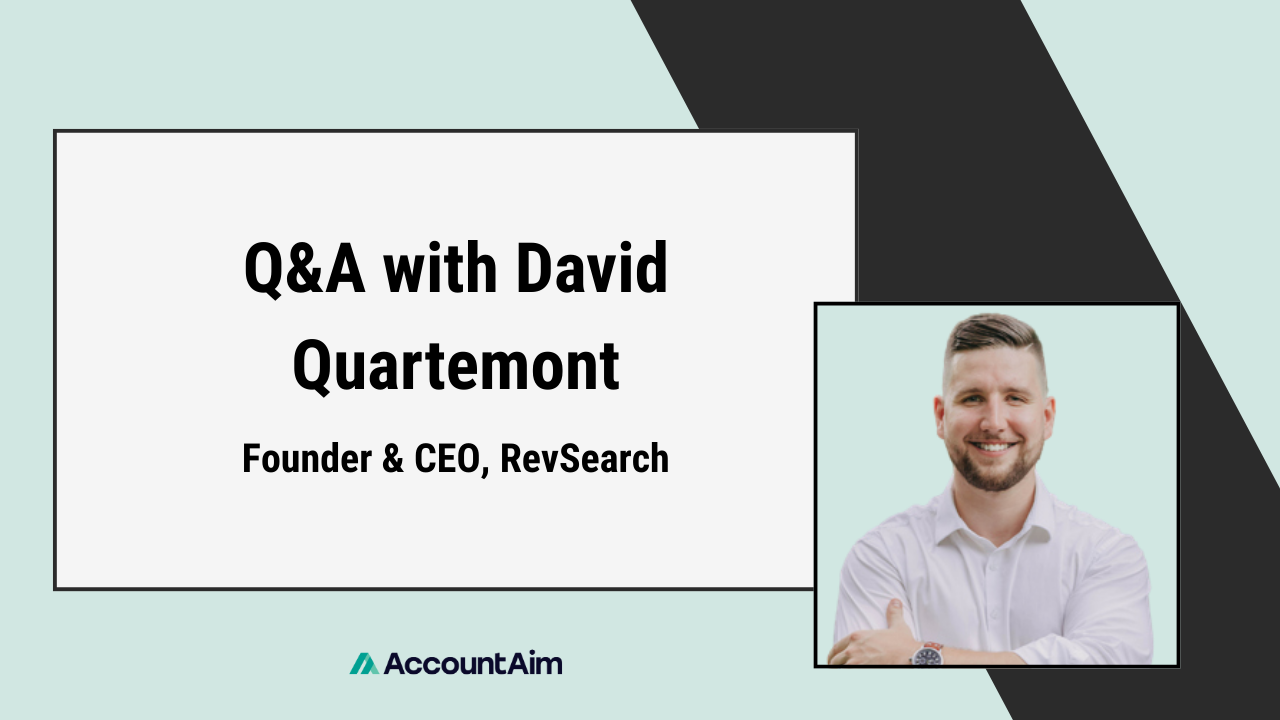

David Quartemont Q&A
David Quartemont has built his career evaluating operators in environments where clarity, speed, and outcomes matter. As the Founder and CEO of RevSearch, a RevOps-focused executive search firm, he partners closely with private equity–backed companies under constant pressure to perform. Across dozens of placements, one pattern consistently shows up: technical capability opens the door, but emotional intelligence determines whether a RevOps leader actually creates impact.
Quartemont’s background is in executive recruiting, placing VP- and C-level leaders into operationally complex roles across large, global organizations. Over time, he gravitated toward searches that required navigating ambiguity, cross-functional tension, and transformation at scale. When he was introduced to revenue operations, the alignment was immediate. RevOps brought together systems thinking, data, and human dynamics in a way few roles did, and it quickly became clear that it was one of the most strategically important functions inside a modern business.
What ultimately drew him in was not just the scope of the role, but its mandate. RevOps sits at the intersection of data, process, and people, often without formal authority, yet expected to create alignment, drive adoption, and enable leadership decisions. In private equity environments especially, that expectation raises the bar for how RevOps leaders must operate.
How did you come to specialize in RevOps recruiting, and why did the role stand out as strategically important to you?
I came from executive search, primarily VP and C-level placements, and I kept finding myself drawn to roles that were operationally complex. I enjoyed unpacking what problem a company was actually trying to solve and identifying the person with the right mix of skills to drive change.
When I started learning about RevOps, it became obvious how critical the role was. It touches everything. It is end-to-end, cross-functional, and deeply strategic. Once you really unpack the skill set, you realize RevOps is one of the highest-value assets a business can have, especially as companies move away from siloed teams toward a more integrated revenue model.
Why is emotional intelligence such a critical capability for RevOps leaders?
“If the RevOps leader doesn’t have high EQ, none of this other stuff is gonna get done. We can have the greatest tools, the greatest tech stack, great processes, great data, but if you can’t actually move an organization towards adoption, it’s not gonna work.”
RevOps is a human role at its core. It is about how you show up in high-pressure situations, how you navigate leadership conversations, and whether you respond thoughtfully or react emotionally. The most effective RevOps leaders are able to pause, regulate themselves, and operate from logic rather than emotion. That ability is what allows them to influence outcomes instead of just executing tasks.
What does high emotional intelligence look like in practice for a RevOps leader?
It starts with self-awareness and self-regulation. Are you aware of your emotional responses at work? Do you know what triggers you? Can you respond in a measured way instead of burning bridges?
RevOps leaders sit in the middle of competing priorities every day. Sales, marketing, finance, and executives all want different things. The leaders who succeed are the ones who can stay grounded, manage those relationships, and move conversations toward outcomes. That is what allows them to have difficult conversations and still create alignment.
How does a RevOps leader build trust and influence without direct authority?
“You’re not the CEO, but you have to think like the CEO. Navigating, leading without authority, that’s one of the hardest things. That’s why this role is so difficult.”
Trust is built by showing value early. That means deeply understanding the people you support, doing real discovery with stakeholders, and surfacing opportunities that matter to them. Coming in with a pre-baked solution is one of the fastest ways to lose credibility. The strongest RevOps leaders diagnose first, build relationships, and then bring recommendations that connect individual goals to the broader business objective.
What causes RevOps hires to struggle or fail, even when they are technically strong?
This shows up frequently. Many people have strong technical skills. They understand systems, data, and processes. Where they struggle is making the leap to influence.
Impact matters. Can you quantify what you have changed? Can you clearly explain to leadership what is working, what is not, and why it matters? If someone cannot demonstrate that they have driven change and influenced decisions, it becomes very difficult for them to succeed in a senior RevOps role.
Why are private equity–backed companies such a demanding environment for RevOps leaders?
Private equity brings in RevOps to remove emotion from decision-making. The expectation is to get to the heart of the matter quickly and help the business move in the right direction.
“The main reason why I’m bringing in RevOps is to take the emotions out of the boardroom. Let’s get to the heart of the matter and get the ship rowing in the right direction.”
These environments move fast. The window for value creation is narrow, and expectations are high. RevOps leaders need to understand the business quickly, identify the most meaningful levers, and communicate clearly with executives and boards. Comfort with pressure, adaptability, and executive presence are non-negotiable.
What advice would you give RevOps professionals who want to grow into strategic, executive-level leaders?
Start with self-reflection. Understand how you show up under stress and where your blind spots are. Be willing to ask for feedback, even when it is uncomfortable.
Mentorship also plays a big role. Spend time with people who have already operated at the level you aspire to. Learn how they think, how they prioritize, and how they communicate. Finally, take initiative. Push beyond your job description and surface insights others are not seeing. That is how RevOps leaders earn trust and grow into true strategic partners.
Go Deeper
If you enjoyed this Q&A, check out the full conversation with David Quartemont at YouTube or Spotify.
About AccountAim
AccountAim is the planning and analytics platform built for Strategic RevOps teams. With AccountAim, RevOps teams connect all of their fragmented GTM data, automatically snapshot and see trended changes over time, and build full-funnel reporting — all without SQL or data team support. Learn how Strategic RevOps teams use AccountAim to streamline forecasting, territories, cross-sells and more here.
James Geyer: All right. It is time for our latest episode of boardroom RevOps, where we’re bringing you valuable tips from RevOps experts so you can make it to the C-suite. I’m James, co-founder of AccountAim of the RevOps BI platform. Really excited to welcome David Quartemont today. He’s the founder and CEO at RevSearch.
Uh, David. Great to have you, man.
David Quartemont: Yeah, James, I’m, I’m excited to be here, man. Long, long overdue. So thanks for having me.
James Geyer: Yeah. Uh, David will share his background here, um, but he leads a RevOps focused search firm. Um, and we’re gonna get into a really interesting topic today that, uh, is actually kind of near and dear to my heart, and that’s just like the role of eq, emotional intelligence, um, and work broadly, but also RevOps specifically.
So we’re gonna dive in there today, gonna be really interesting. But first, uh, David, why don’t you give us kind of the, the background?
David Quartemont: Sure, sure. Yeah. So, um, without getting too, too worded on my intro, I have a tendency to do that. I’ll try to keep it really concise here. But, um, yeah, ventured out in 2020 to start this firm called RevSearch.
And, uh, my background, I, I come from the exec recruiting side, so, you know, that’s where I started my career. Boutique search, VP C-level placement. So that’s where I cut my teeth. And, um, you know, ended up getting the opportunity to, to work on some high level searches, um, that were very operationally focused, uh, throughout, throughout the years.
And, you know, big, big scale organizations, transformational roles, lots of six Sigma. Uh, continuous improvement kind of cross industry. But, um, you know, I started to develop this knack for complexity and profile and, you know, just kind of fell in love with that, you know, company has X issue, we’re trying to solve this issue, and we need to find the right person with the right combination of skills to, to, to drive this transformation through.
And, um, so that, that kind of gives you a little bit of background on, on myself. You know, I, I grew up in Germany. Fun fact, I, I was born and raised in Germany, a dual citizen. And so a lot of my search career has been focused on European companies as well. Um, but most recently with, with, uh, with RevSearch, um, it’s, it’s been mainly, uh, north America focused.
So, um, we really, you know, fun story. A a buddy of mine who was a RevOps leader at a telco company, me and him actually talked while I was kind of going through transition of figuring out. What is gonna be my niche in stepping out and building this firm? And he, he was a RevOps person, and we had quite a few chats about, you know, my background, some of the placements I had made, and he, he went, what do you know about revenue operations?
There’s something happening, uh, there’s a shift happening and it’s, it’s a really complex role. There’s an evolution happening. You know, we’re moving from silo to end-to-end, holistic, uh, you know, revenue organizations. And, you know, what are your thoughts on this? You know, and I started unpacking the skillset with him and I started realizing, wow, this is, this is it.
This is the role. Um, this is one of the most high value, most critical strategic assets in a business. And I realized that quickly and, um. You know, there’s other parts to the story that I won’t go into around, you know, the, the founder piece and the survival piece of having a, you know, going off on my own and, and trying to make something happen.
But, um, long story short, fell in love with the role and, and sourcing this role, and I realized this is gonna be it. This is gonna be the specialty. And we just happened to fall into the private equity space because of my network. And so that’s where we kind of niched down again and found really good, uh, fit.
Uh, you know, which is some of the topics we’ll we’ll go into here around private equity and portfolio company and that relationship and how RevOps really is the unlock, um, in maximizing value. So yeah, that’s a little bit about me. Um. That’s great. We’re obsessed with RevOps here. We love the role and we believe in it.
So, um,
James Geyer: yeah, you, you’ve clearly, uh, made the pitch on, on pro RevOps before I think you, uh, articulated as well as anyone I’ve heard. Um, so I think listeners will love it, for sure. Um, well that’s great David. Let’s dive right in. We’ll definitely cover the private equity piece as well. Um. We’ve had past guests on the show where we talk about it too, and it really seems like they’re starting to, to wake up to the value of RevOps, which is really great to see.
’cause they’re some of the smartest folks in the room, as they say. So we’ll get to that. But let’s kick off with just the emotional intelligence piece. Like maybe run me through the highest level, like A, you know, what is emotional intelligence B, what does it mean in kinda the context of a RevOps hire?
David Quartemont: Yeah. Yeah. So, um, I, I think it’s, if you look at emotional intelligence, and I’m not, and I’m not an expert, I’ve not written a book on it, right? But there are kind of four domains. There’s self-awareness, self-regulation, um, uh, relationship management, you know, social awareness. So, um, what does that look like in terms of work?
Obviously there’s a pers, there’s a, there’s the home front where that, uh, comes, comes out as well. Um, but within work. Uh, that is, that is how we navigate relationships. That is, um, you know, emotional intelligence is, uh, is the key to adoption in revenue operations. You know, when I think of, when I think of eq, it can be kind of abstract of like, what is, what is eq?
And I’ve talked to a lot of people. Um, but once you start unpacking it, you go, wait a minute, if the RevOps leader doesn’t have high EQ, none of this other stuff is gonna get done, right? Mm-hmm. And so it, it’s really this internal battle of self. Which now we’re getting kind of, you know, philosophical in a way.
And again, I’m gonna steer away from that ’cause I’m not the expert on that. But it’s really a battle of self and how we show up at work, how we operate in high stress, uh, situations, how we interact with leadership, um, how we navigate relationships, right? Are we, are we easily offendable? Uh, you know, what is our threshold?
Uh, are you aware of your emotional responses? At work, you know, are you burning bridges constantly because of the way you react, as opposed to hit the pause button and respond in a, in a healthy, calculated way. So, you know, there’s dia, there are diagrams of the brain that show kind of the different parts of the different centers, you know, where all of this takes place in the brain.
And you’ve got kind of your, your in instinct, which is, you know, your lizard. Portion of the brain, and you’ve got your, your emotional center, your limbic, and then you’ve got your front, your, your prefrontal cortex. And so a lot of us, including myself at times, we get stuck in the emotional part of the brain, right?
So we’re stuck in this emotional part. So, so we’re spiraling, we’re dysregulated, and you’re trying to figure out like, what is happening? I’m under attack, right? It’s this fight or flight moment. And really good leaders. Can get to the logic quickly. They can get to the front of the brain through different exercises, through internal kind of calibration, right?
Uh, they can get to that front frontal part of the brain to. Respond in a healthy way to have that crucial conversation, to navigate that relationship, to get to a win-win as opposed to blowing everything up right. With the wrong response. So I think that, that, in a sense, that gives you a good picture and hopefully the listeners of what, how I view it, um, ’cause it’s a human thing.
Mm-hmm. Uh, it’s, it’s a human thing. But you, people that operate at a high level, they tend to have high EQ because they’re influencing, they’re leading. And in order to achieve, again, in RevOps, the word adoption is so critical. ’cause without adoption, we have nothing. We can have the greatest tools, the greatest tech stack, the greatest processes, great data, great analysis, but if you can’t actually move an organization towards adoption, you can’t.
If you can’t get people on board, um, it’s not gonna, it’s not gonna work.
James Geyer: I, I, I think that’s so right. And then RevOps is such a central role touching every part of the organization. There’s so much coordination to be done that I think a huge gap I see for folks at the. Associate or manager level is just like, you know, I’m gonna do my job and I’m do my technical job well, um, and then I should get promoted.
But if you’re not actually going out and like actually affecting change to your point, um, you maybe won’t get promoted. In fact, you likely won’t. And I think some people don’t really realize that. Um, I’m, I’m curious, like, you know, you have these conversations all day long. Um, can you share an example from some of your searches where like a candidate’s eq like kind of really stood out to you or where it held someone back?
Curious to hear this in kind of like practice?
David Quartemont: Yeah, yeah. All the time, man. This is, this is, this is, um, the more I’m doing this, you know, the longer we’re doing this, the more I’m seeing this, we call it the secret sauce. You know, this, this soft skill set of the role being so important. Um, you know, you need to have the data chops.
You need to understand the system. You need to have. Of depth within the different domains from mar, you know, lead to cash, lead to renewal, kind of cross-functionally. You need to understand what the system needs to look like, but the, the soft skillset of actually, uh, like you said, initiating change, driving impact, that’s a whole nother level.
So I would say, uh, I mean the majority of folks that come to us that either want to do a confidential replacement. Or, uh, a backfill of some sort. We talk about eq, we talk about we need somebody who can drive. We do not want to hand somebody. We do not wanna give somebody orders. We need somebody who can affect change.
We need a force multiplier. We need somebody who can come in, diagnose, hand us the doctor’s diagnosis of what our company looks like, and help us understand what’s working, what’s not working, and then help us execute right. Navigate, again, leading without authority. Uh, how do you do that? I mean, that, that is, that’s one of the hardest things, that’s why this role is so difficult is because you’re not the CEO, but you have to think like the CEO.
Right. And so I would say from within our process, I’ve had candidates that didn’t make it forward numerous times because I’m not hearing the signals. On that greater perspective that, you know, the, the, the capacity to move to that influencer level. I’m not seeing it right. I mean, we have a vetting process and we dig into, we do a lot around impact.
Like that’s mainly what we do. You know, it’s all about numbers. It’s can you quantify your impact as an operator? So that’s what we look at. So when I’m in conversations with candidates, I’ve done this so long now that. I can quickly size somebody up based on the answers, based on digging into a case study with that candidate and understanding, wow, there’s, there’s not a depth here to justify, uh, to show me that, that they have the ability to get it done for my client.
Right? And so, you know, again, there’s different part there. There’s different ways to look at it, right? There are different, um, different parts of RevOps where that. Skillset comes up. But I, I think the main thing is, what I look for is I look for impact and I look for candidates that, you know, they, they are initiating, they’re driving, they’re, they’re proactive.
Um, and so to answer your question, you know, I was just thinking through some of the interviews recently. Um, I mean, actually a recent placement is a, is a good example. We, we came into a process PE-backed company and you know, they had a vp, they had a senior level person that was a sales enablement leader.
Um, that was a good people leader. Um, but, but they didn’t have this end-to-end skillset. Uh, they didn’t have the insights ability, the ability to actually, you know, um, tell the story. Mm. Uh, quite frankly to leadership, which is a huge piece. So it was an interesting one because it wasn’t like a, Hey, we’re hiring our first leader.
This person’s gonna run the show, we’re gonna build it out. It was a bigger team with a leader, and they were lacking this core. Piece of revenue operations in the team to, for the CRO to start to do more high level stuff. So that was the whole goal, was get the CRO out of the weeds. He’s trying to manipulate data and he’s trying to get a read on what’s going on.
We need somebody in the trenches that can go end to end and make sense of this and create one view and communicate insights and communicate trends and help us put a plan together. And so we started with a very narrow remit and you know, we put somebody in there. That has already within a few months, expanded their role, uh, in a way that, you know, somebody with low EQ would not have been able to do.
Right. With the, with, with the soft skills of, you know, getting to know, building that trust really quickly. That’s another piece of this. It’s building trust with stakeholders, right? So that you are, you are becoming the trusted resource in the organization. That’s, that’s the goal. Um, and if you’re not that, then you’re just an order taker in the back office, and that’s how people see you, right?
I’m gonna pause there for a moment. I’ve been going on for a while. No, it’s,
James Geyer: it’s great stuff. There’s two things I wanted to follow up on. I’ll, I’ll do them in reverse order. You mentioned like building on trust and expanding the role and I think so many RevOps people say, okay, great, I need to build trust.
I want to do that, but just like don’t know how. So I’m curious like if you’ve seen a trend from some of your successful candidates, maybe folks that have made VP or whichever level of like. The tactics they, they use to do that or how they talk about doing it. Like maybe in some of these like case studies they talk about, like, you know, how they’ve actually done that influence.
I’m curious if there’s like a second level that, that folks are doing that anyone listening can kind of take away as advice.
David Quartemont: Yeah, absolutely. So I would say the key word is ROI. Um, it’s opportunity, it’s white space. It’s, um, those are some of the key words that I would, I would, I would say differentiate.
Differentiate somebody. If you’re coming in, the way you build trust is you show value. How do you show value? Get to know the people that you’re supporting and you understand what matters most to them. You understand the,
James Geyer: it’s like a sales process. Yeah. We talk about this sometimes. You’re gonna do discovery on your stakeholders and deliver for ’em.
David Quartemont: Yeah, a hundred percent. So if, if you’re coming in and you’re going, I’ve got the solution. I don’t need to talk to anybody. I’ll build a world class revenue engine and you guys are gonna go to the moon. It’s like, nope, no, no. Hard stop. Right? That’s not. The solution. The solution is you are an expert that is coming in to diagnose, understand the people that you’re serving, understand the different personalities that you’re dealing with, understand the fiefdoms, the shortcomings.
Do a deep dive, build trust with people in a relationship, you know, manner, uh, like building relationships around their goals, understanding, and then understanding what is the overarching goal of this company and in pe. What is the thesis, right for this business? What, what are we trying to achieve? Where are we trying to go?
So I think it’s understanding that and getting to the heart of the matter quickly. You know, I think you can, you can, I’ve heard you know, quite a few stories of folks coming into this role and losing trust pretty quickly because they think they have the solution. They think they have it figured out, and really it’s a collaborative effort.
It’s under, it’s, it’s bringing your own playbook for sure. You have best practices that this company needs, but depending on the culture and the business, that changes. So you have to be able to adapt to a different culture, to a different business model and, and then come up with a win-win for that particular business.
So that requires a consultative approach, you know? Mm-hmm. And that’s how I would label it. So I think that’s the differentiator. It’s. You know, are, are you able to surface game changing insights? Are you able to find the opportunities? Are you able to size the business up fairly quickly and communicate it in a way that doesn’t make you the bull in a China shop?
James Geyer: Yeah. Uh, that’s really well put in, uh, shameless plug for AccountAim too. That’s what we talk about though, in terms of getting the data foundation in place to actually be able to provide those insights in real time and provide that value. Um, you also said something that really resonated to me that I wanted to kind of underline as well, and that was, um.
Um, understanding what the business is trying to get done and what your senior stakeholders are trying to get done. I think I hear more often than negative cases where things go wrong for RevOps folks. And, you know, we chat in the market and folks are frustrated and many folks will understandably so complain about how there’s just so much to do.
It’s chaotic. They become an order taker. They can have that, uh, strategic insight, but I, I think in many cases, those folks. Maybe aren’t doing as good of a job of actually understanding what really matters and laser focusing in on non delivering it for the rest of the company. I think it’s really easy to get distracted, but actually doing yourself a disservice in, in your career by trying to do everything and including many of the maybe priority C and D items and not the priority A items.
Um, and so I think like the EQ coming back to it is understanding what actually matters. Having those conversations with people, um, to, to figure that out.
David Quartemont: A hundred percent, a hundred percent. Uh, you know, everybody has good ideas. Um, and I think that the role of RevOps, you know, if I were to, first of all, RevOps must be un offendable.
You know, the, the RevOps leader must be un offendable. Like, I’m gonna just pause there for a second. That’s huge. That’s eq. You know, you, I heard one of my, um, one of my private equity contacts, uh, I was in a meeting with him one time. We were kicking off a roll and, and he said, uh, David. Really, the main reason why I’m bringing in RevOps is to take the emotions out of the boardroom.
That’s why I’m hiring RevOps. Let’s cut the bs. Let’s get, get to the heart of the matter, right? And let’s get, let’s get the ship in the rowing in the right direction. That’s ultimately what ops is supposed to do, um, you know, support, uh, in, in a business. So, um, yeah. So, so I think that, that, that’s great
James Geyer: that, that should be so flattering for RevOps folks too, that that’s why people are bringing RevOps folks in.
That’s incredibly impactful. Taking emotion out of the boardroom.
David Quartemont: Yeah, and it’s, again, it’s easier said than done. Right? I’m gonna, I’m gonna also say, you, you, it’s an organism, right? A business is full of different personalities, and sometimes you have growth minded people. Sometimes you have fixed minded people.
In that business. Right? What would be great is if you had only growth-minded people, and I’ve actually heard of companies like that. I’ve worked with a couple where you drop RevOps in and it’s like, it’s like putting gasoline on a fire and it’s unreal, right? The impact. But oftentimes it’s a mixed bag.
Of certain people that have been there. There’s some politics, there’s some fixed mindset. There’s, you know, I, I’ve been doing this this way, right? I don’t want to, uh, challenge the status quo. I’ve, you know, I don’t need you. And, and so RevOps is up against, there’s like a, you know, a, a battle that RevOps is fighting.
Um, but again, great RevOps leaders are gonna be able to come in there. And convert that person, that fixed minded person. You know, sometimes maybe it’s impossible, right? There are people that are so off the beaten path that are hard to convince, right? Hard to turn around. But I think generally when you get to, um, why does this matter for me?
You know, how how does this, this change that is make, you know, this, this new thing, this new process, this new tool, this new strategy that is gonna move me away from my comfort zone. How is that gonna impact me? How is that gonna make my life better? Right. That’s the connection that the RevOps leader has to make while thinking about the overall business objective.
Mm-hmm. Because it is about the business. It’s not about fief dumps, it’s not about people. And, and if we run a business that is full of people that think it’s their domain, like their function matters more than what the business is about, that’s a failing scenario. You know, it has to be about the business.
So. But I think at an individual level, it has to be that connection of what’s in it for me.
James Geyer: Yeah, definitely. These are, yeah. Great. Really great reflections here. Um, I want to chat, we’re kind of coming up on time soon-ish. I want to chat on your perspectives of EQ and kind of, uh, p backed company, but real quick first, as we kind of round out the, the first conversation here, like, you know, based on what you’ve seen, the conversations you’ve had, maybe understanding the background of really successful ops folks that, that you’ve placed.
Um, like what advice would you give to someone who’s maybe strong technically, but needs to build that leadership presence to move into an executive role? Like how, how can folks actually flex this muscle?
David Quartemont: Well, uh, get into the AccountAim, uh, mentorship program.
James Geyer: Yeah, RevOps Connect. Another shameless plug.
You’re just teeing me up, man. Thanks. Yeah,
David Quartemont: yeah, man. Here you go. Um, layup, uh, yeah, I think, I think it’s a, I think it’s a multifaceted approach, so, you know, on an individual level. Sit back, uh, and go inward. Like understand who you are as a person. Understand how, what triggers you, what’s your story of origin that informs your emotional spirals.
If you are someone who’s not quite there yet with that self-control, that self-assessment, you know, and then to be able to respond in a healthy way, do some self-reflection, I think that goes a long way. Um, uh, and, and you know, the easiest thing to do is. Ask your spouse significant other or, or whoever in your life, what do they see?
You know, what kind of person do they see? Um, and that’s really insightful actually. When you ask, it’s a scary thing to ask feedback. It’s a very scary thing to ask. But, you know, I think people that want to have high emotional intelligence are gonna, they’re willing to go there. They’re, they’re gonna receive feedback.
That’s another thing. They’re un offendable. They’re gonna humble themselves and go, okay, I’ll listen. Because there’s probably something there to learn, right? Which is another like innate thing that RevOps leaders bring is this desire to improve and get better and iterate. Yes. And so that should also be about self.
So that’s one thing. I think the other thing is mentorship. So getting into, you know, I’ve connected folks with senior leaders in my pipeline. Um, you guys have a more formalized, um, uh, community, which is awesome. So I think. Having somebody look at what you’re doing and, and going and asking them questions.
How did you, what, what was your journey like? How did you get there? What kind of questions did you ask? What did you prioritize? You know, how, how do you operate at this level? Because a lot of it goes into higher level strategy work, you know, corporate strategy and planning. And so I think having VP mentoring, like what you guys are doing is fantastic.
The other thing I would say is make friends with C-level leaders. Mm-hmm. Right? Get to know the priorities of the people you’re trying to serve, and, and specifically if you wanna be a PE-backed RevOps leader, find folks that have worked in PE-backed companies and have scaled and exited, right. Finding people, um, and building those relationships.
Now, those folks are busy, but I, I think. You know, I’ve met a lot of FO folks at that level, CROs, CFOs that want to give back, you know, they’re, they’re happy to hop on a quick call. So I think understanding your stakeholders better is gonna make you a better, is gonna set you up better to move into this higher level EQ skillset because you know, you know what the real needs are, um, of that individual.
And, um, and that’s what it’s really all about is, is not wasting time and getting to the heart of the matter. So there are also books. Crucial conversations. I’m in that one right now. That’s a great one, right? Having hard conversations without burning bridges, getting to a win-win, putting your emotions to the side, to the sideline, and getting to, um, actual solutions.
Uh, so that’s, that’s been a great book. Emotional two point, uh, emotional Intelligence 2.0 is another one. They actually do an online assessment so you can kind of self-assess and, and test. So, um, so yeah. And then the other piece is. Take initiative. If you’re, if you’re an IC or if you’re a number two, take initiative.
Push the envelope a little bit, right? Take some risks, find some insights that nobody else knows about if there are some, right. And surface those up and see what happens. Get out of your comfort zone. I, I think it’s, it’s all of this is coming back to challenging self and moving outside the comfort zone and starting, and that’s, those are the stories of great RevOps leaders.
They were in a role. Where they started going. There’s more, there’s more opportunity here and I’m gonna start doing some stuff. And before you know it, you pull a C-level leader aside, you give them a couple of game changers and they go, oh my gosh, that’s, yeah, absolutely. We should double down on that. And that’s how you, that’s how you start to, those are the building blocks.
James Geyer: A hundred percent. I love it. Um, I think that’s really well covered, at least from my experience too. The only other thing I’d add is kinda like a different form of mentorship is just. Bigger companies. My co-founder, Josh and I both started in investment banking, which has a really good kind of apprenticeship model.
I, I think a lot of, um, consultants I’ve worked with have had really good skill sets. I think there’s a a, a good apprenticeship model there as well, not necessarily as formal in RevOps. And that’s the challenge of the role is that it’s kind of ill-defined in some cases, but there’s gotta be some companies out there that do RevOps really well.
You know, ask around, you’ll probably hear it and you know, maybe you can go meet someone there that’s like really figured this out kind of. Uh, take you under your wing. And so I’d throw that on the radar as well. Maybe not quite as easy. Um, but something I, I’ve seen work. Um, I wanna speed through, well, not speed through, get to the PE backed part of this.
Um, you spend a lot of time placing folks into PE backed companies. Little bit different of an environment in, in many cases, like how do they differ in terms of expectations, jobs to be done? Pressure, maybe. Yeah. Feel free to wax poetic on it, man.
David Quartemont: Uh, so I’m gonna quote my. My good friend and, uh, yeah, my, my good friend Matt, Matt Gallagher, who we work a lot with over at HG Capital, uh, he on, actually, we did a case study together on a placement recently, and he, uh, in the video he said, we have 20 months to get this thing right.
I mean, sorry, I misquoted. Uh, we have, we have, uh, 20 quarters to get it right. Okay, so five year hold period on average. Sometimes longer. Uh, what does that create? That creates, um, a very small window of unlocking up value for a company like True Value, right? So, you know, most, most PE companies, they have a hundred day plan.
They come into a new company, a hundred day plan to get things going, right? The time to value is so narrow, so small. That’s why CROs average tenure is, uh, what, 12, 13 months, 24 months, something like that. Uh, don’t quote me on that, but again, it’s, it’s the, um, you know, it’s, it’s the 20 quarters, it’s the five year hold period.
And PE is looking at it and going, we want a three x, you know, we want to three x the value of this company essentially, and we wanna do it as fast as possible. We wanna get the biggest return, biggest thing on, on, on the buck, right? And so what does that create? That creates a small window, uh, a very fast-paced environment.
A very hands-on environment, PE being involved, PE meaning, so not standing off. There are some private equity firms that are more hands off. They’re less, they’re less push, more pull in their approach with the portco. But I think the ones that I’ve worked with that, that really value this role and prioritize the role, they know they need somebody there for them to get the scorecard.
That’s fast as human possible. They need to get a tight ship. They need to have reads on performance, on, you know, growth rate on re, you know, really the most, the most important things now in the, you know, post growth at all cost. It’s, it’s growth and profitability. You know, it’s EBITDA margin, right? That’s the main thing.
It’s like we’re not just growing. Okay, great. We’re bringing in new logos, but are we actually efficiently growing? Are we truly creating value, right? So you have to look at both of those. So you have to understand what are the most important things that private equity folks are looking for? What kind of metrics matter most, right?
And so, and then layering it down to the organization level. And so, you know, things like, uh, rule of 40, magic number, LTV to CAC ratios. Those are the game changing metrics that show viability of a great growing business. And RevOps has to absolutely care about those. Revenue operations, has to know how to influence and move the needle on those most important metrics.
Now, obviously layer down from that, it gets more granular across the customer life cycle, but I think you still have to keep in mind what does private equity care about? How do we influence these metrics in this business? Right? Um, so often I talk to, to, to leaders and they. Um, you know, they come in and, uh, and, and you’re looking at, okay, we’re, we’re making, we’re selling, well, we’re bringing in tons of new logos, but yet there’s an imbalance in the business, like, we’re losing what’s going on.
And you start to dig and they’re bleeding a bunch of logos on the other side. You know, we’re not actually keeping customers, so, mm-hmm. You know, it, it really has to be a holistic approach to revenue, uh, and with, with those metrics in mind. Um, and so the speed.
James Geyer: I, I am totally with you. And we see it as well for piggybacked companies.
Like, I think it’s such an interesting role for RevOps folks because it forces you to understand the customer journey, how it actually impacts the business, and what are the levers for every important part of the customer journey as it relates to the bottom line. And I think that’s, I think sometimes, uh, I love all the tools.
I love ai. I, I love a good system, but I think sometimes folks get. A little bit mired in kind of the workflows and stuff, which are important and can have great business impact, but it’s really like how do we deliver an effective customer journey that makes this a really successful business? And I love the laser focus from PE firms on that.
David Quartemont: Yeah, for sure. For sure. And um, I, I think I mentioned on the call before when we prepped for this, you know, technology is, is easy. It’s linear, people are really hard, they’re non-linear. And that’s why EQ is so essential in this role. ’cause you’re not just. You’re not just, well, maybe we’ll get there. We, we’ll have a bunch of AI agents running businesses at some point.
So who knows? Man, fast forward five to 10 years, who knows what we’ll be, but you know, right now we’re still, we’re dealing with humans. And humans do what humans want to do. Uh, they have feelings, they have emotions, right? And so you have to, you have to figure out how to herd, uh, the village and get, get the village moving.
So. Um, that’s, that’s why this is so essential for this role. Keeps definitely so important.
James Geyer: Yeah. I’ll, I’ll cut this off by just kind of combining the two topics. So tell me, I think we, you kind of have alluded to it maybe indirectly, like with how you described the RevOps role and the overall objective for a p backed company.
How does that change the type of people you hire? This can be EQ related, not EQ related. More about like competencies, kind of like what are you looking for that’s maybe slightly different than the average RevOps person. Or what are they looking for on the board?
David Quartemont: Yeah, they’re, they’re looking for people that have that soft skillset.
They’re looking for people that have command, they have drive. Uh, because if you don’t have influence, you’re not gonna, you’re not gonna get it done. You know, the, the, the, the order, the, the private equity order is so tall that you have to be someone who can thrive in, uh, adversity. In, in, you know, adapt to change super fast, right?
That’s, that’s a key. You have to try things. You have to fail, you have to change, you have to, uh, make change. You can’t sit back and, and test something for forever. You know, you have to really be, you have to, you have to match that pace. So what I look for is I, I look for people that have thrived in that sort of environment.
You know, I, um, oftentimes I look for folks that have been there, done that, right? Most of our clients want to have somebody who’s had a case study in a PE-backed environment. So, but I, I do think there are plays where we’ve had candidates that don’t necessarily check all the boxes, but they bring, they bring that initiative, they bring that drive, and they’re able to demonstrate that throughout the interview process that, no, I’ve, I’ve, I’ve unlocked opportunity and here’s how I’ve done it.
Right. I’ve presented up to leadership and, you know, I’ve been able to drive those conversations. I’ve been able to thrive in very uncomfortable. Environments in the boardroom. Um, you know, and here’s how I’ve done that. Here’s how I’ve accomplished this change. Here’s how it impacted those top, top metrics that we’re talking about in private equity.
So, um, I think part of it’s communicate, communicating, impact. And then the other part is, you know, are you able to run at a really fast pace and get to the heart of the matter quickly? Let’s not waste any time here. Let’s not sit back and think this little thing here in a siloed mindset is gonna, ma is gonna be the game changer for this company.
No, we need to diagnose. So I look at people that really diagnose end to end. I think that’s one of the most important things in this. Um, and, and, you know, and understand business really quickly. That’s the other piece. Mm-hmm. It’s understanding the business. If you can understand and size up a business quickly, you will be able to have those conversations.
Um, and, and you’ll come across as someone who has acumen, you know, the, uh, they throw out the terms, gravitas, uh, business acumen, all of that’s rooted in your ability to come into a business, understand the business really fast, and put together a plan and identify the leaks. Identify the gaps. Find the root causes, right?
Analyzing really quickly and being able to say, Hey. Here are the three to five things I’ve identified that are gonna move this business forward. Let’s talk about it. Let’s align on it. Do we want to put a plan together around this? Those kinds of folks tend to thrive in, in PE-backed companies.
James Geyer: That’s great.
That’s a good place to leave it. David, thank you so much for joining. This is awesome. I think it’s one of my favorite episodes in a while. Um, anyone listening, uh, if you’re kind of looking for a new gig, David Quartemont, uh, RevSearch. He’s your guy. Uh, thanks for coming on.
David Quartemont: Yes, sir. Take care.