RevOps Fundamentals: Lifecycle Stages, AI, and Career Growth with Mike from the Sales Nerd
What does it actually take to build a clean RevOps foundation, ship projects that stick, and grow your career in an AI-driven world?
In this session, Josh sits down with Mike from the Sales Nerd to get tactical about the RevOps challenges that come up every single day: from inheriting broken funnel definitions to getting sales leaders aligned, to figuring out where AI actually helps versus where it just makes a broken system break faster.
In this episode:
- Why lifecycle stages and sales stages are almost always a mess when you inherit them, and how to fix them in the right order
- The difference between acceptance criteria and solution design, and why mixing them up creates conflict with sales leadership
- How to build a CRM like a communication tool, not a reporting tool
- Why projects fail after launch and how postmortems and weekly KPI dashboards prevent it
- The case for tracking win reasons, not just loss reasons
- How to measure RevOps impact without overclaiming revenue attribution
- What AI is actually doing for RevOps teams right now versus what LinkedIn says it’s doing
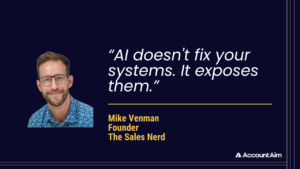
- Why AI exposes broken systems instead of fixing them
- How to grow from manager to director to VP in RevOps: the translator mindset and the curiosity framework
Guest: Mike Venman, Founder of the Sales Nerd
Predictable growth in 2026
Predictable growth in 2026
Josh McClanahan: Awesome. We are officially live and we already have folks starting to trickle in. Mike, super excited to connect today. As always. Uh, I feel like you’ve just been doing the AccountAim circuit, which I don’t think James and I have actually. Like really, we, we probably should be more coordinated on these things than we actually are, but I think today is gonna be a, a little bit more, uh, maybe freewheeling than, uh, than James’ conversation with you at least.
So I’m really excited. Uh, I thought we could do here. We’ve got folks trickling in and as they do, just a quick reminder. Anybody that’s listening, if you have any questions, drop ’em in the q and a at the bottom. We’ll try to get to, uh, any of those that come in here. We have a lot to cover today. Super excited to chat with Mike.
We’re gonna go into lifecycle stages, ai, career development in RevOps. All very high in mind. I get questions on this just about every day. So, Mike, maybe to kick us off, do you wanna give folks a bit of a background, uh, on yourself, kinda what you’re up to at the sales nerd? I think it’s one of the more interesting journeys that, that I’ve kind of come across in the, uh, in the RevOps sphere, at least.
Mike Venman: Cool. Yeah, of course. Uh, and great to be here, Josh. so my background starts with, I’m a salesperson. I feel like RevOps people, uh, sales ops people come from different backgrounds. Some are marketing, some are sales, some are finance. Some just picked it up immediately outta out of school. Those are the rarer types.
but I come from sales. So my first sales job was going door-to-door selling environmental non-profit memberships when I was 17. Uh, after studying in college, I came out. As a sales person, became a sales manager pretty quickly in my career. and then, um, and then developed a love for operations. It, stemmed because I was managing a sales team of about 20 and in this startup-y environment, and we didn’t have a Salesforce person.
So that’s when I started to really jump in and started solving these problems. you know, I, I. Realized managing salespeople may not be for me, but I loved the tactics behind it. I loved being able to organize people and processes into, into more profitable systems. so after doing that, I joined another startup, built out their revenue ops infrastructure, and then jumped into consulting, uh, where I started working with private equity firms, Vista Ta, ST six.
to merge companies in their business systems. And that became sort of like the big chunk of big meat that I, there were enough problems that I would never be lazy or, bored. Uh, so many fun new puzzles I get approached with every day. and then about three and a half years ago or so, I started the sales nerd, moved down to Ecuador, had a little bit of a midlife mix up, learned Spanish and started to, started to build out my company.
And now we work again mostly with SaaS based companies to, to formalize their business systems so they can understand conversions down through the funnel. and uh, we also touch on customer success and marketing ops and we touch on really anything that is part of the go-to-market systems. And, we are now working from comp with companies who do about 10 million a year up to about 500 million.
So, we get to see a huge scope of problems and, revenue operations varies. Incredibly, depending on what stage of the journey you’re in. Uh, so it’s really fun and I’m excited to hear with you, Josh.
Josh McClanahan: I’m super excited to touch on some of the differences that you see as these businesses are growing and scaling.
One of the areas that we’ve been talking about as we prep for this and just inform, um, in past conversations, has been around tracking lifecycle stages and just maybe the funnel more broadly. You mentioned in some of the conversations we’ve had, like some of the, the mistakes that you’ve seen folks make here, maybe not the right way to get the most out of it, that they could be.
If you were, you know, kind of starting from zero, like how would you think about designing kind of like the, funnel and lifecycle stages, um, as kind of a new RevOps hire or somebody that’s, you know, maybe picking up pieces from a process that isn’t quite as, uh, as well put together as one that you might do.
Mike Venman: Yeah, of course. So when a lot of people come into their RevOps gig, uh, inheriting the systems that other teams have built, and I think that there’s an order in in how you wanna approach your system because there, there are dependencies as you go through the process. So, for instance, how you’re gonna track the stage progressions, uh, depend on what those stage progressions are.
And if you change what those stage progressions are, you need to change how you’re gonna track ’em. So it makes sense to focus on key things first. first things that companies usually prioritize, is uh, stage definitions. And so opportunity stages, once a deal is created, either creating some sort of stage gate or process that is formalized, once a team does that for new business, uh, then they start working up the funnel and they start looking at lifecycle stages, which is really how marketing understands their, funnel progression.
once you have opportunity stages and then lifecycle stages, which typically live on the leader contact, then you would start, most companies start to think about customer success and amendments and, and they start to think about those types of processes. Once you really have that framework of new business marketing and then customer success and support, that’s when you can start to layer on additional sort of AI tactics or, um, sort of additional things to make you more efficient throughout the process.
But really until you have those three things, understanding your new business sales funnel, new business marketing funnel, and your expansion funnel, until you have those things nailed down, it’s probably not worth it to focus on other places. but as a company grows, they start to get more focused on moving the 90 to 95% solved problems as opposed to the zero to 50%, which you may find yourself at now.
Josh McClanahan: Yeah, it, it, it’s super interesting and honestly, something that I’ve really struggled with in understanding like, why is it the case that sales stages and lifecycle stages are not better to find and more standardized across teams? I would say in four outta five conversations I have with RevOps, uh, new RevOps leadership, that’s the first place that they go to and almost every time it is.
This is a disaster. We don’t have this well defined, like where does the root cause come from and why haven’t we gotten closer to standardizing this as kind of maybe an industry or within RevOps? It feels like, again, like this is just like starting from scratch. Every time that a new RevOps leader is, kind of hired, is it a systems problem, a process problem, a definition problem?
Like what is it?
Mike Venman: So I think there are about five stages that are pretty well known. discovery qualification. some type of demo or scoping and then negotiation and then closing. So there are probably like four or five that like, are consistent and then it becomes, then it becomes dependent on the culture of the business.
Many times sales leaders will come in and they want to put their stamp on the business. So there’s a, there’s a desire to say, okay, I’m gonna rename it. kind of like a new Trump building, that sort of thing. Like, I’m gonna come in, I’m gonna put my impact on, But that isn’t always necessary.
the, the reason why it’s not standardized is because of that personal sort of, uh, desire to make an impact or to make some sort of change in the business, something that’s visible. but it’s also due to the variance and the types of sales processes that they can be. I’ve worked on sales processes that are run completely in leads and they don’t create opportunities until it’s close one, and that’s the right way to do it for that specific type of business.
you might have an enterprise sale that is, 12 months to five years, something like that, that is a different sales process than something’s that’s gonna turn over in two weeks. because of the variance and the types of sales motions and the desire for, sales leaders to make an impact or a visible impact, that’s why I think you have the variance in, um, in sales stages.
they’re not as sort of defined as, as marketing stages are.
Josh McClanahan: I think it makes a ton of sense. One thing you mentioned here is making an impact where there’s already legacy and a lot of legacy in place working with private equity backed businesses. A lot of these businesses I know have been around for 10 plus years.
They have a lot of, yeah. You know, strong culture. They’ve got a lot of business processes in place and I think a lot of times revs is brought into transform that. How do you think about like that transformation both from like a systems perspective on like the RevOps side, but maybe more importantly, like how do you get everyone in an organization to change and think about change when that’s really why you’re getting brought in as a new RevOps leader?
Mike Venman: I think I, I think of a CRM as a communication tool. It’s a communication tool. So, often within companies, teams have different incentives and that then hurts the way that they can, can communicate in person. So by, by creating a, a system to do that communication for you, that’s sort of the end goal. Uh, and that’s what we try to do within our projects and, and what I’d imagine a RevOps leader wants to do when they sit there, but then how to do that, that process.
My strategy is to come in, understand what the problems are, create a safe space for everyone to advocate for what they need. Um, make sure that by the end of it, everyone fully understands what the process will be and what the definitions are, and then signs off on it. you’re not tying anyone to the railroad tracks.
You’re not, saying to someone that they, that they’re wrong. Even though that might be what you feel. So there’s a lot of, I think that’s a little bit of the sales person in me comes out. Um, yeah. ’cause I’m able to sort of convince people along the way of the journey, provide options and then, let the other person pick.
I mean, so, so many times in RevOps, you should not be the one deciding something. You’re the one listening and coaching and guiding to the answer that should be there. So, if it ever feels like you’re forcing a sales leader into something, you should probably stop and ask yourself why. why it feels that way.
Josh McClanahan: That’s really interesting. I maybe have a slightly different view on it, but I wanna talk a little bit more about like the way that you communicate maybe internally with your team and the way that you’ve coached RevOps teams to also communicate that. So maybe given the example here, you know, we’re in a situation where sales leadership feels one way.
And you and the RevOps team feel maybe slightly different and you have a different perspective and opinion on maybe the path forward. How do you communicate and advocate for, what RevOps believes to be the right decision? to your point, you know, taking into consideration what sales leadership is wanting or, you know, maybe even broader leadership is kind of wanting, um, I’ve always felt that a strain, um, I’d say like running ops teams myself, where, uh, trying to find that balance has always been a little bit tougher than I’d like.
Mike Venman: I, I really enjoy the separation between acceptance, criter and solution design. So the, it is something that I do on every single project. Right before this, I was typing away the acceptance criteria for a project, and it can be a little. Monotonous. It can be a little tiring to actually go through that process, but the separation’s super important, especially for this topic.
the sales leaders, the business leaders are responsible for delivering the requirements. They’re responsible for delivering. I need to be able to see this. I need to be able to strategize or twist the data like this. I need to be able to have this communication automated or I need to. have auto-generated content, whatever it is.
I, they’re user stories, uh, they’re usually in layman’s terms, usually in just plain English. I need this, if, if this is the case and I do this, this is the expected outcome. then it’s up to RevOps to figure out how to do it. It’s not up to the salesperson, to sales leader to figure out how to do it.
And, and if you’re, if you’re, I think being a good RevOps. Sort of team member you are playing that technical, technical guide. but you’re, you’re leaving the responsibility of the acceptance criteria, like what the team needs and how they need to function, what they’re asking for. You should listen to that because they’ve been successful with that before and most likely they will be successful with that here at your company.
Josh McClanahan: I, I like that framework a lot. I’m gonna steal some of that here. My, myself, I think, well, when it comes to like, some of the work, I’d say in Revs very related to this, there’s a lot of what I’ll call like. Semi-pro related work. Mm-hmm. I think a lot of what new RevOps leaders are doing for the most part, is like they’re standing up these new projects and then they’re moving on to the next project and they’re standing up that project and then they’re moving to the next one and they’re standing up that project.
And yeah. As they’re doing that, what we’ve seen is that the maintenance kind of starts to fall over. They’re starts to get cracks in some of these processes. You know, you left this project in month one and everyone’s in agreement, in alignment, and then, you know, three months later you look back and you’re like, wait a minute, why isn’t our team following this process?
how do you think about kinda like the maintenance side of projects, you know, once we’ve gotten like, success off the ground initially, like how, yeah, how, how do you think about managing that and making sure that folks are still, you know, remaining in alignment post that, you know, final sign off and victory on the, on the project side.
Mike Venman: Yeah, everyone likes to celebrate. Mission accomplished, you know? A
Josh McClanahan: hundred percent.
Mike Venman: A hundred.
Josh McClanahan: Me too. Me too. Yeah.
Mike Venman: Hey, you know, I’ll take the win. Take the W. Yeah. you know, so many, so many times when you begin a trial, you need to think about like a scientific. And this is why I love revenue operations is because you’re mashing together this like, this very technical background, this ones and zeros, black and white with the world as it works, right?
Mm-hmm. Uh, where you need to understand, people. So we often. Take the project. We say, oh, as RevOps people, we love to help out. We love to, to feel needed and, and, and do good for other people. That’s why we get into this type of role. We say, okay, I can do that. Cool. I’m gonna go do that. And then we do that and then move on.
but we don’t start to think about, okay, what is the actual impact of this gonna be? What is, how are we going to test this before we roll it out to the entire team? Because you only wanna make small tests first. Prove it out and then, you know. To the entire team. And, then three ongoing. How are we going to make sure that this works in the long term?
like what is the specific metric that we’re looking at to determine if something’s working or not working? And, one, one secret tip a month in, uh, write up, set up a meeting for a postmortem. Bring, bring the, bring the group that said that they wanted that, set up the meeting a month after it’s live and put that on the calendar right away.
Don’t wait. Um, the other thing would be set up a dashboard or send, set up some sort of system so that of all the projects that you have, you’ve already isolated the KPIs that you’re looking at. Uh, just put it on the dashboard. Take a look at it once a once a week, Yeah, there’s a good line. You don’t get what you expect.
You get what you inspect. So I like
Josh McClanahan: that.
Mike Venman: that’s true, but it, it, it does happen quite often that it needs to be revisited and the RevOps person is gonna be the one to revisit it. You really want to be the canary in the coal mine, being the first to alert as opposed to being caught on your heels once an executive runs a report and it’s not right.
I’ve been there way too many times. Um, thankfully it was early enough in my career that I had some time to bounce back.
Josh McClanahan: Oh, likewise. I, I love the analogy actually of canary in the coal mine. Uh, again, I think I’m just going to start ripping everything that you’re saying here, which is why I do these in the first place, just so I can get a, a little bit better at my job.
one thing you mentioned that I really do think that folks who spend more time with is the idea of doing postmortems. At least what I see in most organizations. Postmortem are done when things go poorly. I would say doing them when they’re actually going successfully is as important, if not more important too, for a lot of the reasons we’re talking about.
One, to stay on track from a maintenance perspective, but two, how do you take like and learn from the success? Like what actually made these projects successful? Um, I just don’t think we spend on the rev side enough time there. We spend a lot of time on the, the problems and. To the point you were making earlier, like those problems are gonna continually exist and go away.
Like one of the reasons I like RevOps is like, you just, there’s no end state. There isn’t this like place in Nirvana where you’re gonna get to where it’s like, oh yeah. Like our job is to actually, oh, wouldn’t that be great? Yeah. Oh, a hundred percent. the number one thing thing when
Mike Venman: you solve all the problems and then you just coast, oh, that’d be beautiful.
No, the problems just keep popping up. and you know, there’s this idea of a loss reason on opportunities. How many companies have a win reason?
Josh McClanahan: very few, far fewer than should.
Mike Venman: Very few, far fewer than should. So instead of running from the things that are pushing you far away, why don’t you run towards the things that are pulling you?
Why not we do this with ICP all the time. What are the customers that we have and what do they look Like what’s their revenue size? What industry are they in? Where are they located? When re were they funded? Whatever? Then we go after companies like that. Well, why don’t we do the same thing with opportunity?
Close one reasons. Why don’t we do the same thing for, you know, projects that worked really well? It’s the same idea. Let’s go after the things that are pulling us instead of running from the things that push us
Josh McClanahan: could not agree more. I mean, it’s one of the reasons why private equity firms, it’s the first piece of analysis that they’re doing every single time for any Port Co.
Let’s get our ICP straight and let’s go after it. So that account tiering exercise, it seems basic at times. Probably should be being done a lot more. So if you’re looking for quick wins on the RevOps side, probably start there today and you’ll, you’ll be in a good spot. I wanna go back to a point you mentioned earlier, which is around the lack of measuring impact in mm-hmm.
RevOps and projects before they get started. I’ve heard a lot of folks talking about this both from a, like, how do I, you know, become more strategic and I wanna make sure that we’re working on the projects that are impactful. So just overarchingly like. How do I think about measuring the impact? And then from a career perspective too, I think it’s really important obviously to know what your impact is on the company.
RevOps is a little bit squishy. It’s not like sales and that there’s, you know, I can see exactly how many dollars I brought in this quarter, like in front of my face every single day. How do you think RevOps should measure, impact the projects that they’re working on? And as a whole, how should teams and companies be thinking about measuring the impact of RevOps?
Mike Venman: Uh, I mean, that’s a good question. A lot. A lot of it can be time. You can be associated to time. but it comes back to what I was saying before. When you start a project, what are the KPIs you’re gonna be measuring against? And, how are you going to be measuring it? That will directly lead into, okay, it impacted this much revenue.
if I am thinking, okay, I want to increase, call pickup rates because I’m, and I’m going to include a new data enrichment service. Uh, that should, uh, give us better phone numbers. Right now, the pickup rate is X and I suspect that if I do this change, it will be Y, and then after you do the change, it’s Z.
Okay. the difference between X and Z, what it was before and what it is after, is your impact if you multiply it down the phone. So if you measure the KPIs that you, or if you choose the KPIs that you’re gonna be measuring against, and then do that consistently throughout the project, you can then.
Take that, take that value and then move it down the funnel. it’s not so clear as marketing attribution. It’s not so clear as sales. It’s all project based. It’s all a custom metric. don’t, stop with the things that are immediately not measurable, like communication. Not every project that you do needs to have some, some outcome.
That is a number. Some of it is just the communication at the beginning, and then it’ll get into projects that are more tactical and have the, have the revenue figure tied to it.
Josh McClanahan: I think that’s a really good point. Knowing what KPIs you’re trying to go after, I’d say is critical. But I think in the world of ops, there are a lot of metrics that are just gonna be harder to define, harder to measure the impact, but you know, at your core that it’s going to be helpful if it’s speeding things up, if it’s allowing people to communicate better and more efficiently.
Assuredly there’s an impact there. I’m curious, I, how do you decide what like the right level of KPI is that you should be picking in RevOps? One challenge I’ve heard from folks oftentimes, and I mean I struggle with this a lot when I was in BizOps too, is. Yeah, I could roll almost everything up eventually to revenue, but if I was to tell my boss like, Hey, this project impacted the business by adding $5 million in revenue to the business, I think that’s probably too far away from like, where maybe the metric that we should have been measuring would’ve been.
It. It kind of gets lost in the noise a little bit where you’re like, well, maybe that was true. so how do you think about like picking like kind of the right metric? I.
Mike Venman: Yeah, I mean that’s a, that’s a good point because if, let’s say you’re, you’re working on lifecycle stages and you’re, you’re trying to increase the conversion from one thing to another, from one stage to another.
But that conversion happens more often because you change the criteria and then you see the loss of that conversion in the next stage jump. then you could easily say, well, I increased the conversion from this step to this step. Which if you play that down the funnel. $5 million. and that won’t work.
So you, it’s a very good point. It’s, it is an outline. Um, it’s, you know, when I was, when I was working in, in RevOps directly, which was seven, eight years ago, working directly for companies, it, it wasn’t something that I, that I kept track of the same way I did when I was a salesperson. And maybe I should have, maybe I should have.
Josh McClanahan: I think it’s hard for what it’s worth, I don’t think anyone that I’ve met yet is tracking it at that granular level in RevOps yet. But I do think it comes up really frequently and I think especially as you think about like growing your career in Revs, I do think it’s important to be able to communicate that, um Oh yeah.
While maintaining the credibility with it. Because I think you can lose credibility if you’re like, this impacted $5 million when I updated a lifecycle change like lifecycle stage. Maybe
Mike Venman: it really depends where you sit in RevOps. there are some positions that just focus on territories, just focus on commissions, just focus on data, just focus on, uh, it really depends what company you’re at and what’s, what particular area you’re in, inside RevOps.
and it might be more outcome based as opposed to revenue based. So you can say, you know, 50% of our team is doing outbound cold calls. I increased the pickup rate. From this to this, uh, if that was maintained down the funnel, it would be this. We saw an increase of this.
Josh McClanahan: I think that is definitely the right way to do it.
You mentioned outcome-based, which leads us to outcome-based pricing, which leads us to ai because everything goes to ai. Um mm-hmm. One of the reasons that I was so excited to chat with with you in particular is I think that you’ve taken a much more tactical approach to AI with your clients and customers than.
What you see on LinkedIn. So I’m curious, like what’s actually working from your perspective in AI for RevOps teams and the customers that you’re working with, and kind of what else, what’s like the noise out there?
Mike Venman: Well, the noise is thinking that one system will solve every problem. that’s the, that’s the noise.
you’re not gonna be able to write a prompt, uh, that will create an SDR that’ll pitch a product just as well as you will. And that’s what a lot of the junk on LinkedIn is, is being able to, hit a couple keystrokes and then make money. Yeah, it doesn’t work like that. you have to really choose the biggest pain points in your business and focus on breaking that down into smaller chunks, um, so that each of those can be become skills.
And then you can, then you can create an architecture of an agent with all of those skills that employs those skills whenever you want. so it could be something like account tiering, account sc, account scoring signal, uh, based, how do I know, uh, how do I put the correct accounts in front of my team?
That’s the biggest problem. They just have a territory that’s too big and they don’t know how to target. That’s the problem I want to target. How do I do that? Well, I’m gonna look at signals, I’m gonna look at all these other things, or content generation. so outbound email, cadences, that sort of thing.
how to do, and that specific one is broken to, you know, I think six or eight different skills different. Agents, just because you’re taking this larger problem and you’re chunking it down. so what I suggest, kind of like when you’re choosing a thesis is to get as specific as you can, because as soon as you dive in, you’re gonna need to get even more specific, uh, in order to make it work.
it’s also that AI does not fix your system. That that is a, that is a, an error. it exposes it. So if you have a jumped up system and you couldn’t understand your funnel before, it ain’t gonna help with that. it’s just gonna, make the car go faster, but you still don’t gotta steal it.
Steering wheel.
Josh McClanahan: I think that’s a lot in line with what we see. There’s this belief, it feels like on LinkedIn that like almost all business becomes the way I liken it’s to like high frequency trading where just like money is printed and made automatically in next to zero time. And I just don’t think that’s the world that most of us are living in.
Um, albeit there’s a lot of exciting change and I don’t think that we’re at a place where you can just be as skeptical about some of the impact because like we’re seeing impact of it. Every single day in every customer that we work with. Mm-hmm. There’s definitely portions of it, but I think to your point, like being methodical about where and how to approach it versus just waiting for this like one shot, it’s gonna fix my entire business and we’re all gonna be sitting on the beach.
we, we might be a few years out from that, uh, still.
Mike Venman: Yeah. Uh, hopefully. Well, maybe not hopefully, but who knows? yeah, I think, I think with the development of ai, you have a lot of security problems, uh, that are, gonna come through, um, as well as revenue Operations teams generally come from those backgrounds, marketing, sales, finance.
They don’t come from DevOps. They don’t, they aren’t programmers. So AI introduces a table structure into, introduces security problems, introduces coding, introduces a lot of, uh, skill sets that a lot of RevOps people don’t have right now. So I think over the next few years we’re gonna learn more about how to handle the database of skills and inside of an AI platform and how to deal with security and how to upskill in the revenue operation space.
Because if you don’t have a, have a programming background right now, you don’t have access to. And if you aren’t learning, you don’t have access to a lot of things that are making a big impact. I did. I card code is
Josh McClanahan: a
Mike Venman: great example.
Josh McClanahan: I think that’s spot on. Um, I would say like I am more than dangerous with tools like log code and then you give it to somebody that is an engineer like our CTO and it is just night and day what they’re able to do.
Um, it’s a very different tool, very different skillset. I mean, speaking of, I think a lot of folks, you know, are really focused right now on like. How do I uplevel my career in RevOps, both from a skills perspective, which we’re touching on now, but overall just like, how do I continually move up the, you know, kind of the, the progression within an organization in this like ever changing world.
Any kinda advice? I know that you’ve been out of it now for a little bit, but you got, you have like a unique perspective, I think, given that you work with a lot of RevOps teams inside the companies like. Anything that you’d recommend from like a career development perspective now for somebody that’s like maybe newer to RevOps or just looking to kind of break through and get to like that, that next level maybe, going from manager to director level or director to VP level?
Mike Venman: Yeah. Sorry, there’s a little piece of fluff that is floating around. There we go. so I think that there are two sides. Revenue operations. You’re a translator. That’s your job. Your job is to translate between systems, and processes that people are following into those platforms, uh, and to different teams.
You’re communicating in between sales and marketing and finance, and cs. You’re a translator. So I think the more skills that you can, develop in order to communicate. The better your career is gonna go in general. Apart from that, technically, technically understanding these AI tools as they come out, if you have a good base fundamental knowledge of Salesforce or HubSpot, whatever the CRM is, then starting to just get curious about these other tools as they might be able to solve some of your problems.
if you’re not using ai, you will, I, don’t even wanna finish that sentence, uh, because it’s so stupid. It’s been said too many times, but, it would be to be curious is be curious. Try to solve, problems that you’re given using the new tools. don’t just solve them the way that you know how, especially if you’re being paid to do it by a company.
Let yourself learn while they’re paying you
Josh McClanahan: I
Audio Only – All Participants: love
Mike Venman: that. Solve the problems with these new tools. Learn these new tools, and then that’ll make you more marketable. how to go up the ladder. Similarly, be curious. Raise your hand. Raise your hand, be humble, be curious, and, um, and admit when you make a, make an error, don’t make errors on an island.
Um, get to consensus before you act. And then if you do those things, people are gonna like working with you. And then, and then you’ll move up, you’ll be exposed to more.
Josh McClanahan: I think that’s incredibly helpful for folks that are looking to make that transition. Like in the beginning of this, before we started, we said we were gonna be able to talk for hours and hours and hours.
And I think we were a hundred percent right. We’re somehow already in time. And I feel like we just kicked things off. I know. Uh, we, we, we will absolutely have to do this again. Um, I wanted take the time to thank you for doing this. Thank everybody for joining. as a quick reminder, we’re gonna be posting this.
So don’t worry. Yes, we are recording it and it will be posted so you’ll get access to this again, Mike. If folks are looking to learn a little bit more about you, the sales nerd, kind of some of the companies and problems that you’re facing, what’s the best way to find you?
Mike Venman: Uh, best way is probably on LinkedIn or to look at my website, uh, the sales nerd.com.
Uh, there I post a lot about common, revs, RevOps, e challenges, uh, as well as, uh, a little bit of the types of problems that I love solving. Uh, but feel free to reach out to me on LinkedIn. I, love geeking out about everything, sales and, and operations. So, uh, just reach out and I’ll, look forward to hearing from you.
Josh McClanahan: Amazing. Well, Mike, thank you again. Thank you everyone again, and we will talk soon.
Mike Venman: All right. Thanks, Josh.
Josh McClanahan: All right. Take care.