
How to land a new role, prove value, and move up
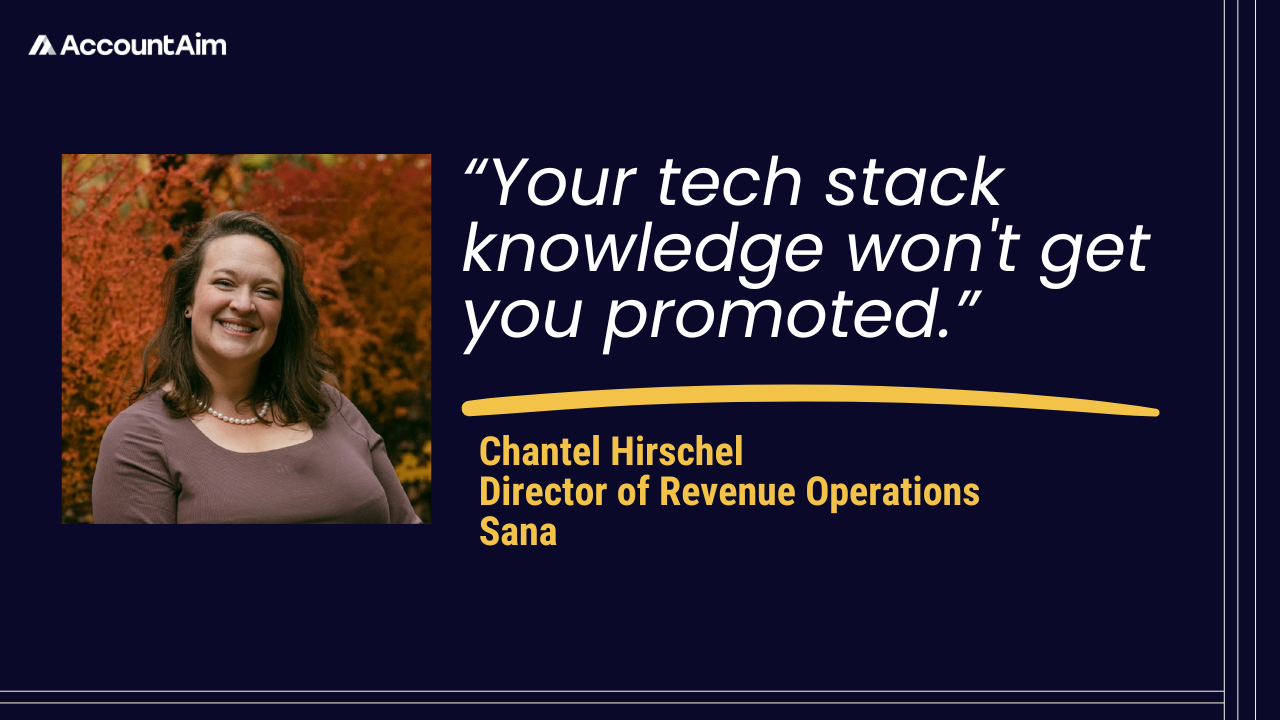
Starting a new RevOps role, proving your impact to leadership, and actually moving up the ladder are three of the hardest things to do in this field. In this session, Josh sits down with Chantel Hirschel to get honest about what changes when you start a RevOps role with 15 years of experience behind you, why the politics of an organization matter more than your tech stack knowledge, and how to build the social skills that actually get you promoted.
In this episode:
- What changes about starting a new RevOps role when you’re doing it in your thirties versus right out of college
- Why the first 90 days should start with the tech stack, not the CRM
- How to say no without ever actually saying no, and why building trust first makes everything else easier
- The case for tech stack consolidation and contract negotiation as your first quick wins
- How to measure and communicate RevOps impact in a way that’s credible, not self-promotional
- The brag book: why you need one and how to build the habit of tracking wins
- Managing the sales, marketing, and CS triangle when everyone has a different definition of a lead
- Why MOPS experience makes RevOps leaders better and where most sales-ops-to-RevOps transitions fall short
- How to actually build soft skills, from personality assessments to the AMA communication courses
- Navigating org politics at the director and VP level without getting caught in the crossfire
Guest: Chantel Hirschel, Director of RevOps, Sana
Our webinar is officially live and it looks like we already have folks trickling in. So we will give it just a second here and then we’ll kick off. But for those that have already joined, great to see you all. This has been a fun webinar series. I’m glad that I started doing this.
So this year one of my goals was to produce a lot more content. It’s been great to have a lot of conversations like these. Really excited to talk to Chantel today and share a little bit more about navigating a RevOps career. We’re gonna dive a little bit deeper here, but for those that have joined, we are going to be recording this. If you have any questions, there’s a Q&A section at the bottom. Go ahead and submit those and we’ll try to cover them as we get going.
Chantel, why don’t we go ahead and get started. It’s going to be a little bit of a deviation from some of the typical topics we cover on this series at least. Would love for you to share a little bit about your background. How did you get into RevOps? I think it’s a little bit different than most, but at the same time I don’t know if there’s one linear path quite yet into RevOps. How’d you get into this fun world?
Yeah, I’m definitely pretty self-taught. I graduated at the tail end of the recession with a good degree in international relations, and it was hard to find a job back then. I found a job on Craigslist for a small local company, and it said you needed Microsoft skills. I said I have those and I need a job. So I joined the company and they were using Goldmine CRM. I ended up having to do a lot of Excel builds to manipulate the data I would dump out of Goldmine, and I started doing a lot of reporting.
My title was business development, but I was doing everything. Six months in, the marketing person quit. So I began running all of our marketing programs as well. I moved us to our first email marketing system, I think it was Constant Contact, and then eventually moved us into our first CRM and MAP. We migrated from Goldmine into Salesforce and Pardot, and that was this huge move. We’d been on a physical server for all my time there. When I first started sending emails, it took almost 48 hours to send an email because it was sending directly from a physical server. When the server went down, the entire company stopped. That was the life I started with. And so we migrated into Salesforce, which felt like a whole new world.
Got to build a Salesforce instance from scratch. Got bought out by a larger company, migrated back to NetSuite with them, and then back to Salesforce a year later. Then did Marketo, became the MOPS manager there. From there, built a RevOps team from scratch. More recently moved into Sauna Benefits because I knew I needed more industry experience. I’d been in the mechanical engineering space for 12 years and needed something fresh in order to keep growing and improve my skills. So now I’m in the healthcare space. I like to say I came up through MOPS, but I’ve pretty much been doing what’s known as RevOps since I started my career.
I like it. It’s funny to hear you talk about some of these tools that most folks aren’t even really familiar with unless you’ve studied the history of RevOps technology, like Goldmine and Constant Contact. Still around, still sometimes comes up on resumes, but in this world moving so fast, it’s easy to forget how much has changed so quickly. Even in the past, when I first started in M&A, I was covering software businesses and almost everyone was trying to go from a licensed maintenance model on-prem to the cloud and SaaS. That was novel at the time, and this was 2014, which feels like a lifetime ago but also not that long ago.
You started a new role here recently. What was different about starting in this role now, in 2025 and 2026, other than obviously being much more experienced than you might have been coming right out of school?
Yeah. I think there’s a lot more nerves, but they’re different. There are also boundaries. I feel like a lot of times when you come out of college, you have no boundaries. When you first come out of college, you’re eager, you’re hungry, you’re gonna stay late, you’re gonna do everything in your power to prove that you can make it. When you’re starting a new job in your thirties or forties, you’re like, wait a second, I’ve got little kids, I have to balance how much I’m going to burn out. You just don’t have the energy you had at 22 when you’re starting a job at 35. It’s just different.
But there’s also a quiet confidence. When you first get corrected as a newbie going into a new role, you’re going to take that correction and you should. When you come in as a director, you have to pause and actually think about whether all feedback is right. Feedback is good, but not all feedback is the right feedback, especially in RevOps. If you’re coming into an org that’s never had it before, you have to be willing to say: that’s actually a terrible idea. And that can be really uncomfortable when you just moved into a new job and you’re trying to feed a family. If you got fired when you were 22 and single, not ideal, but not the end of the world. If I get fired now, my family doesn’t eat. And that’s scary.
It’s very scary. Any advice for navigating some of those tough conversations in the earliest days when you’re in onboarding, trying to make a good impression, trying to have impact early on, but sometimes getting requests that probably just shouldn’t be done or might not be best for the business? How do you communicate that when you don’t really have a strong relationship in place yet with the person requesting it?
Yeah, I usually look for low hanging fruit right off the bat first to build trust. I think we see a lot of RevOps people now so focused on the strong arm of “no” that they miss that it does require relationship building and trust. It could be simply that someone really needs a dashboard and has never had one. Build that for them and start from a strong point of success. Maybe delay a conversation rather than say no right off the bat, and look for something you can say yes to first. If you can say yes to something first, that can really build a lot of trust and show how you execute quickly. You’re no longer an unknown quantity. You just solved a problem.
The next time something comes up, you could also frame it differently. Ask: I see what you want, but why do you want it like that? You might be able to tease out the real reason and then respond in a way that doesn’t sound like a flat no, even if it’s a complete 180 on what they asked for.
That’s such a good point. And that’s something I always tried to do when I was in ops. I advocate all the time in RevOps that teams should say no much more frequently than they typically do, but very rarely was it ever an explicit “we will absolutely not do that.” When you build credibility, you can eventually get to that place. But finding that balance, and I love what you mentioned about finding quick wins and low hanging fruit first, it feels like almost like a give and a get, the way you think about it in the sales process. I’ll give you this and maybe I’ll get something later.
You mentioned low hanging fruit. One thing that comes up all the time for folks in RevOps is there’s a million problems when you first get brought in, especially if you’re the first RevOps hire. There’s so much low hanging fruit that it can be hard to know where to even start. How do you think about where you should start and where to prioritize in those early days?
Yeah. One of the things I did here really early was build a GTM list of all the subscriptions, the tools, how much they cost, and when their dates were. It gave me a framework to work off of for knowing which tools I needed to decide on. Tech stack consolidation is a big deal. It’s an easy way to prove your value quickly if you cut a big tool, especially if nobody’s using it. So that’s a great option to start with: just look at the tech stack and look at the finances.
A lot of times before companies have a RevOps leader, nobody’s been negotiating those contracts. Most senior RevOps leaders are actually pretty good negotiators. It was pretty shocking to my current company to have someone come in and negotiate and actually get prices down. That’s foreign to a lot of people. So that can be a win even if you’re just getting on the renewal calls. I also tried to consolidate as much of the tech as I could underneath my ownership so that I had more control, and it built trust because it took something off of someone else’s plate.
That timeline is also really useful. Some of those contracts might be three years in, and those are ones you’re not necessarily going to change yet. But if something is only six months out and you hate that tool, can you just rebuild that process somewhere else? There are just a lot of opportunities when you’re looking at a pricing sheet.
The other thing is, I know everybody likes to joke about dashboards, but the reality is there are times when people genuinely don’t have a dashboard. Or they’ve built a dashboard to sales specifications and sales doesn’t actually know what they’re looking at. Look at their reporting and decide if it’s answering the questions they should be asking. Is your close rate suffering? Is your top of funnel the problem? Look for some basic things to help them with.
If you can provide some useful insights like: I’m noticing that our top of funnel is struggling and it looks like a web-to-lead conversion issue, maybe there’s a simple web form that’s actually the problem because someone decided 20 fields is the right way to have someone fill out a form. Those little things can show that you have strategic knowledge where they might be unfamiliar with that concept. I love looking at conversion rates. There are about nine points of conversion in a typical sales process, and that’s a very good place to find something to have a win on.
I couldn’t agree more. As the founder of a company that spends a lot of time in the data analytics and dashboarding space, it’s been kind of shocking to actually see how many folks literally don’t have any dashboards. I don’t think of those as the end point necessarily, but it’s a really easy way to get quick wins. It’s also a really easy way to start to understand the business and the questions that are going to get asked from it. As soon as you put a new dashboard in front of someone, you’re going to get into a myriad of different questions: what’s the definition of a customer, what’s the definition of revenue, what’s the definition of a renewal. You can start to unpack all of those things by approaching it systematically.
I want to go back to the first point you mentioned though, because from a finance perspective, you really made me happy. Consolidating spend and focusing on the bottom line is one of the easiest and quickest ways to tie the value of RevOps to real dollars and cents. This is one of the most common challenges we see and get questions on: how does RevOps prove its impact, especially in the early days? Are there other ways you’ve found to successfully prove what RevOps is impacting, beyond the finance side?
Yeah. I think it depends on what kind of environment you’re in. If you’re in a startup environment like I am now, it’s not necessarily about ROI of RevOps. It’s more about: can we actually do things that exist, right, as we’re scaling? It’s more about scalability than ROI proof. But in a larger organization, I was measured on how many hours I saved each sales rep per week. If you know roughly what the sales team is making, you can translate that directly into a cost analysis.
One time we rolled out a project that saved over 2,000 hours a year. That’s a full FTE. That’s not insignificant in terms of savings. Resource modeling, knowing roughly what your reps are making, and calculating hours saved doesn’t have to be perfect. In that case, we knew a quote took about 10 minutes to do. We cut that time in half. You factor in how many quotes are done over a certain period of time, and that’s not just the time per quote, that’s also how many times they’re redoing a quote. If we cut it in half across 70 reps, that’s a lot of hours saved.
Really tactically, how do you think about sharing these types of wins? When do you do it, and who do you share them with? I think RevOps is actually adding more value than is often being communicated to the rest of the org.
This is a very tricky part because sometimes when RevOps says something, it feels like they’re bragging and taking all the credit. And sometimes it only comes up when RevOps is suddenly in trouble for something that went wrong.
It does feel like those two extremes often.
It does. Some RevOps leaders are more personality-based and they veer toward being too cocky. Others are too process-based and they’re constantly on the defensive. First, I would recommend having a brag book. I’m terrible at this, I want to be clear, the hypocrisy is real. But have a brag book because a lot of times we’re building so fast and pumping things out that I forget what I’ve built. I even just instituted a new policy on my team that we all have to say what we did successfully that week and then write it down. Or I’ll tell them if something is worthy of a resume update and how they should phrase it. Being able to speak to those skills is really important.
You should be sharing wins with your boss every week. The question then is, depending on what level you are: the director might have the chance to talk to senior leaders, but if you’re an individual operator, they should be talking to their manager. Ask: how does this get shared up in the org? Most leaders at director and above get a monthly or quarterly with the C-suite, and in a healthy org they should be putting your face on a slide and talking about that. You should be advocating for yourself with your boss. How are we getting this win promoted?
This can be really hard because it really depends on company culture. It’s also a balance: some things are just you doing your job. So pick what actually is a win. Make sure you roll it up to whoever needs to hear it. And if all else fails and there’s no channel for you, make a video and send it to a couple of cross-functional leaders above you to show these are the things I’ve done and here is how they benefited you. Documentation is always going to be your best friend in RevOps.
I really like the idea of having an operational cadence for sharing your wins. That just speaks to the RevOps mindset so well. But I really do think this is an area that goes so under-reported by most folks in RevOps. There’s such a big impact that teams are often making, but when you’re in it day to day you can always see the progress. The problem is it gets lost. And I think it’s particularly true for RevOps where you’re crossing across so many different departments. They’re only seeing a piece of what you’re doing and probably wondering why you’re not supporting them even more.
I want to talk about the intersection between marketing, sales, and CS. How do you think about managing expectations and relationships across the three? Do you approach them independently? Do you try to get all of them into a room together?
This is tough depending on each org. Are you a sales-driven org or a marketing-driven org? There are questions around who gets the final say. I think we’re seeing more and more orgs roll marketing underneath the revenue org though, which is helpful because now it’s all being driven by revenue.
I love a Level 10 meeting. That was something that one of my orgs used a lot. You pull all the cross-functional leaders in and talk about initiatives more on a collaborative level. I prefer to think of everything in one streamlined impact rather than individually. But you’re going to have to talk to each of those teams individually, and oftentimes you are the bridge between them. Marketing doesn’t understand that when sales is upset about conversion rates, they might be talking about completely different conversion rates. They might even have a different definition of a lead.
And then the handoff to customer success is the one that gets forgotten most in RevOps. That’s actually a really big deal because that’s where the friction point happens most for customers, and it’s where the highest risk of churn starts. Did sales tell everybody the right things or not? That’s often a friction point I’ve noticed. Making sure both sides are set up for success process-wise can really help. That’s why I love mapping a customer journey: to see the full flow of the customer experience. Yes, it’s important internally, but ultimately the goal is to make sure the customer is happy. Find the experience from the outside in and then build the backend to match. It shouldn’t be a handoff so much as a continuing part of the process if it’s a RevOps team that’s truly in its fully graduated form.
I like the idea of a fully graduated RevOps form. And I like the idea too that one of the first steps in a new role is mapping that customer journey. Just getting that literally on paper is one of the first things I hear from so many new leaders that are joining, and it’s incredible how helpful that is to drive alignment. Just get everyone on the same page: what are the definitions of conversion rates, are we even speaking the same language? That’s something I always plug as something more folks should do early on.
I want to switch gears slightly. RevOps means something different at every single organization. How should a job seeker evaluate whether the role they’re looking at is actually going to be set up for success? Are there red flags you were looking for when you recently went through the hiring process?
Yeah. You really have to look at your own skillsets first and define what RevOps means to you. There’s some flexibility there. I knew I couldn’t do anything in the finance space because there are some revenue operations roles out there where people think it’s entirely finance and they want accounting-based skills and certifications in those spaces, which I obviously wasn’t going to have. Those were easy nos. Also watch out for job titles in the healthcare space that are called “revenue cycle,” because those are very different.
But when it comes down to it, you have to decide what’s important to you. I love marketing operations. I came up through marketing operations. So roles that are called RevOps but are really just sales ops renamed don’t appeal to me. When I was interviewing, I would ask whether there was any marketing operations involved. If the marketing operations team was fully separated, that probably wasn’t what I was looking for. It doesn’t mean it’s a hard no, but I’d immediately get in there and get involved with the marketing team because in my opinion, revenue operations is most successful when all the teams are working together.
Could not agree more. You touched on this a little bit, but are there any skills or experiences that you think are underrated when it comes to RevOps?
I definitely think that MOPS skills are harder to come by. A lot of RevOps is just sales ops rebranded, so the true operators who have MOPS experience tend to be better at it in general because they have a better understanding of how integrations work and how things pass between systems. Sales ops at the entry level has tended to be more focused on admin work, while marketing operations people were already building those integration skills.
But the biggest thing is: yes, we’re operators, but you have to be skilled socially. I’ve had a lot of training on that because I’ve been really bad at it over the years, and I still get it wrong sometimes. That’s something a lot of RevOps people haven’t spent time on. They’re used to just being the backend. But the further up you go in your career, because you are a bridge between teams, you need to learn how to translate between sales and marketing, which is a historically challenging mix. You have to know how to handle that and keep both groups happy with you. If you’re going to invest anywhere in yourself, that’s probably where it matters most.
Any advice on how to start building that skillset? I think one of the misconceptions is that folks believe if they just get better at the tools or know Salesforce like the back of their hand, that’s how they’re going to get promoted. And frankly, I just haven’t seen that as you get to director or VP level. The soft skills are really critical if you want to continually move up the ladder. I would argue even more critical today than ever before. But how do folks actually build that, other than just failing your way through it?
Yeah, there are a couple of different things. Most companies now have some kind of budget for it. There are online classes available now. The first one I went to was the AMA, the American Management Association. I got sent to one by my bosses because they were concerned. It was a course on how to communicate with credibility, tact, and diplomacy, and it was a two-day course. A lot of those things stuck with me.
Personality tests are another option. I know some people think they’re mumbo jumbo, but I think they can help facilitate conversations, especially if you can get your whole team involved. I love the Color Insights one. I keep the blocks on my desk. Those will give you analysis reports on what you might be struggling with in communication and which types of people you might be struggling to communicate with. That can be really useful, especially if other people on the team are doing it too.
Skillpath USA has a lot of courses I recommend my team take. And you should always try to seek feedback, even though feedback is not fun. I don’t know that people who say “feedback is a gift” actually enjoy hearing negative feedback.
We like good feedback, right?
We like good feedback. But not all feedback is true. I always like to emphasize that because I’ve definitely taken feedback from people and let it change my behavior when it probably wasn’t accurate. So you have to filter it. But when you do find someone you trust who’s giving you feedback, that is a gift. Leverage it. Find a mentor. A lot of companies now, especially once you’re entering the director level, will provide coaches that can help with that.
Another thing that’s not necessarily fun but necessary: you have to learn how to understand the politics of the organization you’re in and the communication style of that org. At the director level especially, you are the middle point between the top and the bottom, and things get misconstrued all the time. You’re the one who gets blamed from above for everything happening below and vice versa. Most of the time the C-suite has a kind of golden aura, which is fine, but that means you’re absorbing the hits from both sides. Anything you say can get misconstrued very easily.
Understand how information flows. Make sure you’re talking correctly to the right people. Don’t throw people under the bus, and don’t even be perceived as doing that. Perception is reality. Ask other people how you’re perceived. I’m a very direct communicator and that can sometimes be viewed as aggressive. As a woman, I’ve had to work on how I deliver things so that people don’t perceive something that I’m not actually trying to put out there.
I completely agree. From my perspective, when I first got into ops, I was hoping that if I just did my job well enough I could avoid all of that. It couldn’t have been further from the truth. It is important. It is critical. It happens in every single organization, whether you think you’re playing that game or not. Being mindful of it as an operator is the first step. And I always found, especially at the director and VP level, being in between was just really hard. I always felt like I was battling on both ends, wanting to do my job really well, wanting to make sure everyone is happy. It’s just a tough position.
Chantel, this has been amazing. I feel like we could have kept going for hours. This has been so incredibly helpful. Thank you for sharing your experience. We’re going to be sharing the recording for everyone to go back to. If folks have questions about growing their career in RevOps or mentorship, how can they get in touch with you?
Yeah, LinkedIn is definitely the best way. You’ll know you found the right Chantel Hirschel because there’s a mushroom in the middle of my name. And I did just sign up to be a mentor again, so.
We never try to be too promotional here, but we do run a mentorship program and it is free. If you’re looking to build your career in RevOps, it’s a great program. You can learn from folks like Chantel directly. Thank you so much again for doing this, Chantel. We’ll talk soon. Thank you everybody again for joining.
Thank you. Have a great day everybody.