
What You’ll Learn:
Margin Intelligence: The Non-SaaS RevOps Frontier
- Why margin is a leading indicator of sustainability while revenue is a lagging indicator of effort
- How to identify which deals are actually worth closing, not just which ones might close
- Why you can scale bookings fast but can’t scale profitability accidentally
Key Differences from SaaS RevOps:
- Fragmented legacy systems (ERPs, MRPs, distributor portals)
- Physical operations constraints like inventory, logistics, and QA
- Episodic or project-based revenue vs. recurring subscription models
- “Bob” problem: critical business knowledge trapped in people and local systems
- Warehouse forecasting as a core RevOps function
Building Trust as a First RevOps Hire:
- How to introduce RevOps concepts to organizations unfamiliar with the function
- Why curiosity and empathy matter more than technical knowledge when starting out
- The partnership approach to replacing siloed, informal systems
Systems & Data Challenges:
- Why unifying data in manufacturing feels closer to forensic accounting than pipeline management
- How to map margin across cost centers, profit centers, and logistics
- Creating a single source of truth when legacy systems dominate
Key Takeaways:
- RevOps was born in SaaS but is not a SaaS-only discipline
- AI is closing the gap between SaaS and non-SaaS margin profiles
- 80% of RevOps skills transfer across industries, but margin thinking requires a mindset shift
Perfect for RevOps professionals exploring non-SaaS roles, manufacturing operators looking to modernize their revenue function, and anyone curious about how physical businesses approach revenue intelligence.
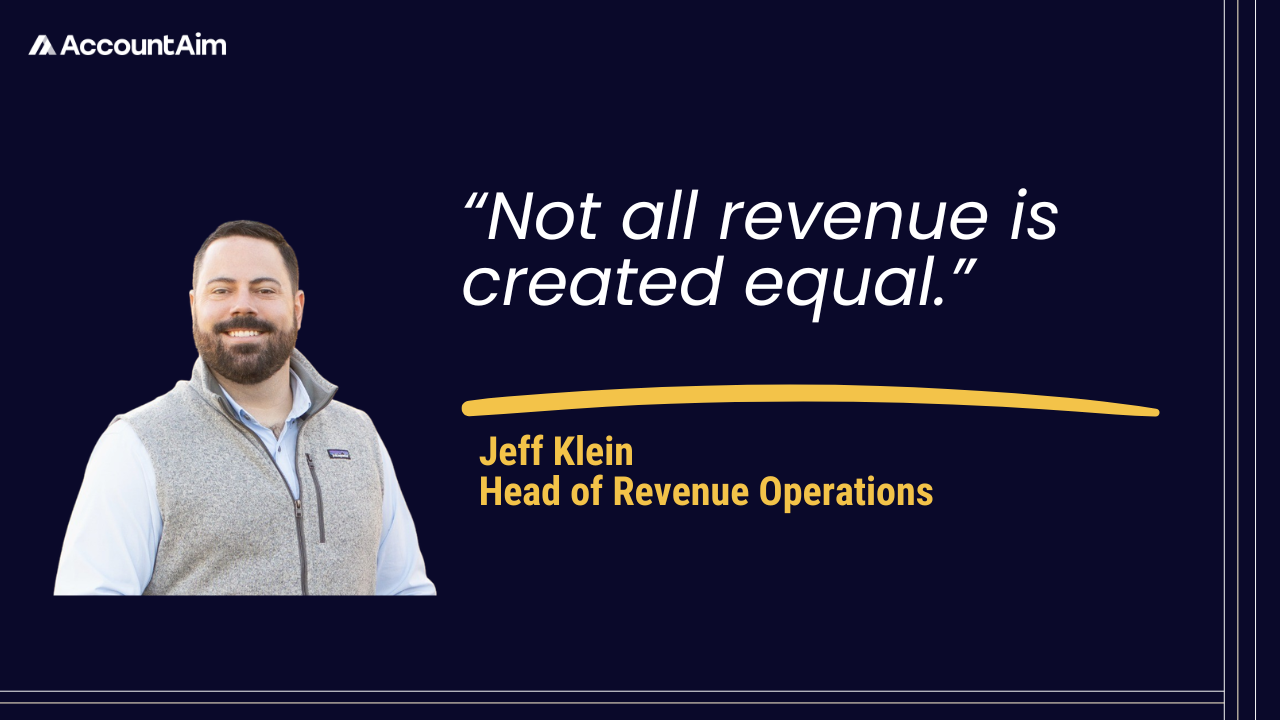
Featured Speaker: Jeff Klein, Head of Revenue Operations (growth-stage B2B SaaS companies scaling to $100M+)
Transcript:
We have officially started and we will give it a second for folks to trickle in here. But I’m super excited. It has been great to get to know you over the past couple of years here, Jeff. So thank you for coming on and sharing all of your rev ops wisdom here with everybody.
My pleasure. Yeah, it’s been great getting to know you guys too. And you know, I look forward to chatting through and maybe a different or non-traditional side of rev ops. I think it’s an interesting angle to bring in to your audience and also to just talk about as more of a well-rounded view on rev ops in general.
No, likewise, we get a lot of questions. And for better or worse, a lot of our customers are actually outside of the SaaS space. And so this should be a really fun conversation. So why don’t we go ahead and dive in. Just as a quick refresher for everybody that has joined, we’ve got a Q&A section at the bottom here. Feel free to submit any questions that you might have down there. And we will try to get to those throughout. We’ve got a lot to cover. We’ve got 30 minutes here. We’ll share the recording. So Jeff, let’s go ahead and dive in. Maybe where we can start, it’d be amazing if you could just share your background briefly on your path into rev ops and we’ll kind of dive a little bit deeper from there.
Yeah. No, I appreciate that. I’ve been lucky in my career to work with a lot of great mentors and learn from them and work in different avenues and industries, mostly outside of SaaS, but recently in SaaS. So I feel like I am well positioned to talk about this. This particular topic as it is near and dear to me for sure.
You know, I’m a revenue operations leader. I’ve been in the field for, gosh, almost 20 years now. Doing sometimes undefined rev ops work, but then certainly by title as well. You know, I’ve worked in most aspects of the manufacturing model. Whether it be a distributor model, a manufacturer rep model, a direct B2B and B2C sales model, a marketplace model, and then most recently in a hardware platform, which is also ManuTech related.
So you know, I’ve had the pleasure of growing rev ops teams from the start, often first hire or early hire. Really seeing the transformation of that rev ops function, not only in those businesses, but obviously more broadly in the community. And then specific to me, I’ve seen growth within, you know, the 20 — call it mid eight figures and well into the mid nine figures with PE exits, IPO, and you know, some other things that I think are probably relevant. But certainly I’ve been especially proud of teams I’ve built through the years and obviously the systems and the legacy that has been left behind that I think companies are still benefiting from today.
So super happy to be here and share what I can about rev ops in a non-SaaS function.
I mean, when most people think about rev ops, they do think about rev ops in SaaS. I’d say at this point, rev ops is pretty ubiquitous across software. Not every company has it yet, but I’d say the value is definitely there. When you think about manufacturing or other, you know, kind of more physical industries, what does rev ops really look like there, and how does it compare to maybe traditional rev ops, if you will?
Yeah, that’s a great question. You know, I don’t think rev ops is a SaaS function. I think it was born there. It certainly took its form there. But I think rev ops in general is a revenue system design discipline. In SaaS specifically, subscription models force that kind of rigor that rev ops are famous for producing, creating, architecting. You know, CRMs were always central to the business. Data was natively digital, which is one of the big gaps, which I’m sure we’ll get to. And you know, the closing cycle was relatively linear outside of SaaS. Revenue is often episodic or project based. The systems are incredibly fragmented in various forms and fashions for sure. You know, there’s a physical operations matter or issue, and margin is operational. It’s not just contractual. So there’s another layer of financial wisdom in there.
So I think when we talk about rev ops and the future of it, especially with AI — and that’s something we can easily touch on — I think really the next great frontier for revenue operations, especially as it relates to non-SaaS function, is really margin intelligence. I got to thinking the other day about what to talk about here, and it became kind of clear to me that there weren’t a lot of things out there that look at margin intelligence. And that is part and parcel because it’s probably not the most sexy or expensive software suite to get you there. But you know, I think that’s one of those areas where, especially in a non-SaaS space, rev ops is gonna go through another maturity point. And I think it really is around that margin intelligence theme.
For the folks that aren’t maybe quite as familiar, what is margin intelligence?
That’s a great question. So margin intelligence is a discipline of understanding not just what revenue is coming in, but how efficiently and sustainably that revenue is converting to profits. Revenue ultimately is a lagging indicator of effort. Margin is a leading indicator of sustainability because that’s actually what fuels the business.
So you can scale bookings fast. I’ve seen it, I’ve lived through it at several companies. But the difficult part is you can’t scale profitability accidentally. It is not a magic wand for sure. And so there’s a lot of facets of that that you have to consider that go well beyond sort of your traditional stack and measurements of SaaS.
And look, I am by no means suggesting that it’s more complex or one is better than the other. That’s not it at all. And I don’t think we’re here to draw a line in the sand, but I think margin intelligence tells you what’s worth closing. That’s a little bit different than pipeline management, because pipeline management tells you what might close.
But sometimes, especially in manufacturing and also when we’re looking at various forms of physical goods, sometimes it matters who you’re selling to and how you’re selling it. And you know, we went through this quite a bit of geometry in terms of understanding where to lean in and where to back off spend. Do we automate inbounds in some form or fashion to remove burden on low conversion, low margin opportunities? All these conversations come up in a non-SaaS company.
I think Xometry might consider themselves closer to SaaS than this conversation will preclude. But having been in there for six years, I can give you my opinion on that for sure. So, not all revenue is created equal. And especially in that space, rev ops has to know the difference.
No, it’s really interesting. One of the reasons I was so excited to chat is one of the things I’m seeing is what I’ll call the convergence between SaaS and non-SaaS.
Five years ago, I’m not sure if anyone in SaaS even needed to think about margins. If you’re in a pure SaaS business, historically gross margins are 80 plus percent — effectively you can round and call it a hundred percent. There’s effectively no cost to serve software. You build it once, you sell it a million times and that was kind of it. AI has definitely changed the margin profile. And now what some SaaS businesses are starting to see is actually having to be more mindful about this margin intelligence because it’s now possible that your margins are no longer 80%, they could be 40%, they could be lower than that.
And so I think really starting to bring in some of what has historically been done on the manufacturing side is starting to become even more relevant for folks in SaaS. So I think there’s a lot of learnings that can be had by thinking about the actual margin profile of the business in a way that you could kind of just glaze over historically. Absolutely is critical to the business today.
I want to touch on one of the things you mentioned — siloed data, which is something that we hear even in SaaS and non-SaaS. What are the key differences from a systems perspective that you see on the manufacturing side versus what you see more in the traditional rev ops stack? Are there big differences?
Well in principle there are more acronym systems. When you think of manufacturing, there are ERPs — and I mean in SaaS too, there are ERPs — but the manufacturing side tends to have a lot of very legacy systems. Epicor is a great example of that. Epicor has been around forever and they are a dinosaur, but everybody uses them in manufacturing because it works and there’s nothing wrong with that. They’ve gotten a lot better. I haven’t been in an Epicor system in a while, so I’m sure they’ve come a long way. But they have been around a while and I would consider them one of those legacy systems.
I don’t think Salesforce is at a point in its lifecycle where people can call it a legacy system. I mean, maybe some people do, but I look at the horizon and think of when it came out versus when an ERP like Epicor came out — Epicor has been around much longer. But you know, other things could be claim systems in healthcare, policy systems in insurance, distributor portals, channel partner type portals. And then there’s Bob. Just Bob, sitting at the desk next to you. I know that sounds silly.
But if you think of manufacturing as a tail end economic factor, you have a lot of companies that have been around for a significant amount of time. Some of them want to grow, some of them are happy with what they’re doing, and in a large way they’re okay with Bob sitting over here owning this one thing. It’s in Bob’s head and on his PC. And if his PC crashes, the business is gonna be out for a few months while they figure out how to recreate what the heck’s going on.
Bob’s of the world exist. Bob’s systems of the world exist. And so when you’re walking into a situation like this, when you’re talking about fragmented data, creating a single source of truth is a feat — sometimes very, very difficult. But when you talk about really understanding that margin and you take revenue intelligence another layer deeper — when you step into a situation coming into a non-SaaS or manufacturing environment — I think your initial time period there is closer to forensic accounting than anything else.
You’re really trying to find every control, measure every cost center, every profit center, and connect them together so that you can get a really true picture of, okay, when we put a dollar in, what’s coming out. You’re putting a dollar in the marketing spend, it’s trickling into sales, then it goes into an operating cost, and then out the other end is your margin. And there’s obviously a lot more intricacies than that.
And then getting all of those legacy systems into a place where you can understand — this is where we should focus because it has the highest, quickest cycle time, the highest average order value or average sale price. Or, this thing over here makes barely any money and has a long sales cycle. This thing over here is more transactional and we can really crank up the scale. Like where would you focus?
We want to close these 20K opportunities with regularity, or 50K opportunities or whatever your top 5% ASP is. But conversely, with minimal effort we could increase the efficiency of selling something else, and it’s actually gonna outpace that and it’s a higher profit margin as well. So that’s what I mean when I say not all revenue is equal. It’s managed by logistics, quoting accuracy, commissions, cost to serve — there are all these different things.
In SaaS there’s this obsession with pipeline — CV math, CRM, forecasting, things like this. But when you flip the script and look the other direction, there’s a lot of data reconciliation, system inventory, looking at where revenue is leaking, margin mapping — and those are all forensic accounting factors that I think give you the full picture of what’s actually happening.
Maybe a good segue from there. One of the challenges I think a lot of folks have in rev ops is being the first hire in, even in a SaaS business. Even where folks are familiar with what rev ops is, they may not have the exact same definition as everyone else. It’s funny, we ask everyone that comes onto the podcast what is rev ops and we’ve got a different answer about 50 different times at this point. You were describing a situation — I’m not sure if Bob knows what rev ops is. How do you think about explaining what rev ops is and the value of rev ops in these environments as maybe the first hire to an organization that just might not even be familiar with it?
Yeah, a hundred percent. I’ve lived that movie multiple times. It is sometimes like trudging in the mud. And it can be threatening. My gut always tells me it goes back to really understanding how partnerships with those people make their lives easier. And again, in a non-threatening way, certainly in a partnership way — sometimes that can be very difficult to break through.
But I think your value is often in connecting all the dots and pulling it all together so the organization can quite frankly see what they should be doing, see what they should be focusing on. And I’ve had one of my mentors tell me this in manufacturing once — the best manufacturers will have an empty warehouse and happy customers. You think about that and go, wait a second, that doesn’t make sense. But if you break it down: empty warehouse and happy customers — if you have happy customers, it implies they have your product. And empty warehouse means you don’t have anything sitting on the shelves waiting to be sold. So that’s a direct cycle-related conversation. You don’t want a whole bunch of things sitting on the shelf.
And so one of your jobs in revenue operations is to really drive forecasting against inventory as well, in a physical goods situation where you’re the direct seller from a manufacturing site. That is a major aspect of forecasting that is not something even remotely present in SaaS, because SaaS doesn’t ship things. It’s not confined by a warehouse. It’s not confined by a rack.
And so their confinements could be service related. We’re trying to implement 30 customers next month and we have the resources to do 26 of them. What are we gonna do? So that’s a conversation certainly from an implication standpoint. But if your choke point is a warehouse or a lack of inventory or a QA or QC issue that stops shipping because they detected something in the field and had to pull things back and rework — that’s a problem that doesn’t necessarily happen in SaaS the same way. Bugs typically can be fixed relatively quickly and then pushed. A push in manufacturing means it has to get on a truck and go somewhere, or a person has to go somewhere and fix it on site. So definitely differences. And again, I’m not trying to say one is easier or more complex or better than the other. It’s just different.
I think it’s very much a trust factor. You gotta build that trust at an executive level. I think that trust comes from having already had some of these trust conversations going into the role. Like, what would you do first? And you lay that out. Based on all my observations, here are the three big things I would tackle. And I know I don’t know everything, but based on what I know, this makes a lot of sense.
And how you walk into that is very much out of a pure place of curiosity. You have to have that curiosity. And I think you have to have those early partnerships no matter what — especially with older companies. It’s very much about driving those relationships and helping them see the continuity of what you’re doing and how it all ties together. Like, Bob, you sit here doing this — if I could make you more efficient in this one way, that’s gonna trickle up through the revenue funnel. And it’s also gonna trickle down to you from a fulfillment standpoint. I don’t think it’s any different in SaaS. It’s just who and where and the topics of conversation that are different.
It’s just different. Yeah. I worked in a physical business before starting accounting, and you’re right. In terms of complexity, maybe a little bit more on the physical side, but a lot of the things you’re mentioning apply across all of rev ops — being curious, being empathetic to the folks like Bob that are experiencing these challenges, really highlighting how you could be helpful to them. That goes a really long way, especially for folks that have been doing the job for 30 plus years and you’re walking in telling them maybe they can do it better. I think just bringing empathy to these conversations is one of the ways you can break through.
I want to go back — when we were prepping for the call, you mentioned you have a lot of hot takes on the world of rev ops. Give us a hot take, Jeff. What should we be thinking about as we round things out here?
We’ve cranked through some of them for sure. Let’s see. I think margin intelligence is one of the big differentiating factors between SaaS and non-SaaS. And I think that is a major sanity check for anybody that wants to get into a non-SaaS role.
When we look at the complexity factor as well — the multiple systems of truth — while in SaaS your proliferation is more on the engagement side, when you walk into a situation outside of that it’s very much about fundamental system variation. That data is often harder to tie together and in a non-traditional way. Those companies don’t have the same or those systems don’t always have the same prolific development backing or variety.
And you know, when you talk to rev ops folks, you’re gonna hear the engagement platforms, the enablement platforms, the CRM variants, the AI tools — and it’s like, well, nobody talks about the finance tools and how they plug in, or the ERPs and MRPs. Nobody talks about the logistics and shipping. So I think from a cultural standpoint, in SaaS, rev ops is very much born to serve sales and the functions around sales. In non-SaaS, it’s more of an enterprise level conversation. And that’s where the trust factor comes in, because I don’t think you can operate within sales alone and be successful in rev ops outside of SaaS.
I just don’t know how you would be successful, because you’re gonna be completely focused on top line. If your instinct is to improve speed, that’s probably where you should focus. But if you want to improve clarity in that non-SaaS vein, I don’t know how you do that without being in the weeds of other systems that are uncomfortable. How they connect to the margin is of vital importance to also consider.
So if you were in a position to look at a transition — and I don’t mean in a very binary way, but we’ve kind of framed it that way, meaning SaaS and non-SaaS — I would say it’s 80% the same if not more. But it’s also interesting when you’re on one side of this invisible fence and you want to go to the other. There’s some repurposing of thought and positioning of skills that you have on one side and how they apply to the other. And I think that is actually an interesting topic as well. I think we could probably talk for 30 minutes on just that.
I think we could go for hours and hours. But with that said, Jeff, I think we’re coming up on time here. Want to thank you so much for this — for me, near and dear to my heart. I love the physical side of business. Before I started accounting, I was much more in the world of manufacturing and warehousing. All sorts of these types of problems are present. Fortunately, I think there is a lot that can be translated from that environment to SaaS and vice versa. So really appreciate you taking the time out. Jeff, if folks want to connect with you after, where’s the best place to find you?
LinkedIn is probably the best place. Yeah. If they have any questions on all things manufacturing and rev ops, please absolutely follow up. I’m sure you’re gonna post the webinar, so feel free to drop a question there, drop a comment there, or just reach out to me directly. Happy to engage at any level.
Amazing. Well Jeff, can’t thank you enough. And everyone, like he even mentioned, we’re gonna share the recording here with y’all. Take care and have a great rest of your day.
Thanks everybody. Thank you all. Thank you.