
Sit down with Syed Rahman, Director of GTM Ops & Analytics at 6Sense, to see how GTM Analytics teams are driving revenue and operational efficiency in 2026.
What You’ll Learn:
- What GTM Analytics is and why it matters now
- The 5 pillars of a mature go-to-market analytics function
- How to partner effectively with traditional rev ops teams
- Common pitfalls analytics teams face (and how to avoid them)
- How to prioritize optimization opportunities using value vs. effort matrices
- Leading vs. lagging indicators: stop reporting the news, start being proactive
- How to get exec buy-in and avoid surprises in the boardroom
- Why “directionally useful and early” beats “perfectly right and late”
Key Takeaways:
- Clear metric ownership accelerates execution
- Analytics owns definition, modeling, and insights; Ops drives process, systems, and enablement
- Use the 80/20 rule: don’t let perfection kill progress
- Always provide insights with a clear call to action
- Your job is to help leadership see around corners
Transcript
GTM Analytics: Driving Revenue and Operational Efficiency
Josh McClanahan: Yeah, I feel like I shouldn’t show bias here, but I will tell, say that this is my first, uh, webinar of the year, uh, that we’re doing together. And it’s the one that I’m personally really excited about. For whatever reason, the G2 network has just been, uh, we, we’ve kinda shared worlds. Last year did some fun collab with, uh, with Miles.
It’s just the small world of, uh, yeah. Of RevOps
Syed Rahman: for sure. My Miles and I actually partnered really closely together while we’re at G2. So, uh, I, I almost, he, I wanna say he was an inspiration when he, uh, when I saw his, uh, webinar a couple months ago.
Josh McClanahan: Oh, amazing. Yeah. Uh, miles is great. Uh, Mitch is obviously amazing, so, um, no, it’s, it’s fun to collab.
And so, uh, yeah, well, why don’t we do this, ed? Uh, I think we can go ahead and, and get things started. Um, like I said, I’m sure folks are gonna continue to trickle in here, but again, super excited to have you on here, uh, leading the first webinar, uh, in the series for this year for us. So. Ed, we’ve got a lot to cover in not that much time.
And so, I’ll, I’ll kind of give you the floor here. It’d be helpful, maybe give us a quick intro on, uh, kinda your background here and then floor is yours. Like, let’s dive into GTM Analytics.
Syed Rahman: Yeah, sure. Hey everyone, I’m Ed Roman. I’m a director of Go-to-Market Analytics and Operations at Six Sense.
Currently, uh, I wouldn’t say I’ve been in this space for like five to six years. Started off my career in finance, but slowly kind of matriculated my way to. Understanding big data, working with, uh, leaders to understand different metrics and insights and, and how do you automate that and, uh, really drive drive interesting insights.
So I’m excited to talk to you guys today about a topic I’m passionate about, uh, which is driving a revenue and operational excellence from a go-to-market analytics standpoint. Before that, I wanna do a quick icebreaker in the chat. A literal icebreaker ’cause uh, this is very top of mind for me.
Comment in the chat. If you’re in a location that is currently above or below freezing temperature, which is 32 degrees Fahrenheit or zero degrees Celsius.
Cool. This is top of mind for me because tomorrow we are, uh, experiencing negative 30 to two degree windshield here in Chicago. So I’m, uh, not looking forward to it, but it’s, uh, just relevant for me. So a little icebreaker there. For the agenda today, we’ll talk about four different things. What is go-to-market analytics first and why it matters?
Uh, the name go-to-Market analytics. Uh, I’ve heard it called revenue analytics. Uh, a couple different names, but why does it matter now and what is it? What does a mature go-to-market analytics function look like? How do we partner with traditional operations team? So we have this, uh, kind of, uh, legacy revenue operations, go-to market operations teams.
Uh, how does the analytics team fit in there? And how do we help leadership see around corners? So first, I won’t read off the slide necessarily, but I have five kind of pillars of what I think a good go-to market or go-to market analytics team looks like. First, we’re responsible for comprehensive data collection.
You, you kind of see in a couple slides here that, uh, there’s so many different touch points along the customer journey from marketing to sales, customer customer success and advocacy. And then, uh, how, how does the customer interact with our product analytics teams in partnership with a bunch of oth other different teams and organizations have the opportunity to bring all that data all together and create one holistic view.
Of, of that customer journey and all the touch points along the way, once we have the data, like what do we do with it, right? There’s a ton of different tools out there, a ton of different data. How do we work cross-functionally with all those, uh, functions that I just mentioned to drive metric ownership, business logic, to then inherently.
Perform analytics understand trends in the business, how those trends vary between segments and strategies and things like that. This one’s top of mind for me ’cause I’m heavily involved in it right now. How do we how are we involved in the go to market strategy and planning cycle? How do we think about segmentation?
How do we think about our customer base currently? And what characteristics they have, behaviors and preferences to help us drive targeted marketing and sales efforts. There’s hundreds of thousands of, uh, of accounts out there. How do we use a data that we have through our comprehensive data collection to drive the outcomes we want as a business?
And then along the way, like once we have the data, once we have the metrics defined. How are we how are we performing strategic modeling to help determining if our, uh, go to market strategy will drive the outcomes we want. And this last one, I would say is the most important to me is like once we have all those four main other pillars.
How are we helping the rest of the business see around corners and using predictive analytics where like we can tell you a, a quarter from now where our bookings gonna be because we gotta have a good understanding of our pipeline or our retention, uh, modeling and things like that. So those are kind of the five main pillars, I would say from a a, a good go marketing, uh, analytics function looks like.
Why does it matter now? There’s so many different channel segment strategies. The, the whole I would say startup SE series A to E landscape has changed so much in the last five years, and most companies are struggling to navigate all this effectively as a, all of our data and digital landscape continues to evolve.
We, we can be the stewards and what’s help affirm our. Data engineers, corporate data functions, things like that, we can be the stewards of all different touch points and, uh, metrics that help bring in data and insights from all the sales, marketing, customer experience, and product teams in, in one place.
And I kind of touched upon the customer journey, and this is a sample one. You probably see something similar like this if you’re in a revenue operations space, but. There’s so many touchpoint along the customer journey. We, if you’re a part of a go-to-market analytics function, or even just a function that captures data, you likely have data around each one of these touch points and more.
And that’s what makes your function, your role in this landscape so important. ’cause you’re closest to this data and you can help tell that story. So what does a good or mature go-to-market analytics function look like? Kind of touched upon some of these already, but there’s clear metric hierarchy.
We’re working with leaders to, uh, define North Star metrics, drive inputs and KPIs across segments. Speaking of segments, we, we understand the different nuances between our different customers. So let’s say you’re a company that has a hundred customers, not all a hundred customers are gonna look and act the same way.
But you understand what characteristics that that drive different customer segments, and you can, uh, provide specific benchmarks to track performance there. So, for example, a common segment is. Enterprise customers versus a small business, right? So you understand like what our win rates are, what’s, uh, enterprise customers versus a small business, their renewal rates, their pipeline conversion, et cetera.
And you’re able to share that back with leadership in, in a cohesive way that makes sense. Stats, we talked about data collection. What data collection is strong data governance needed? And this can’t all be solely on the go to market analytics function, but they can be driving it. Right.
Right. So making sure they’re working cross-functionally throughout their organization to make sure we have consistent definitions and, uh, lineage for trusted, actionable insights. We’re embedded in forecasting and planning. Analytics integrated into RevOps workflows and forecasting. We are involved in the planning cycle.
We’re involved in forecasting. If there’s scenarios where we’re shifting go-to-market strategy, we’re using our, our comprehensive data to Dr. Help drive that outcome. And then lastly, I think this is where the, the biggest opportunity area is, is for analytics functions, is where trusted partners. To revenue teams and RevOps.
So how are we collaborating closely with, uh, the leaders and operations teams to drive the business outcomes that we want?
And then. How are we applying those insights, right? So we have the data driven decision making. How do we use that to then, uh, identify different optimization opportunities? So if we see trends in the business that don’t make sense or don’t align to the strategy that we’re going out for, how can we course correct really quickly?
How can we then work with, uh, our partners to forecast and scenario plan? And then how do we align our teams and strategies to course correct and, uh, then measure that progress? Because we start off with the strategy at the beginning of the year, uh, likely there’s, uh, areas of opportunity within that strategy that we’ll learn, learn through, across across the year.
We have to be nimble enough to provide the insights back to leadership where we can. Quickly, course correct. Change behaviors and then realign on where we wanna go. Uh, ahead,
Josh McClanahan: ed, really quick, uh, one question that comes up, I think a lot around this is actually like, which of the opportunities do we prioritize first?
Anyone that’s in a startup knows that there’s, you know, a ton of different areas that could be optimized. Yeah. Like how does the GTM analytics function kind of play a part in deciding what, which one should we go after, kind of today versus tomorrow versus maybe never.
Syed Rahman: Yeah, that’s a great question. And that’s where, um, like, I like to think of prioritization matrixes.
So one of the things that we have here at Six Sense, and in my, that I’ve used in, uh, past lives as well, is the value, the value of effort, and the val uh, the value of importance, right? So how do we if something is going, is really complex to execute. Uh, and is low importance. You should probably not prioritize that, uh, that opportunity, right?
But if something is high value at a and medium level of effort, you should go after it. And these are things that you should align with, uh, with your cross-functional leaders and partners. So, for example, I’m in lockstep with our sales operations team to say, Hey, we have a pipeline issue and we need to go, uh, course correct X, Y, and Z.
What’s the reasonability of like what we want? To do, to, to drive those outcomes and making sure that we’re like, we’re all swimming in the same direction. And having that conversation upfront versus like having it after, uh, a certain metric, beco or inside becomes a problem. Being able to see that like being able to that through leading indicators, uh, and seeing around corners.
Josh McClanahan: That’s super helpful. It’s one of those things I wish I had adopted much, much earlier in my ops career. Um, the idea of how much effort is going into it and the impact. So super helpful. Thank you.
Syed Rahman: Yeah. Appreciate it. Great question. So I kind of talked about what, uh, does good go to market analytics teams look like?
Uh, what about some of the pitfalls? And these are things that I’ve experienced and learned throughout my, my kind of career here so far and like. Not to say that, uh, I’m still learning, right? So I would love to hear from you guys, uh, as well as we get connected more and more on like what are the things that are not showing up on this lists.
But to me there’s too many dashboards and not enough decisions. I. We sometimes fall into the trap of like, all right, let’s spin up a dashboard to track X, Y, and Z, or let’s spin up a dashboard to drive this behavior outcome. But, uh, I don’t know, two weeks after we spin up that dashboard, there’s no usage, right?
So what are the, the, what are the things that we are actually trying to drive behaviors on, and how do we make sure. Everyone in the organization is en enabled on that. And how are we making sure everyone’s held accountable? This is, I’ll get into this a little bit more when we talk about partnerships with traditional ops teams.
The other one, uh, I would say is no clear me metric ownership. If there’s five different definitions of win rate, there’s no definition of win rate, right? We need to be able to, uh, align on a singular definition. And there’s gonna be nuances and things like that along the way, but we, we need to be able to align on a single singular definition that the company is driving towards for especially our key core metrics, right?
Uh, a RR bookings, retention rates, pipeline, pipeline conversion, win rates, et cetera, et cetera. But we we need to be able to be the stewards of that, those, that logic and that metric ownership working cross-functionally with our sales, marketing, customer success, product and finance partners. This one. I think as, as honestly, uh, some of the feedback I’ve gotten early on in my career are two behind the scenes we built we’re the ones who are kind of the closest to the data.
And we have a comprehensive view of the data, right. And the prospect to customer journey. Make your voice heard. How are we looking at different trends in the data? How are we working with our leaders bubbling up issues that we see, uh, as opportunity areas using kind of some of that prioritization that Josh asked about in the previous slide.
How are we making our voice heard because we are the closest to the data and being owners of that like. Typically, leaders are looking for someone to help drive drive their decision making and verify some of their hunches, right? And we can honestly do that with data and we can bring up items that are not on their radar, right?
Like maybe there’s an issue that in, in retention, uh, along the customer journey that we find out there’s a low adoption in a certain area. How are we, how are we using our data to bubble that up? I’ll also say typical analytics team pitfall is, uh, reacting instead of leading. And I wanna bring up a, a key point here is that perfection is the enemy of progress.
I feel like analytics teams in the past have always fallen to the trap of a, okay, I need to make sure this data is like a hundred percent right before sharing it out. But along the way, if you’re wasting too much time on that perfection, you probably miss the opportunity to drive the behavior you wanted to change.
So this is a key point. ’cause like I always like to use like the 80 20 rule or the 90 10 rule or what have you. If we feel like our data is, I don’t know, 90% clean. And then there’s a, a 10% outlier. Let’s just go with it. ’cause it is probably gonna tell you the, the same story that we wanna tell anyways.
And the last thing, kind of related to the previous one, but we have insights with a, a clear call to action. We, we are presenting a trend in the data and, and just like, Hey, you go ahead and digest it later. You go ahead and digest it. FLM, uh, on your patch of reps, right? But a good analytics.
Professional will look at the data, synthesize it, create an action item for that person you’re sharing this insight with, and, uh, open up meaningful dialogue along the way. I.
Josh McClanahan: We started to get some, uh, some questions rolling in on pitfalls. Uh, maybe unsurprisingly this one’s one of my favorite ones.
So, uh, the questions, it’s, it’s common for execs to just keep asking for more data, more reports, more dashboards, and never use them. Like how do you manage that conversation and requests so you and your team aren’t just wasting time. For these?
Syed Rahman: Yeah, that’s a great question. ’cause like, I, I still fall into that trap, uh, today, right?
Like, hey, we we’re often moving at such a fast pace. Like you don’t understand a hundred percent the context of what they’re asking, and you’re just like, all right. May, uh, you just trust them. Right? But I would say as stewards of the data and, uh, and like, and making sure you, like, you’re the closest ones to the data.
Go out, spend five to 10 minutes try to understand what the context was behind the question. ’cause oftentimes like something that could be solved in a dashboard could be solved. Solved in a slide or like an email or a quick slack message, right? And, uh, and, but that’s where like being in lockstep.
With your operations team and your strategy and your go-to-market strategy is so important because you can understand like, Hey, I know x, Y uh, Charles is asking for X, Y, and Z, but hey, he’s he doesn’t really understand the data. Too much. I have a better I have a better lens to this, and here’s what I was sharing instead.
And it is tough earlier on in your career to, to have those conversations. But understanding the context of the question and what they’re, the outcome they’re trying to drive is often, uh, just as important as the, the output you’re produc.
Josh McClanahan: Super helpful. Yeah, I think getting to the why behind the ask is like one of the most critical pieces, but it’s so easy.
Um, and I used to do this all the time and I’d still do this today where I’ll just spit up the dashboard right away. Yeah. And then it ends up to your point, uh, earlier in this graveyard of dashboards that no one’s looking at. And I think trust just starts to deteriorate then. So, super helpful.
Thanks, ed.
Syed Rahman: And the other thing I would say is like. Every go to market Alex function should have some sort of a roadmap and being very transparent with their roadmap, right? So like if you have a con comprehensive dashboard strategy already likely some of the requests that are coming in are, are already captured there.
So that’s where I would be like, ha, spend some time work with yourself, your leaders, your team, uh, wherever you are in your careers to make sure, like, Hey, we have a roadmap of dashboards or products that we wanna pull out, put, put out there and this is what it will cover and this is what it might not cover.
And that’s where you can have more of a trade off conversation with leaders, with people who are making these requests on like, Hey, if you give us a little bit more time, here’s what we’ll produce. That’s a little bit more comprehensive and. Uh, more that’ll drive more engagement and, uh, enablement, uh, down the line.
Josh McClanahan: I
Syed Rahman: love it. Great question. Great question though. Wanted to get into, uh, a slightly different topic, but very related. So, and this is a, how do analytics teams and traditional ops teams work together? Right. I almost think like there’s. A strong overlap in the capabilities of each team, but they’re kind of different roles, right?
What, look, I don’t know. Let’s say, uh, the operations teams are more of the quarterbacks and the, the analytics team are more of the offensive line if you’re, if you’re following football recently. But I would say different roles and, uh, and, but there’s a strong overlap, right? So how do we kind of divide and conquer?
And so what come uh, showing here is that like analytics teams are, can provide insights, modeling, measurement, prioritization, work with partnership to then drive process systems enablement, comp plans, outcomes and then a good relationship has a kind, this circular, uh, almost like circular thing aspect where you’re partnering and you’re in lockstep with those functions along the way.
And so. What I kind of depict here is that we clear ownership, accelerates execution. So analytics teams own definition, own the data collection, own modeling insights, and then we’re working back with the RevOps teams to. Taking those insights and hey, we, maybe we need a process improvement or an SSLA improvement.
Maybe we need another field to capture data in Salesforce or, or what have you. I know, I know data integrity is tough there when you’re adding in tons of different fields, but, uh, you can’t catch my drift there. Like taking the definitions and the insights and passing, working closely with your sales operations, CS operations, marketing operations functions to help drive process improvements, SLA improvements.
Tooling and enablement to thus drive field execution, which is the most important part of this, is if we’re putting out a bunch of data out there and insights that is falling flat, we’re not gonna get the field execution. So making sure your first, your RevOps sales ops partner CS ops partner, understands.
The data that you’re putting out there, and they’re able to take that data and, uh, work out, out with the field, with the leaders to, uh, drive that drive that accountability and the execution that, and that’s needed.
The last thing I’ll touch upon is how do we get more front facing in the exec board room? Um. So throughout my career, this has been like a evolving journey for me. Like, uh, I’ve been owning board deck, board decks, for example, really telling the narrative around there. But I would say that to make sure you have trust in your ELT conversations and your executive level conversations.
They’re really trying to understand like, hey, how do you help them see around corners? So confidence in the forecast using our data points to provide another lens on like what we think, uh, a bookings forecast could be. What we think a pipeline forecast could be or where, where are, which customers are gonna churn and which customers are gonna retain using data along, along those points to help drive that.
’cause there’s always gonna be a field level of like, Hey, they’re the closest to the. To the customers. There’s the closest to the prospects. But we can use data along the way to, uh, say like, Hey, typically I don’t know. We’ve had 10 different, uh, meetings with a, a prospect before. We, uh, are in a, a place where we’re gonna close the business.
How do we use that to drive a forecast for, for bookings, for example. So just helping leadership and the board, uh, rooms help see around corners and then, like, we kind of touched upon this earlier, but clear trade offs, right? We’re not gonna be able to solve everything all at once. And so making sure you’re having that conversation to, explicitly kind of show like the drivers on what you’re working on and how, uh, that is gonna show up in, in the results. So, like to me right now, one, one of my biggest focus areas is always gonna be like, do we have a good sense of where we’re gonna end our bookings numbers and our churn numbers in any given period of time and pipeline?
And I wish I should be able to spit that off to anyone who asks, uh, at any given point in time. And I have like a running model. I have people on my team that help facilitate that. But that’s one of the things that is important to me. And there’s other things that that’ll come along with in your way that you kind of need to navigate to make sure you’re focusing on the right, right things at the right time.
And being able to have those conversations with leaders is really important on like, what are those trade offs? If I’m gonna work on X, uh, A, B, and C, I need to give up X, Y, and Z right now is something I can prioritize later. And then more so than like, so I would say like we, we’ve been in a challenging startup environment in the last, uh, three to five years, depending on the type of business you’re in.
I, I’ve always heard from leaders like, the results are gonna be the results, but I don’t wanna be surprised. And so how do you. Enable your data, your operating rhythm to make sure that your leaders are not surprised. So this, I can’t even talk about a scenario. It is just, pretty vulnerable and transparent here, but a scenario where I was very involved in the forecasting process a month before the, the quarter ended.
Uh, our bookings, uh, number was like, I don’t know. 20, 30% off. And I it came as a surprise to me and it came as a surprise to my leaders. And I had to raise my hand and say like, Hey, that’s, that’s my fault. My team’s fault our, our team’s fault because we, uh, didn’t capture the data points that we needed along the way.
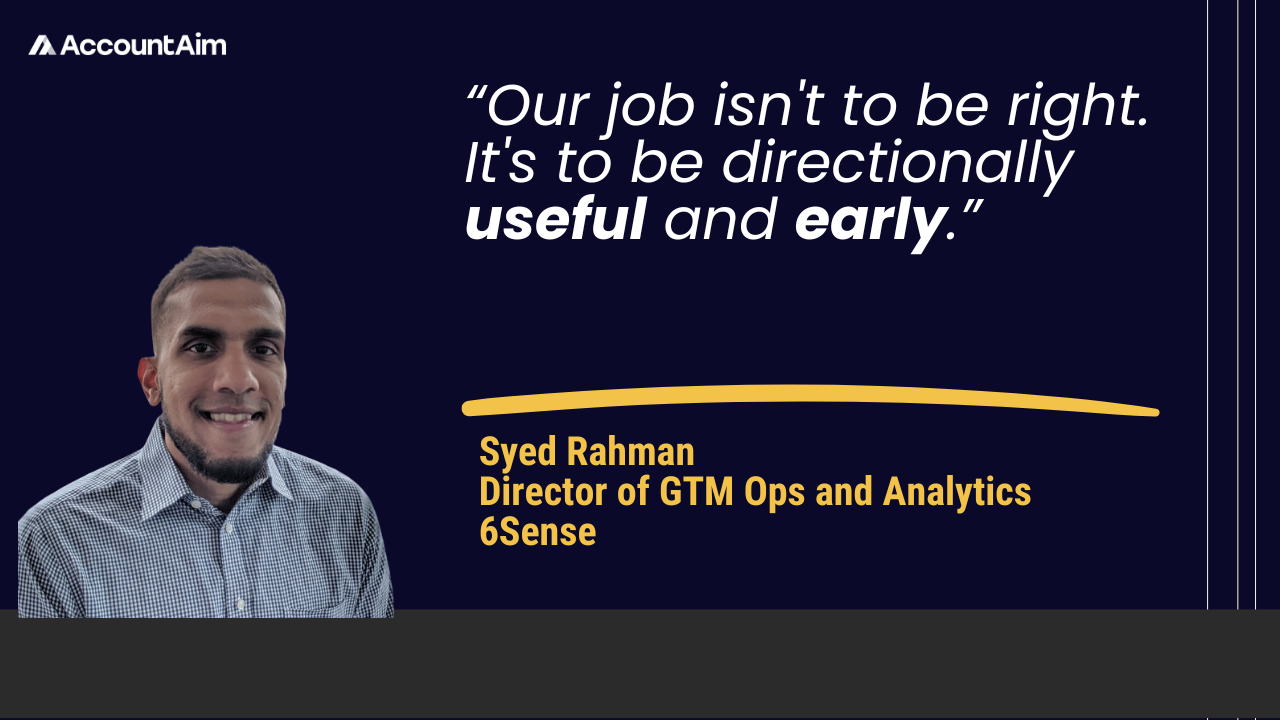
So how do you take that as a learning opportunity, continue to refine all the data points you need to drive the right outcomes? ’cause, uh. I, I think more so than like, tough results, uh, is, uh, is execs hate being, uh, surprised. And so I, I kind of left that a quote down below is our job isn’t to be right.
It’s to be directionally useful and early. So how do you like it’s weak. Two in the quarter, how are you looking at our, your pipeline right now to, and are able to identify bookings down the line and making sure like you, we, we have a. 10% conference interval on where we are gonna end the, the quarter on.
And that kinda delved into leading versus lagging indicators. And so this is a mindset shift on like reporting the news or, and being proactive. So I’ll give you, uh, one example. So if you kinda work backwards from here. Down below you talk, you see like the bookings ar and win rate. To me, those are our lagging indicators of the health of a business of our business.
Right. Prior to that, are we having are we getting the activity we need with our certain segments, with our certain customers and prospects? Is there early stage conversion? Is, are all reps on our sales teams participating in, in building out pipeline build, having meetings and conversations?
We have account scoring models is, are we focused in on the right customers and, and the right fit of customers? And what is like the eligibility and, and white space of those things. These are all items that happen that feed into bookings and a r and win rates and current a CV and current customers.
But being able to capture these data points along the way is really important to make sure you have leading indicators so you can, uh, help see, help everyone see around corners and then you create less, less surprises.
That’s pretty much it. Uh, Josh was there any other questions that you had or in, in the chat? From the group?
Josh McClanahan: Yeah, I think we’ll have time for maybe one more, but first, uh, said, thank you so much for going through this. I think this is such an important topic area. One of the questions was, you know, a lot of teams out there don’t have GTM analytics as a standalone function yet.
Syed Rahman: Yeah.
Josh McClanahan: How do you think about, you know, being in somebody that’s in RevOps shoes or you know, at a company that doesn’t have it? Like, how, how do you get your boss? How do you get your executive team on board that this should be prioritized?
Syed Rahman: Yeah, it all, I would say it all depends on the stage of the company you’re in.
Uh, like, I don’t know, I, I’ve been, I started at, at a, a company where I was a go to market analytics team of one, right? So you’re really just working on every, everything. But, uh, but I think just understanding and emphasizing the, the value of like the, the data collection please and the metric ownership and where that drives value in the organization is really important.
And so, uh. Like the f operations teams are spread so thin, uh, nowadays that they can’t be stewards of definition and data governance and things like that, and they, they can’t work with the field on enablement and build out modeling and all at the same time. So it’s really important to have some. Even if it’s not a dedicated function, but a dedicated maybe person that has, uh, I don’t know, 50% capacity in their schedule to work on, uh, data collection and, and is working on, uh, how they would go about learning about consolidating data in all in one place.
And in the EDW, like Snowflake or Databricks, for example. Amazing. Well, I think that brings us to time. Thank you so much again for going through this. Uh, this has been a much requested topic for folks, so, can’t thank you enough. Thank you everyone for joining. Uh, as usual with these, we’ll be sharing the recording coming out after this.
Josh McClanahan: Um, if you wanna get connected to Ed, he’s active on LinkedIn, I’d encourage you to reach out if you have more questions on the GTM analytics side. Uh, reach out to me if you need help, uh, standing it up inside of your company as well. But again, thank you everybody for uh, for joining and we’ll chat soon.
Syed Rahman: Thanks everyone. Bye.
Josh McClanahan: Alright, thanks again.